Our advocacy work in Scotland
The Royal College of Pharmacy (RCPharm) in Scotland is advocating on behalf of pharmacists every day. On this page, you will find examples of what the Scotland Team have been doing to promote the profession across Scotland.
Contents on this page
- Scottish Parliament Motion: Celebrating the Royal College of Pharmacy
- Sustainability in healthcare
- Health, social care and sport committee: Scottish parliament
- Assisted dying for terminally ill adults (Scotland) bill
- Inquiry into remote and rural healthcare
- Inquiry into alternative pathways into primary care
- Medicine shortages
- Pharmacy 2030
- Pharmacy workforce
- Pharmacy’s role in reducing harm and preventing drugs deaths
- Scottish parliament debate on antimicrobial resistance
Scottish Parliament Motion: Celebrating the Royal College of Pharmacy
The Scottish Parliament has celebrated us becoming the Royal College of Pharmacy with a Parliamentary motion.
This motion recognises the active and positive contribution that Royal Pharmaceutical Society has made to influencing public policy in Scotland and highlights the Parliament’s expectation that the Royal College of Pharmacy will continue this good work to deliver improved health outcomes for people, across all care settings, long into the future.
You can read the motion in full here.
Sustainability in healthcare
In April 2026, the Royal College of Pharmacy held a roundtable in the Scottish Parliament on sustainability in healthcare which brought together MSPs, Royal Colleges and other key stakeholders to discuss how the priorities in our manifesto for health and climate could be made a reality.
Read our news story here.
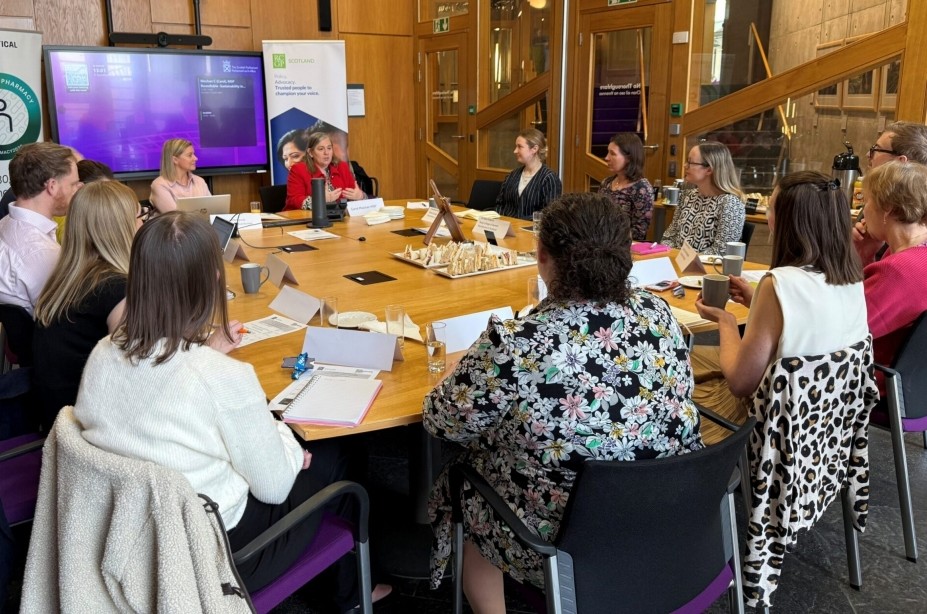
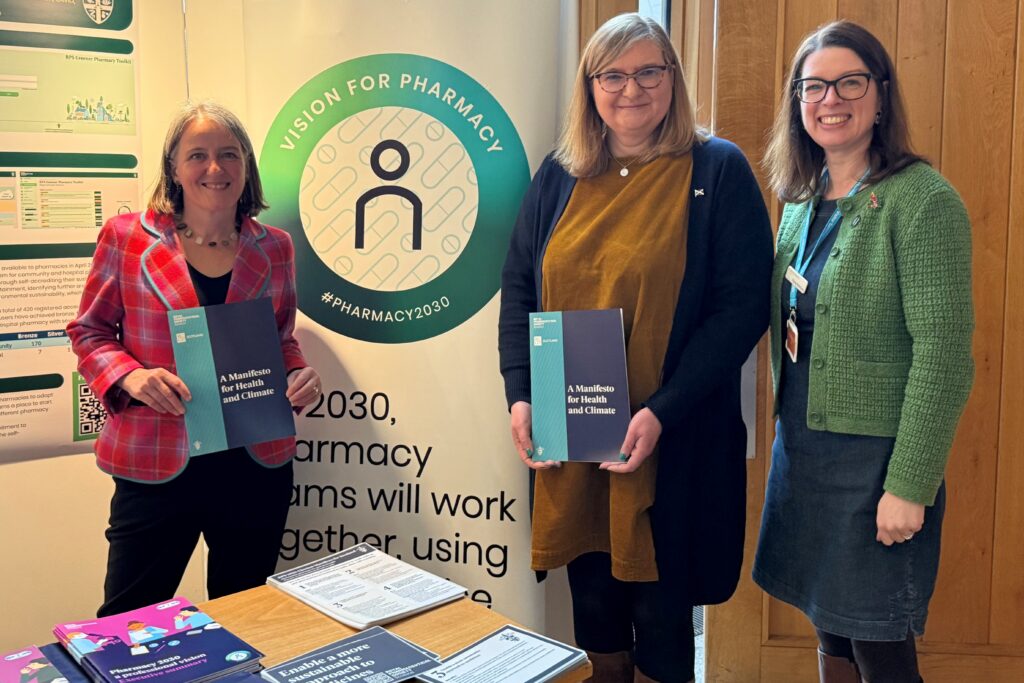
In December 2025, we held a three-day exhibition for MSPs on sustainability in healthcare and our greener pharmacy guide and toolkit.
We had twenty-six conversation with MSPs about the work the Royal College of Pharmacy is doing to support pharmacists to work in more environmentally sustainable ways, and we were able to demonstrate our greener pharmacy guide and toolkit.
You can access the greener pharmacy guide and toolkit for use in community and hospital pharmacies here.
Health, social care and sport committee: Scottish parliament
RCPharm in Scotland engages regularly with the committee, who scrutinise Scottish Government policy on healthcare.
Assisted dying for terminally ill adults (Scotland) bill
In 2024, the committee held evidence sessions as part of its scrutiny of the draft bill.
On 19 November 2024, the committee took evidence from the Policy and Practice Lead for Scotland at RCPharm, Fiona McIntyre.
- You can watch the oral evidence session here.
- You can watch clips of Fiona’s oral evidence here.
- You can read our written evidence to the inquiry on our consultations page here.
- You can read our full news story here.
The Royal College of Pharmacy is neutral on the principle of assisted dying, but not on the process. The Royal College of Pharmacy (previously the Royal Pharmaceutical Society) was involved in extensive work on this Bill given its potential impact on both pharmacists and patients.
During the Bill’s passage, we strongly advocated for the rights of pharmacists who may, or may not, wish to take part in assisted dying. We submitted written and oral evidence to the Health, Social Care and Sport Committee and met with the Bill’s sponsor Liam McArthur and his team on multiple occasions. We suggested amendments to be tabled at every possible stage of the process to strengthen the legislation and advised MSPs on those proposed amendments to ensure they were fully informed before voting on them.
After contributing to written and oral evidence sessions, working with MSPs to introduce and debate amendments to the legislation, we decided to oppose the Bill as the final version of the Bill was not in line with our policy on Assisted Dying.
You can read our position statement on the Bill here:
The Bill was voted against by a majority of MSPs at third reading, meaning that the Bill will not become law. This topic may well come back to be debated by a future Scottish Parliament. If it does, The Royal College of Pharmacy stands ready to fully engage with the debate again, to ensure any legislation brought forward protects both patients and pharmacists.
You can read our statement here.
Inquiry into remote and rural healthcare
In 2023, the Committee held an inquiry into ‘Healthcare in Remote and Rural Areas‘.
On 19 December 2023, the Committee took evidence from Director for Scotland at RPS, Laura Wilson.
- You can watch the oral evidence session here.
- You can watch clips of Laura’s oral evidence here.
- You can read our written evidence to the inquiry here.
- You can read our full news story here.
Inquiry into alternative pathways into primary care
In 2022, the Committee held an inquiry into ‘Alternative pathways into primary care‘.
On 15 March 2022, the Committee took evidence from Director for Scotland at RPS, Clare Morrison.
- You can watch the oral evidence session here.
- You can read our written evidence to the inquiry here.
- You can read our full news story here.
Medicine shortages
In November 2024, we published our Medicine shortages report: solutions for empty shelves.
The day after the report’s publication, we held an MSP briefing event in the Scottish Parliament for MSPs.
Many MSPs came with powerful stories demonstrating the scale of the medicine shortages challenge for their constituents.
Pharmacy 2030
Pharmacy 2030 is our brand-new professional vision for the future of pharmacy in Scotland.
Pharmacy 2030 outlines an exciting future in which pharmacy teams will work together, using their expertise to make the best use of medicines. It is about taking a person-centred approach, providing care holistically rather than by clinical condition.
The vision was launched in February 2022, and RPS Scotland is now raising awareness of the vision with key stakeholders and discussing how we can achieve the key enablers, so our vision can be delivered.

In March, RPS Scotland met with MSPs on the Health, Social Care and Sport Committee to discuss Pharmacy 2030, which was a great opportunity to raise awareness of our new vision.
On 8 June 2022, RPS Scotland hosted a Scottish Parliamentary Reception to raise awareness of Pharmacy 2030 amongst MSPs. The event was sponsored by the Convener of the Health, Social Care and Sport Committee, Gillian Martin MSP. The Minister for Public Health, Women’s Health and Sport spoke at the event. You can read our news story all about the reception here.
On 7 November 2022, RPS Scotland and National Pharmacy Technician Group Scotland wrote a joint letter to the Commission on Pharmacy Professional Leadership about our positive collaboration to co-produce the Pharmacy 2030 vision.
Pharmacy workforce
RPS Scotland wants to see proper workforce planning for pharmacists and pharmacy technicians, on the same basis as for doctors and nurses.
In 2021, RPS Scotland published a pharmacy workforce briefing, covering the whole pharmacy workforce, which can be read here.
In November 2021, Director for Scotland at RPS, Clare Morrison met with the Cabinet Secretary for Health and Social Care, Humza Yousaf MSP, to discuss workforce issues for pharmacy. You can watch the meeting here.
Clare Morrison has written two columns recently for Holyrood Magazine about how the pharmacy workforce can be supported, which can be read online:
- Why action is needed now to support the pharmacy workforce.
- Digital solutions can help solve the workforce crisis.
On 20 September 2022, RPS Scotland wrote an open letter to MSPs, ‘Pharmacy Workforce Pressures and Closures,’ which can be read here. Humza Yousaf MSP responded to this letter, which can be read here.
In November 2022, Director for Scotland at RPS, Clare Morrison appeared on a panel at the SNP conference and met with the Cabinet Secretary for Health and Social Care, Humza Yousaf MSP, to discuss the pharmacy workforce.
Pharmacy’s role in reducing harm and preventing drugs deaths
Royal Pharmaceutical Society Scotland has published a policy on the role of pharmacy in reducing harm and preventing drugs deaths.
In February 2022, this policy was circulated by Audrey Nicoll MSP the Convener of the Joint Committee into Reducing Drugs Deaths in Scotland and Tackling Problem Drug Use to all MSPs on the Joint Committee, to inform their work.
In advance of the Joint Committee meeting, RPS Scotland met with MSPs on the Committee to discuss our policy in detail.
In May 2023, RPS Scotland met with Elena Whitham MSP, the Minister for Drug and Alcohol Policy. Following the meeting, we sent the Minister this letter.
Scottish parliament debate on antimicrobial resistance
On 22 April, MSPs debated ‘The Scottish Approach to Managing the Global Risk of Antimicrobial Resistance’. You can read the full motion here.
Ahead of the debate, RPS Scotland issued a news release on pharmacy’s role in reducing harms and deaths from antimicrobial resistance, which can be read here.
This highlights four ways that pharmacists can help reduce antimicrobial resistance:
- Providing information to the public about how to manage common self-limiting infections which do not require an antibiotic, about when to seek further help if the condition does not resolve and about when antibiotics are needed. This will help reduce inappropriate, harmful and unnecessary use of antibiotics.
- Developing guidelines to ensure infections are treated with the most appropriate antibiotics, at the right dose and for the correct length of time.
- Prescribing antibiotics according to guidelines and giving advice to patients about how to take antibiotics safely.
- Encouraging the public to return any unused medicines, including antibiotics, to pharmacies for safe disposal.
Scottish policies and consultations
The RCPharm Scotland team produces policies and consultation responses in Scotland and contributes to GB-wide policies.
Pharmacy best practice in Scotland
Explore how pharmacy teams across Scotland are putting the Pharmacy 2030 vision into practice.