Microaggressions
Published: 8 July 2022
This was published when the organisation was the Royal Pharmaceutical Society.
“It’s important to identify and address microaggressions, because if left unchallenged they have the potential to become part of the organisational culture.”
Cherise Gyimah, Medicines Project Lead/Care Homes Pharmacist
What is a microaggression?
Microaggressions are verbal, non-verbal and environmental slights, snubs and insults which communicate hostile, derogatory or negative messages and behaviours. They may target a person based on their protected characteristic or belonging to a marginalised group.
They can be intentional and unintentional and are based on biases (either conscious and unconscious) associated with our race, religion or belief, ethnicity, sexual orientation, gender and/or disability.
Microaggressions are the hidden messages in comments or actions that can:
- Invalidate the group identity or the target person’s lived experience.
- Humiliate them on a personal or group level, or communicate that they are lesser human beings.
- Suggest that they do not belong with the majority group.
- Threaten and intimidate.
- Put them down to a lower status and treatment (see Microaggressions: More Than Just Race from Psychology Today).
Superficially, microaggressions may appear as compliments or jokes. However they contain hidden insults, offensive statements or insensitive questions or assumptions.
Although they may not always be intentional, microaggressions cause harm and offence to others. They might appear small, but their impact is significant and is compounded over time.
The consequences of microaggressions are problematic for all parties:
- The receiver continuously experiences discrimination, albeit in a subtle form, and may begin to disengage. They might also start to doubt themselves (“Did it really happen?”, “Did I really hear that?”, “Am I being oversensitive?”). A term to describe this is “gaslighting”, which is when a person begins to question their own perceptions or memories as a result of a person or group making them think that what they experienced or perceived was not real.
- The individual(s) delivering the microaggression may find that rapport with colleagues or patients doesn’t develop, leading to inadequate engagement and poor clinical outcomes.
- The individual(s) observing the microaggressions may find them difficult to interpret, leading to awkward interactions or learned behaviour. Over time, microaggressions may have an accumulative effect on the individual’s decision-making and self-esteem.
Left unchallenged, others may begin to deem microaggressions as an acceptable behaviour.
This can mean that a team or organisation takes actions and decisions based on bias, which may lead to poor culture, bad practice, lack of progression or achievements for certain groups, an unhappy workforce, high staff absence, recruitment and retention issues and reputational damage.
What does a microaggression look like?
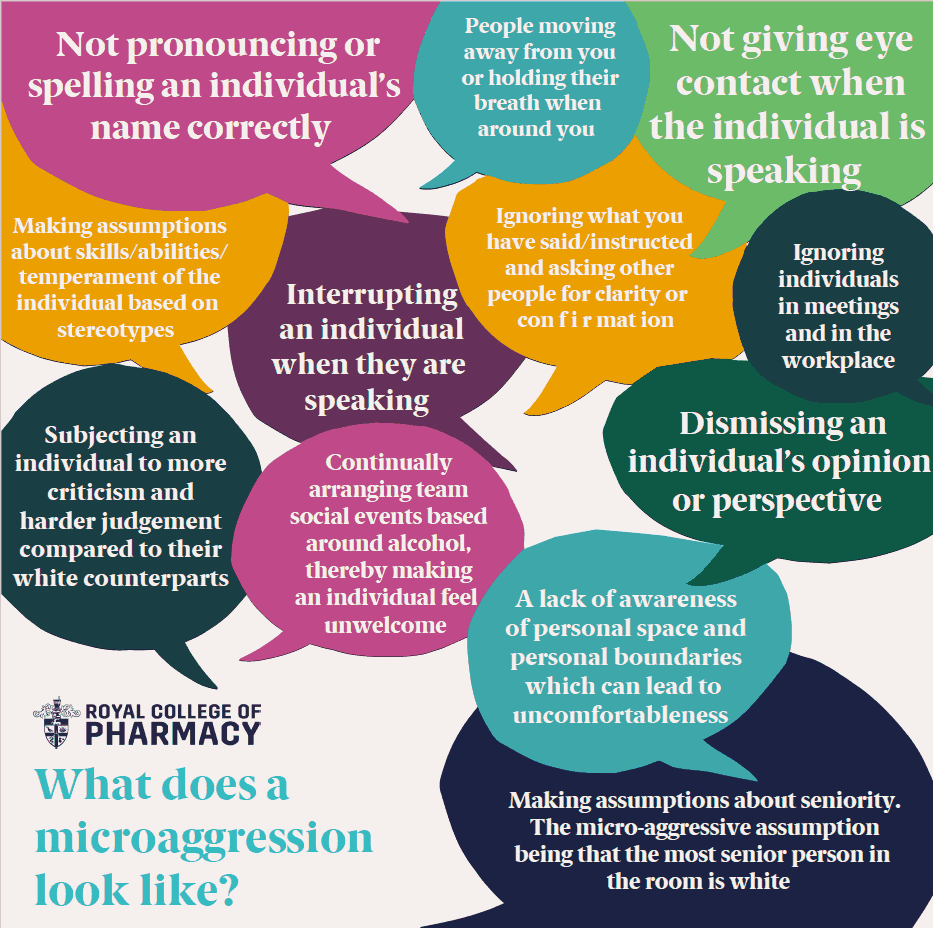
Different forms of microaggression
There are different types of microaggressions, each with their own challenges and effective responses. These sections will help you recognise specific types of microaggressions and how to deal with them.
Challenging microaggressions
Knowing how to respond to a microaggression you have experienced as a victim or an observer can be challenging. It can feel confronting to inform someone that what they have said is wrong or offensive.
Considering how to approach this interaction and knowing what to say or how to behave may be difficult, but each individual should feel empowered to respond in a manner that is authentic to them.
Below are some useful tips on how to address microaggressions. These are relevant to those who receive them, witnesses and those that are in a position of influence who have been informed of the incident.
Step 1: Recognise a microaggression has happened and the message it is sending
Some microaggressions are easy to recognise. Others may be less obvious and therefore harder to identify.
Where there is uncertainty for the victim or observer, they could ask others present for an opinion, clarification or validation.
If this is not possible, either because no one else witnessed the incident or the victim/observer does not feel comfortable with this approach, they may instead wish to seek support from a trusted individual. It can help to discuss the incident with another person if uncertainty exists.
Step 2: Decide if you want to address the microaggression
When deciding whether to address a microaggression, the individual will likely be considering the risks of responding compared with the consequences of not saying anything. This can be a very stressful experience.
The questions below may help to support the person in their decision:
- If the person reacts in a defensive or argumentative manner to my discussion, am I in a position where I can manage this?
- How might I approach this in a way that is constructive?
- What language can I use?
- Will my relationship to this person be affected positively or negatively?
- If I don’t respond, will I regret not saying anything?
- If I don’t respond, does this mean that I accept the behaviour or agree with the statement?
- Is there another route that I would prefer to take to address this matter, for instance speaking with my line manager or an advocate to seek support?
Choosing not to respond
An individual can choose not to respond. It cay be emotionally draining to respond to microaggressions, particularly if they are occurring regularly. An individual may not feel able to respond on each occasion, and this is okay.
However, both victims and observers need to consider the impact of silence and the emotional tax it can place on others. It can reinforce a message that they are not welcome in their workplace.
It is important that everyone reflects on their role in helping individuals feel empowered to respond to microaggressions.
Step 3: Consider when and how to respond to microaggressions
When an individual decides to respond to a microaggression, consideration on how and when to approach this may help to achieve the desired outcome. The approach taken will depend on the individual and the scenario, and it can vary for different incidents.
The timing of the response can be immediate or at a later point.
- Responding immediately in an active way: this allows the microaggression to be called out and its impact explained at the time of the incident.
- Responding at a later time: addressing the microaggression privately at a later point to explain why it was offensive. The risk here is that due to the time delay, the person may need to be reminded of the incident, the microaggression, and the impact.
In responding to a microaggression, it can be constructive to highlight how the behaviour made the person feel. To ensure the message is understood, it is also important to address the behaviour itself and not the individual who performed it, as this is more likely to lead to effective communication.
- Describe what was offensive about the microaggression and what was said. If you are addressing this as a victim, it may be important to use “I” statements for example “I felt hurt when you said that.”, instead of inflammatory statements such as “You’re a racist.”
- Remember to address the behaviour and not the individual.
- Instead of calling the individual “a racist,” you can explain, “that comment is actually a microaggression, which is offensive because…”
Examples of how to respond
You can use a set of micro-interventions (word or deeds) to counteract microaggressions:
- If someone asks you where you are from in a negative way, you could ask “I’m curious, what makes you ask that?”
- If you notice that a female colleague is constantly being interrupted in a meeting, you could address the group: “[name of person] brings up a good point, but I didn’t get a chance to hear all of it. Do you mind sharing that again?”
- If you notice someone making a homophobic joke, you could say: “I didn’t think that was funny. I would like you to stop.”
- Ask for more clarification: “Could you say more about what you mean by that?”, “How have you come that conclusion?”
- Separate intent from impact: “I know you didn’t realise this, but when you said xxxx or behaved in a particular way, it was hurtful/offensive because of xxx. Instead, you could (different language or behaviour)”
- Share your own process: “I noticed that you (comment/behaviour). I used to do/say that too, but then I learned xxxx.”
Support for victims of microaggressions
It’s important that there are ways for the victim to seek support. Organisations, employers and team leaders need to create a culture where raising concerns about behaviours is encouraged and taken seriously.
Practical support can include being able to raise a concern in a safe and confidential way. Is there a network that individuals can join to seek social support to validate their experiences?
Education about microaggressions is also important. The more people are aware of the term and concept, the less likely they will be defensive when confronted about their behaviours.
Allies support marginalised people by taking the time to understand their struggle. They can use their voice alongside marginalised individuals and help to tackle microaggressions.
Allies and observers who step in to respond can validate the experience for victims. Allyship is a powerful mechanism for tackling microaggressions, as it build relationships of trust, consistency, and accountability with marginalised individuals and/or groups of people.
Micro-affirmations
As a member of a team and/or a professional body, you have a duty to ensure that you are not acting in a discriminatory manner, whether it be consciously or unconsciously.
Reflecting on and adopting the use of micro-affirmations would be a positive strategy to prevent microaggressions. Micro-affirmations are small acts that foster inclusion, listening, comfort and support for people who may feel isolated or invisible in their environment. It’s important to focus on action, not avoidance, to create new good behaviours.
Managing inclusion and diversity is a core leadership skill. Leaders need to demonstrate how they manage and celebrate diversity by creating a culture of belonging where their teams are being actively included. There needs to be a culture of open discussion and empowering staff to highlight discriminative behaviour.
Active listening
Active listening, which focuses on hearing clearly what is being shared, can be demonstrated through:
- Giving eye contact.
- Open body language and body posture.
- Acknowledging what is being said (summarising statements).
- Asking qualifying questions to ensure understanding.
- Remember details and recall individuals’ contributions.
- Giving the individual attention and time.
- Proactively invite individuals to ensure everyone is building relationships.
Recognising and affirming emotional reactions
It is helpful to delve deeper by identifying, validating and responding positively to experiences.
This can include:
- Explaining the what, why, and how.
- Expressing care about the effect of the event demonstrating a willingness to think through a productive path forward.
- Acknowledging achievements.
- Verbal acknowledgement that they have experienced something exciting, frustrating, hurtful, etc. this enables the conversation to focus on turning those feelings towards actions that will empower, heal, and/or foster learning.
- Ensure you are giving individuals the attention and time to share their experiences.
- Proactively involve, encourage, and invite people to participate and share their experience.
Additional resources
- Powell, C., Demetriou, C., & Fisher, A. (2013, October). Micro-affirmations in academic advising: Small acts, big impact. The Mentor: An Academic Advising Journal. Retrieved from https://dus.psu.edu/mentor/2013/10/839/
- Rowe, M. (2008). Micro-affirmations and micro-inequities. Journal of the International Ombudsman Association, 1(1), 45-48. Advice on how to respond to a microaggression can be found here: https://hbr.org/2020/07/when-and-how-to-respond-to-microaggressions/