Gender-related microaggressions
Published: 5 May 2022
This was published when the organisation was the Royal Pharmaceutical Society.
What are gender-related microaggressions?
Gender-related microaggressions are a form of discrimination and sexism.
Seemingly innocent transgressions are known as microaggressions and can be intentional or unintentional comments or actions directed against a person who is usually part of a marginalised group, that signal disrespect and inequality.
Gender-related microaggressions may contribute to imposter syndrome. This is the feeling that you’re not qualified for your job and feel a constant pressure to validate your experiences and knowledge. This will be despite having attained your role purely on your own merit.
Some microaggressions will result in silencing women, making women question their abilities and themselves, and reducing their professional self-worth. All of which can negatively impact a woman’s mental health
To get a better understanding of gender related microaggressions, it is important to understand what sexism is.
What is sexism?
Sexism is prejudice or discrimination based on one’s sex or gender.
Sexism can affect anyone. Whilst it primarily affects women and girls, men and boys can also be subjected to it. It has been linked to stereotypes and gender roles and may include the belief that one sex or gender is intrinsically superior to another, and it is considered to be the cause of gender inequity.
Sexism also impacts people of other marginalised genders.
Sexist acts include any that frame one sex or gender as inferior.
Sexism can be conveyed in:
- Behaviour
- Speech
- Writing
- Images
- Gestures
- Laws and policies
- Practices and traditions.
Different types of sexism
Sexism can be categorised in a number of ways:
Hostile
This refers to beliefs and behaviours that are openly hostile toward a group of people based on their sex or gender. Misogyny, or the hatred of women, is an example of hostile sexism.
Examples of hostile sexism include:
- Using sexist language or insults
- Making threatening or aggressive comments based on a person’s gender or sex
- Harassing or threatening someone for defying gender norms
- Treating people as subordinates based on their sex or gender and punishing them when they “step out of line”
- Believing that some victims of sexual assault “ask for it” due to their behaviour or appearance
- Engaging in physical or sexual assault.
Benevolent
This applies some positive traits to women and femininity; it still frames one sex or gender as weaker than another. These ideas can lead to policies and behaviours that limit a person’s agency, or the ability of someone to make their own choices.
Benevolent sexism includes views and behaviours that frame women as:
- Innocent
- Pure
- Caring and nurturing
- Fragile and in need of protection
- Beautiful.
Ambivalent
This is a combination of benevolent and hostile sexism. People who engage in ambivalent sexism may vary between seeing women as good and innocent and seeing them as manipulative or deceitful, depending on the situation.
Examples of ambivalent sexism include:
- Glorifying traditionally feminine behaviour and demonising “unladylike” behaviour.
- Hiring someone because they are attractive, then firing them if they do not respond to sexual advances.
- Differentiating between “good” women and “bad” women based on how they dress.
Sexism can operate on different levels in society. It can be:
Institutional
Refers to sexism that is entrenched in organisations and institutions, such as:
- Legal systems
- Education systems
- Healthcare systems
- Financial institutions
- The media
When policies, procedures, attitudes, or laws create or reinforce sexism, this is institutional sexism.
Institutional sexism is widespread. It can be hostile, benevolent, or ambivalent. One of the clearest indicators is the lack of gender diversity among senior leadership positions.
Another indicator is the gender pay gap. This refers to a difference in the average pay that women and men receive for their work.
Interpersonal
Manifests during interactions with others. It can occur in the workplace, within relationships, among friends and family members, and in interactions with strangers.
Some examples of interpersonal sexism include:
- Telling someone to be more ladylike
- Judging someone for not fitting into stereotypes of femininity (e.g. being caring or submissive)
- Making inappropriate comments about someone’s appearance
- Talking down to someone based on assumptions about their gender.
Internalised sexism
Refers to sexist beliefs that a person has about themselves. Usually, a person adopts these beliefs involuntarily as a result of exposure to sexist behaviour or the opinions of others.
May cause feelings of:
- Incompetence
- Self-doubt
- Powerlessness
- Shame.
It also causes people to unintentionally join in and collude with sexism.
Research suggests that the lower numbers of women working in science, technology, engineering, and mathematics may be due to internalised sexism.
Some other examples of internalised sexism include:
- Making self-deprecating jokes about one’s gender, such as “blonde jokes”
- Someone basing their self-worth on how desirable they are in the eyes of men
- Feeling ashamed of aspects of being female, such as having periods
- Feeling that it is essential to conform to gender ideals, even if this means harming oneself.
It is important to remember that gender based microaggressions impact the entire gender spectrum. Therefore, be mindful of gender based microaggressions directed toward transgender people and gender queer people.
What do gender-related microaggressions look like?
Gender-related micro-aggressive behaviours can be verbal, non-verbal or environmental. View or download the poster for more information.
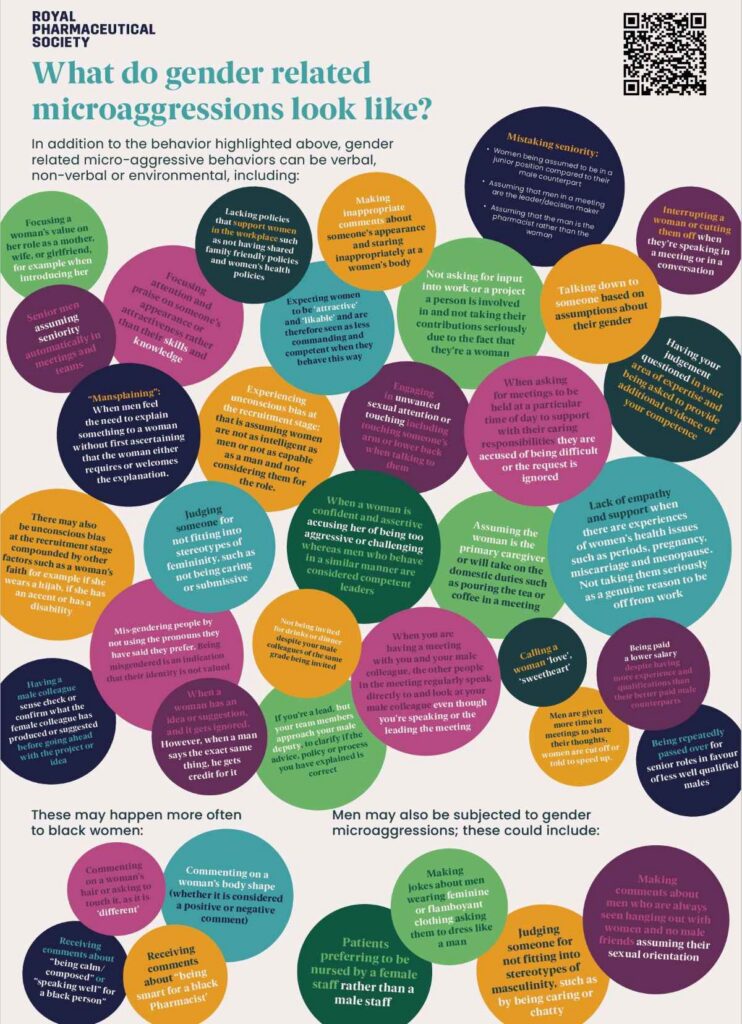
How to recognise gender-related microaggressions
We’ve collected some examples of verbal gender-related microaggressions, with an explanation of why these comments or questions can be offensive, insulting or insensitive. Download the poster for more information.
Gender-related micro-affirmative behaviours
You have a duty to ensure that you’re not acting in a discriminatory manner, whether consciously or unconsciously.
Take positive micro-affirmative actions to be gender inclusive and prevent microaggressions.
Encourage an inclusive culture which is understanding and open to education. Provide support and comfort for individuals and create new positive behaviours.
- Be mindful of your biases, perceptions, and expectations of women – challenge the values that make you think women are lesser than men.
- Challenge your view of traditional gender roles and behaviours.
- Recognising that there is a benefit in having different voices at the table. Appreciate that a broad spectrum of people results in problem-solving skills being enhanced, since there are different approaches to projects, and diversity of thought is likely to improve the final outcome.
- Think about how you touch and speak to women – think about where you’re placing your hand on a woman’s body – it can be very invasive or intrusive to put your hands on their waist or the nape of their back. If you’re in a crowded space, what should you do? Be conscious of the space around you and how you navigate it, so you don’t touch someone without their consent.
- If someone speaks up against a microaggression, or tells you they’re hurt by what you said or did, don’t argue that it didn’t happen – try and understand how your behaviour can be changed.
- Don’t insist women prove their qualifications if you wouldn’t ask the same of men.
- To minimise misgendering individuals, ask people what their preferred pronouns are before making an assumption. You can ask people to include their pronouns when they introduce themselves to someone new or in workshops and meetings.
- If you’re chairing a meeting, make sure you have given everyone the opportunity to contribute.
- If a woman has been interrupted in a meeting, and you witness this, you can provide them with the opportunity to finish their contribution by saying, “xx, can we just return to what you were saying…”
- When you see someone else’s suggestions have been reframed and appropriated by men in the room, you should acknowledge the originator.
- You will often need to take ideas further by discussion, you can acknowledge the originator by saying something like, “developing Jenny’s idea…”
- Acknowledging women’s contributions to discussion and ensuring they have been acknowledged on the work they have contributed to, such as papers and polices.
- Better women’s health support in the workplace by introducing women’s health policies.
- Avoid using negative words such as ‘aggressive’, ‘bossy’, ‘too much’ when talking about someone, and politely correct anyone who does so.
- If there are people in your team with family or caring responsibilities, book in meetings times that are suitable for everyone.