Medicine shortages
Our work to highlight how medicine shortages affect patient care, the pressures on pharmacy teams, and recommendations to inform action.


Our focus on education and credentialing
RCPharm President Tase Oputu reflects on a significant moment for pharmacy and the College’s focus on education, professional development and credentialing.

Enhanced curriculum and credentialing
Supporting newly qualified pharmacist prescribers to develop their prescribing practice, build professional capability and progress with confidence.

RCPharm annual conference 2026
Bringing together pharmacists and pharmaceutical scientists from across the UK and beyond, this will be our first Annual Conference as the new Royal College.

For newly qualified pharmacists
This resource hub provides real-time practical support to ensure you develop the capability, confidence and professional judgement you need to prescribe safely and effectively.

Celebrating Black History Month 2026
Join us in celebrating Black History Month throughout October, to recognise and celebrate the invaluable contributions of Black people to British society and pharmacy.

What’s next for a community pharmacist prescribing service in England?
This episode of The PJ Pod reflects on the ‘Community pharmacy independent prescribing pathfinder programme’.
News
The latest news and updates from Royal College of Pharmacy.
-

Royal College of Pharmacy welcomes expansion of Pharmacy First Services
Commenting on the Government’s expansion of the NHS Pharmacy First service in England, which will enable patients to receive treatment for five additional conditions through participating community pharmacies, Chair of the Royal College of Pharmacy's English Pharmacy Advisory Council, Professor Mahendra Patel OBE, said: “We welcome the expansion of the NHS Pharmacy First service in England to include treatment for migraines, acne, ear infections, rhinitis and scabies. “The expansion of clinical services not only empowers patients with greater choice on where and how they receive care but also makes the most of the valuable skills of pharmacists and their teams. “It reinforces the value of the clinical expertise that pharmacists bring to patients, communities and the wider NHS, through providing services that are convenient, accessible and trusted by the public. “As Pharmacy First continues to evolve, it is vital that investment in the pharmacy workforce and infrastructure keeps pace with growing demand. The College looks forward to working with the NHS, government and pharmacy teams to ensure patients can continue to benefit from high-quality, clinical care delivered through their local pharmacy.” Read more news stories.
-

Royal College of Pharmacy launches enhanced post-registration standard and credential for newly qualified pharmacist prescribers
The Royal College of Pharmacy (RCPharm) is today (7 September) launching its Enhanced Pharmacist Curriculum and Credentialing Pathway, establishing a nationally recognised professional standard for pharmacists developing their practice after registration as prescribers. The pathway is launched as pharmacist prescribing is integrated into registration, with most newly qualified pharmacists, from 2026, entering practice as independent prescribers and taking on more autonomous clinical responsibilities early in their careers. Developed with a broad range of stakeholders across pharmacy, healthcare, education and patient representatives, the Enhanced Pharmacist Curriculum and Credentialing Pathway supports pharmacists to develop the professional judgement, breadth of experience and confidence needed to manage increasingly complex care safely and effectively. The Enhanced Pharmacist Curriculum and credential provide a nationally recognised pathway from initial registration. It also provides a foundation for continued development through advanced level practice and towards consultant-level practice. It will help pharmacists build confidence, broaden their clinical and prescribing scope and demonstrate capability through workplace-based credentialing – giving employers, partners, patients and the public assurance that pharmacists are developing safely and consistently to deliver high-quality, person-centred care. The curriculum sets outcomes across five domains: person-centred care and collaboration professional practice leadership and management education research and evaluation Through the accompanying national pathways, pharmacists will build a portfolio of evidence from their everyday practice using a new e-portfolio platform developed specifically by the royal college for this purpose. They will be supported by structured learning, supervision, feedback and reflection. Portfolios submitted for credentialing will be independently assessed against the curriculum outcomes by the royal college, providing assurance to pharmacists, employers, patients and the public. Tase Oputu, President of the Royal College of Pharmacy, said: “The introduction of pharmacist prescribing at registration is a defining moment for our profession. Registration provides the foundation, but confidence and professional judgement continue to develop through experience, support and reflection. “The Enhanced Curriculum gives pharmacists and employers a clear, shared standard for that next stage of development and will support pharmacists to deliver safe, high-quality care, while giving employers, the wider health system and patients greater assurance.” Supporting implementation across GB The Enhanced Curriculum and Credentialing pathway provides a shared professional standard across the UK, while training, access and funding arrangements reflect the different national systems. In England, eligible pharmacists will be granted e-portfolio access and supported through NHS England’s commissioned Pharmacist Enhanced Practice Programme pathway. In Scotland, the national pathway will provide eligible pharmacists with structured development and e-portfolio access, with the Enhanced credential positioned as a clear endpoint. In Wales, eligible pharmacists will be supported through the Health Education and Improvement Wales Model of Support, including access to structured development, the e-portfolio and the Enhanced credential as a clear endpoint. The College is also working with employers, education providers and national partners to support consistent implementation and access to appropriate supervision, learning opportunities and protected development time. Joseph Oakley, Associate Director of Assessment & Credentialing at the Royal College of Pharmacy, commented: “A curriculum alone cannot transform practice. Pharmacists also need supportive workplaces, skilled supervisors and collaborators to provide observation and feedback, varied clinical and professional experiences and time and space to develop and build their portfolio. “We are asking employers and system leaders to use our Enhanced Curriculum and Credentialing Pathway as part of their workforce and service-development planning, helping newly qualified pharmacists to translate their registration as prescribers into confident, more autonomous practice.” The Enhanced Curriculum, eligibility information and guidance on national routes are available on the enhanced curriculum and credentialing homepage. Read more news stories.
-
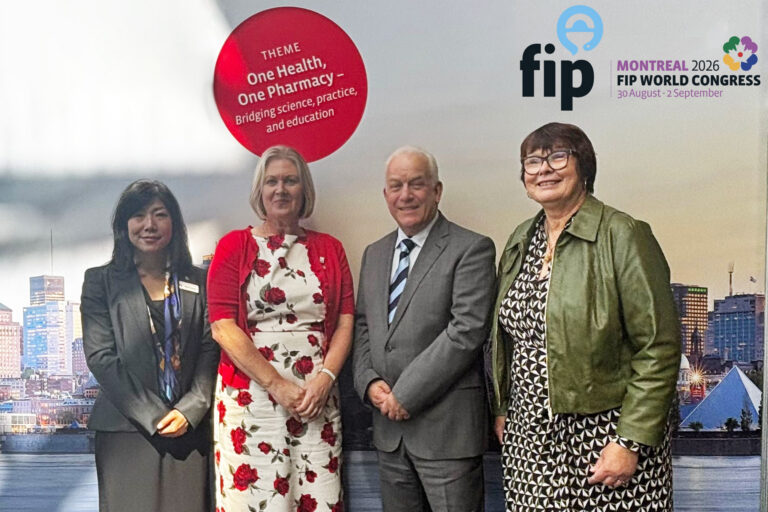
Three RCPharm members take up senior FIP leadership roles
Three members of the Royal College of Pharmacy (RCPharm) have been elected or ratified to senior leadership positions on the Board of the International Pharmaceutical Federation (FIP). Professor Claire Anderson has been elected as a FIP Vice President for 2026–2027, Lars-Åke Söderlund has been elected FIP President-elect for 2026–2027, and Naoko Arakawa has been ratified as FIP Vice President for Operational Education. All three will take up their positions on 3 September, following elections and ratifications by the FIP Council. Former Royal Pharmaceutical Society (RPS) President and current Trustee and Senate member of the RCPharm, Professor Claire Anderson is also a current elected member of the RCPharm English Pharmacy Advisory Council. She served as RPS President from 2021 to 2026 and was nominated by RCPharm for her FIP Vice President role. Lars-Åke will become FIP President from 2027 to 2031, following his term as President-elect. He previously served as a FIP Vice President from 2021 to 2025 and is co-chair of the FIP Technology Advisory Group. Naoko was the International Lead at the RPS for the UK-Japan collaborative programme between 2016 and 2018. She is currently Associate Professor at the School of Pharmacy, University of Nottingham, as well as FIP Interim Education Secretary and a global lead for Competency Development of the FIP Hub. The appointments highlight the depth of expertise and leadership among RCPharm members and their contribution to shaping the future of the profession internationally. Professor Tracey Thornley, a Fellow of RCPharm and former member of the RPS English Pharmacy Board, has also been awarded Fellowship of FIP. RCPharm congratulates Claire, Lars-Åke and Naoko on their appointments, as well as Tracey on her Fellowship. Find out more about FIP. Read more news stories.
-

Pharmacy students must not be left behind as Government expands placement support
The Government has announced that from the start of the 2026/27 academic year, eligible students in England with full access to the NHS Learning Support Fund will be able to receive advance payments towards placement-related travel and accommodation costs. Pharmacy students can currently claim eligible travel and dual accommodation expenses for clinical placements, but do not have full access to the Learning Support Fund. They are not currently eligible for the new advance payment facility, although the Government has said it intends to explore extending the facility to pharmacy students. The Royal College of Pharmacy (RCPharm), alongside the British Pharmaceutical Students’ Association and Pharmacy Schools Council, has previously called on the Government to extend full access to the Learning Support Fund to pharmacy students. Professor Mahendra Patel, Chair of RCPharm’s English Pharmacy Advisory Council, said: “It is disappointing that pharmacy students still do not have full and equal access to the Learning Support Fund. The NHS Long Term Workforce Plan recognised the need to grow the pharmacy workforce, and as pharmacists take on greater clinical and prescribing responsibilities, pharmacy students should have the same access to support as those training for other healthcare professions. “Pharmacy students should not face unjust financial barriers at the very start of their careers. The Government should now build on the progress made so far and ensure pharmacy students have the support they need to train for the future NHS and deliver the care patients need.” Read more news stories.
-

Royal College of Pharmacy issues joint statement on GP walk-in centres
The Royal College of Pharmacy in Scotland has today issued a joint statement setting out our concerns about the roll out of GP walk in centres across Scotland, alongside our colleagues at Royal College of General Practitioners in Scotland and Chartered Society of Physiotherapy. Our organisations represent members who are deeply committed to ensuring that patients can access the right care, from the right professional, at the right time, and that they receive the highest possible standard of care. However, as a collective we do not believe that GP walk-in centres are the solution to current access challenges in primary care. Alongside general practice, community pharmacies across Scotland already provide a wide range of walk-in services that closely mirror those offered by walk-in GP centres. Significant effort has gone into promoting Pharmacy First and Community Pharmacies to patients over the years, and we are concerned that the pilot will create confusion about where a patient’s first port of call should be. Through Pharmacy First care is available at more than 1,200 locations across Scotland at a cost of approximately £7.5 million. By comparison, the initial 16 walk-in GP centres are estimated to cost £36 million. This represents a significantly more expensive service that duplicates existing provision. Furthermore, evidence also suggests that walk-in GP centres can exacerbate health inequalities. Such services are often used disproportionately by people who are generally healthier, more affluent, and more able to navigate healthcare options, frequently for conditions that are self-limiting and may not have required medical intervention. Community pharmacies buck the inverse care law because their distribution is heavily concentrated in high-deprivation neighbourhoods where health needs are greatest. Rather than investing in walk-in GP centres, resources could be directed towards a range of proven measures that would improve access, strengthen existing services, and support higher-quality patient care. From a community pharmacy perspective, the College would like to see investment in a digital and interoperable shared patient record so that all community pharmacists have access to the necessary information that they need to support clinical decision making. We, alongside our General Practice and Physiotherapy colleagues, are fully committed to improving both the speed and quality of patient access to healthcare services. However, we do not believe that walk-in GP centres are the solution to this complex and multifaceted issue. Instead, we believe the Programme for Government 26/27 should focus on the measures outlined above to deliver more meaningful and lasting improvements for patients, clinicians and the wider health system. Director for Scotland at the Royal College of Pharmacy Laura Wilson, speaking about the joint statement, said: “As a group of Royal Colleges and professional bodies, we are fully committed to improving access to and quality of primary care services, so patients can see the right healthcare professional at the right time, and right place. “Community pharmacies across Scotland are based on local high streets and in other community spaces. These services have high footfall and already provide a wide range of walk-in services for typical conditions such as urinary tract infections, respiratory and chest infections, ear, nose, and throat issues, skin conditions, and eye infections. "GP walk in centres duplicate this offering and have the potential to divert a significant amount of resources away from where they are needed most. From a health inequalities perspective, Community pharmacies buck the inverse care law because their distribution is heavily concentrated in high-deprivation neighbourhoods where health needs are greatest. “Instead of investing to duplicate resource, we would prefer to see investment directed into revolutionising the existing primary care offering; including by creating interoperable digital systems which allow for patient information to be shared with community pharmacy teams so that pharmacists have access to all the information required to be able to effectively treat patients in the community.” Read more news stories.
-

Royal College of Pharmacy welcomes new pharmacy minister
The Royal College of Pharmacy welcomes Dame Diana Johnson as the new minister responsible for pharmacy and calls for pharmacy to be central to NHS reforms.

We are the Royal College of Pharmacy, the professional leadership body for pharmacists and pharmaceutical scientists. We exist to advance the safe and effective use of medicines, drive excellence in patient care and support pharmacists to deliver the highest standards of practice.
As the third largest workforce in healthcare, pharmacy plays a vital role in the health system, and as experts in medicines, pharmacists and their teams are central to patient care and public health. Our mission is to put pharmacy at the forefront of patient care, advancing the safe and effective use of medicines to the benefit of patients and the public.




Have any questions or comments on the new Royal College website?
Please visit our support page or email [email protected]

RCPharm Professional support
One-to-one support – every weekday, 9am until 5pm
Call 0207 572 2737 to speak to a member of our support team, or you can email us using the link below.
Our one-to-one support service is exclusively for RCPharm members.