World Patient Safety Day 2026
Published: 17 September 2026

Safe care for life!
17 September 2026
This year’s theme focuses on safe care for noncommunicable diseases (NCDs), under the slogan ‘Safe care for life!’. It calls for multisectoral and multi-stakeholder action to ensure that no one is harmed while receiving care for NCDs.
NCDs are long-term conditions, such as cardiovascular diseases, cancers, diabetes and chronic respiratory diseases, which can affect people of all ages and often require ongoing care throughout life.
People living with NCDs often require continuous care across multiple settings and over long periods, creating multiple points where safety risks can arise — from prevention and diagnosis to treatment, long-term management and self-care. These risks are also influenced by health system challenges and the broader determinants of health.
For more information on World Patient Safety Day 2026, please see the World Health Organisation (WHO) website.
Key campaign messages for WPSD 2026
1. People living with NCDs are at increased risk of harm in healthcare: This risk is driven by the long-term and complex nature of NCDs, health system challenges such as fragmented care, and broader factors that affect access to safe care, such as poverty and discrimination.
2. Risks must be addressed across the continuum of care and in daily life: Safety risks can arise at every stage, from prevention, early detection and diagnosis to treatment and long-term management, across healthcare settings, homes and communities.
3. Strong, integrated health systems and a supported health workforce are essential for safe care: Strengthening primary healthcare, supporting health workers and addressing barriers that affect access to safe care through multisectoral action, are vital to reducing harm.
4. People living with NCDs must be partners in safe care: Meaningful engagement, learning from people with lived experience and supporting health literacy reduces harm and leads to safer, better-quality care.
The 2026 World Patient Safety Day ‘goals’ address the most pressing patient safety concerns in noncommunicable disease care from childhood to older age. For more information on the WHO 2026 goals, please see the WHO website.
Raising awareness of NCDs on WPSD 2026
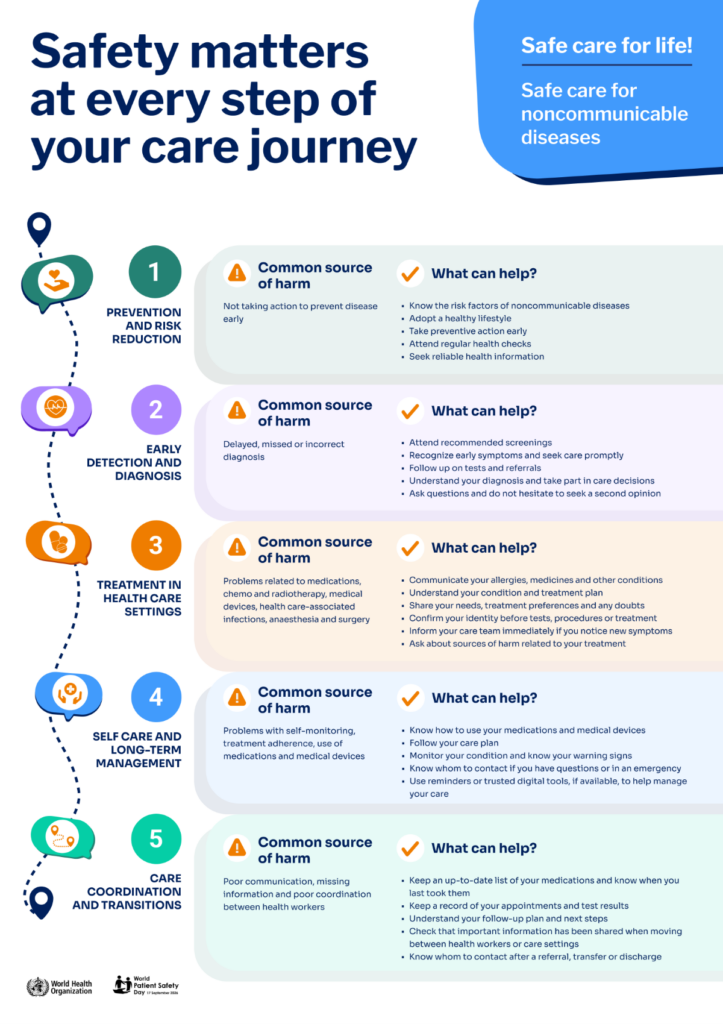
Poster developed by the World Health Organisation. Visit the WHO WPSD campaign materials page for more resources.
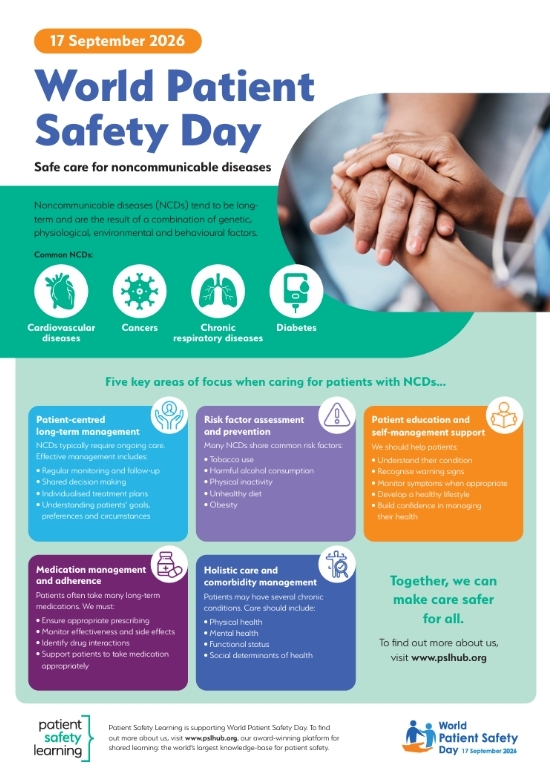
Poster developed by Patient Safety Learning. Visit the PSL WPSD 2026 page for more information and resources.
How can you raise awareness of ‘Safe care for life!’?
The World Health Organisation (WHO) has set out some key calls to action for healthcare professionals to try and ensure that NCD care is safe at every step.
To help you support the World Patient Safety Day 2026 campaign, the Royal College of Pharmacy (RCPharm) and The Pharmaceutical Journal have shared some of their resources to help you achieve the WHO call to action.
We have also suggested some national resources that may be helpful, which align with the World Patient Safety Day 2026 theme. This is not an exhaustive list.
Share your World Patient Safety Day 2026 activities on social media using the hashtags #PatientSafety and #WorldPatientSafetyDay
“Everyone deserves high-quality cancer care, but we know this isn’t the reality for everyone. A cancer diagnosis is the biggest challenge many people will ever face, and for some, it can be made even tougher. How quickly someone is diagnosed, the care they receive, and their chances of recovery can all be affected by where they live, what they earn, where they work, how they communicate or the colour of their skin. It shouldn’t be that way.
That’s why we work alongside people with lived experience to better understand the barriers they face, design services around their needs and make sure their voices are heard.
At Macmillan, we’re on a mission to make cancer care fair for everyone. By bringing together people with lived experience, healthcare professionals, community groups and partners, we can help break down these barriers and bring safer, more equitable cancer care closer to everyone who needs it.”
Adrienne Betteley, Strategic Advisor for Macmillan Cancer Support
Call to action
Prioritise meaningful engagement
Partner with people living with NCDs as expert team members. Support shared decision-making. Empower people living with NCDs to recognise risks, manage their care safely and identify warning signs that require action.
RCPharm and PJ support available to achieve this call to action:
- Consultation skills: This e-learning module supports you to develop essential knowledge, skills, and confidence in delivering effective consultations to provide safe and effective care to your patients.
- The PJ Prescribing hub: This prescribing resource has been developed to support pharmacists as they develop the knowledge and skills required to safely, confidently and independently prescribe medicines and includes a section on communication and person-centred practice.
- The PJ Learning hub on communication and consultation skills: Highlights several articles to support meaningful engagement with people using your services.
Promote prevention and reduce risk
Identify and address modifiable risk factors, support healthy lifestyles and provide evidence-based preventive interventions.
RCPharm and PJ support available to achieve this call to action:
- RCPharm and Heart UK lipids webinar series:
- RCPharm and National Association of Link Workers webinar:
- The PJ: How pharmacists can implement effective health coaching in everyday practice: Health coaching is an effective approach that pharmacists can use to guide patients into making healthier choices.
- The PJ: A pharmacy guide for smoking cessation consultations: This step-by-step guide outlines how pharmacists and pharmacy teams can encourage patients to make an initial decision to quit smoking, going on to provide advice and support on nicotine replacement therapy and relapse prevention.
- The PJ: Tips for effective lipid management consultations for secondary prevention of cardiovascular disease: Practical advice for pharmacy teams on how to provide long-term support for patients, improve adherence and achieve target lipid-levels.
Ensure early detection and accurate diagnosis
Reduce delays, avoid missed or incorrect diagnoses by maintaining a high index of suspicion about NCD-related risks, and interpret tests carefully, especially in people with multiple conditions.
RCPharm and PJ support available to achieve this:
- Clinical assessment skills: This e-learning module supports you to develop essential knowledge, skills and confidence needed to perform clinical assessments and physical examinations to provide safe and effective care to your patients.
- The PJ: Principles of diagnostic reasoning: This article introduces principles and techniques that help prescribers to systematically structure their approach to differential diagnosis.
- Clinical documentation: This pharmacy guide can help you with why, when and where to make a clinical record. It includes documenting any findings, interventions, referrals, reviews, consultations, diagnosis, prescribing, administering, service delivery, decisions and advice. Your records should be detailed but concise, legible, up to date and accurate. This will protect you, support other teams and improve communication.
- Performing regular audits: For example, on your prescribing practice or service. This can help you measure, review and improve your practice and patient care. We can support you in preparing for and conducting clinical audits, and with clinical governance. See our clinical audit guide and clinical governance guide.
Identify risks and prevent harm
Take proactive steps to prevent harm across the continuum of care, such as missed prevention opportunities, delayed or incorrect diagnoses, medication errors, procedural risks and device-related harm.
RCPharm and PJ support available to achieve this:
- Repeat Prescribing Toolkit: This toolkit was developed to help GP practices improve the consistency of repeat prescribing processes and help GP practices to reassess current processes to streamline systems and services for patients. A key driver behind this toolkit is to ensure the safety of patients receiving medicines on a repeat prescription.
- Medication review and adherence: This guide helps all pharmacists in all settings to identify opportunities for medication reviews and conduct them, identify and address practical medicine-related and adherence issues, improve medicine optimisation and reduce polypharmacy and waste.
- The PJ: How to identify red-flag symptoms and refer patients appropriately: Pharmacy teams must understand how to help patients who are experiencing red-flag symptoms through providing appropriate advice and escalation.
- The PJ: How to provide patients with safety-netting advice: Pharmacists can support patients with self-management of their condition by providing clear information about when to seek further help.
- Polypharmacy: Navigating CYP3A Interactions for Safer Patient Care: This interactive e-learning module supports prescribing professionals to develop the knowledge and skills required to identify, assess and manage these interactions in practice, with a strong focus on practical application through case-based learning and real-world scenarios to support safe and effective prescribing.
Ensure continuity and coordination of care
Communicate clearly, manage transitions safely and maintain follow-up across health practitioners and settings.
RCPharm and PJ support available to achieve this:
- Medicines reconciliation and medication history: Pharmacists can use this guide to support with undertaking a medicine reconciliation, including what sources of information to use and how to take an accurate medication history.
- Paediatric medication history taking and medicines reconciliation: This e-learning module supports you to build the knowledge, practical skills, and confidence needed to take an accurate paediatric medication history and complete a safe medicines reconciliation.
- Counselling people on the use of medicines: This pharmacy guide is for pharmacists when advising people on the safe and appropriate use of medicines.
- RCPharm webinar: Moving forward — reducing harm from medicines at transitions of care.
- The PJ: Continuity of care and reducing risk during transitions of care: This article considers the evidence of interventions to reduce risk during transitions of care and explains best practice for pharmacy teams.
Learn and improve continuously
Report incidents, share good practices and foster a culture of safety and continuous improvement.
RCPharm and PJ support available to achieve this:
- Patient safety professional standards: responding to patient safety incidents: Use our patient safety professional standards to support you when responding to patient safety events. They describe good practice and provide a broad framework to support you to continually improve services, shape future services and roles and deliver high-quality care across all settings and sectors. Their implementation will improve patient safety and the quality of pharmaceutical services.
- Quality Improvement (QI): Within healthcare, QI is essential in the improvement and refinement of healthcare services to ensure patients are receiving high-quality, effective care, which contributes to positive patient outcomes. This guide is an introduction to QI and a summary of the different QI approaches.
- Webinar 1: Exploring Human Factors: Truths, myths and practical insights.
- Webinar 2: Exploring Human Factors 2: Connecting safer work practices across care boundaries — benefits of a systems approach.
- Webinar 3: Exploring Human Factors 3: Designing systems to enhance medication safety.
- Webinar 4: Exploring Human Factors: Learning from patient safety investigations — greater improvement using human factors.
- Prescribing Development Programme: The RCPharm Prescribing Development Programme is a flexible, comprehensive learning experience designed to support you at every stage of your prescribing journey. Whether you’re new to prescribing, returning to practice, or looking to develop further, the programme covers everything from core principles to advancing your career. You’ll build the knowledge, skills, and confidence to prescribe safely and effectively across any area of practice. With a blend of e-learning, expert insight, and practical resources, you’ll be supported to grow as a prescriber and deliver the best possible care for your patients.
- The PJ: Adopting a quality improvement approach to patient safety incidents: How pharmacists can support the implementation of the Patient Safety Incident Response Framework and drive continuous improvement.
“Every person with a respiratory condition deserves safe, high-quality care, from diagnosis through to treatment. Asthma is a long-term condition that requires regular preventative treatment to keep symptoms under control, reduce the risk of attacks, and help people stay well.
“Healthcare professionals should always make sure care decisions, such as inhaler prescribing, are made collaboratively with the people they treat so that they understand why any medication changes are being made. By working alongside those affected by respiratory conditions, outcomes can be improved and safer healthcare delivered for everyone.”
Nazir Hussain, Clinical Lead at Asthma + Lung UK
Resources from RCPharm and The Pharmaceutical Journal
Cardiovascular disease
- Hypertension: an introduction: This e-learning module supports you to develop essential knowledge, skills, and confidence in understanding the mechanisms, causes, risks, and treatment for hypertension.
- Cardiovascular disease (CVD): This learning hub from The PJ includes a collection of CVD resources to support your practice including assessment and diagnosis; conditions; medication, toxicity, monitoring and prevention.
Cancer
- Oral cancer for community pharmacists: This interactive e-learning module on oral cancer has been developed specifically for community pharmacy.
- Lung cancer — early detection and supporting smoking cessation: This e-learning module will help you develop the knowledge, skills, and confidence to promote smoking cessation, recognise the signs and symptoms of lung cancer, and support the early detection and referral of people with suspected lung cancer.
- Pancreatic cancer — the role of the pharmacy team: This e-learning module will help you spot potential symptoms of pancreatic cancer among pharmacy patients, to help aid early diagnosis.
- Cancer: This learning hub from The PJ is a collection of oncology content to support your practice, which includes screening and prevention; solid cancers; leukaemia’s; lymphomas and myelomas; immunotherapy; side effects and toxicities; patient care; Pharmacogenomics and future perspectives.
- Daffodil Quality Improvement Standards for Community Pharmacy: RCPharm has written these Standards in partnership with Marie Curie with help from an Expert Steering Group and the RCPharm Community Pharmacy Expert Advisory Group and are based on the work completed by the Royal College of General Practitioners. The Standards have been adapted for Community Pharmacy teams and individual/locum pharmacists.
Diabetes
- Type 2 diabetes — an introduction: This e-learning module supports you to develop essential knowledge, skills, and confidence in the management of type 2 diabetes in adults.
- Weight management: This e-learning module aims to support you to develop essential knowledge, skills and confidence in weight management including skills to assess weight, support behaviour strategies, and recommend nutritional guidance and pharmacological treatments, where appropriate.
- Diabetes: This learning hub from The PJ includes a collection of resources to support your practice, which includes diagnosis and management; complications; living with diabetes; research and future directions.
- Additional articles from The PJ that may be of interest on this clinical area:
Chronic respiratory disease
- Asthma in adults — an introduction: This e-learning module supports you to develop essential knowledge, skills, and confidence in managing people with asthma in practice.
- Chronic obstructive pulmonary disease (COPD) — an introduction: This e-learning module supports you to develop essential knowledge, skills, and confidence in managing people with COPD in practice.
- Respiratory tract diseases: This learning hub from The PJ is a collection of resources to support your practice, which includes upper respiratory infections; lower respiratory infection; asthma; other chronic respiratory conditions; and inhaler prescribing.
External resources
Other national publications of interest
- World Health Organisation (WHO) — resources on non-communicable diseases.
- Patient Safety Learning — Patient Safety Learning has created a poster that can be printed out and displayed within organisations to support World Patient Safety Day 2026 activities.
- Health Services Safety Investigations Body (HSSIB) — HSSIB has published a number of patient safety investigations which have a focus on NCDs:
- Insulin: supporting safe self-administration in vulnerable patient groups in the community (August 2026)
- Online prescribing: challenges and opportunities to improve patient safety (June 2026)
- Medication related harm (May 2026)
- Insulin: supporting safe administration in inpatient settings (March 2026)
- Patient care in temporary care environments (January 2026)
- Electronic patient record (EPR) systems – thematic review (November 2025)
- Workforce and patient safety (July 2025)
- The impact of staff fatigue on patient safety (April 2025)
- Continuity of care: delayed diagnosis in GP practices (November 2023)
- Variations in the delivery of palliative care services to adults (July 2023)
- Administering high-strength insulin from a pen device in hospital (July 2022)
- Missed detection of lung cancer on chest X-rays of patients being seen in primary care (October 2021)
- Management of chronic asthma in children aged 16 years and under (May 2021)
- Management of venous thromboembolism risk in patients following thrombolysis for an acute stroke (October 2020)
National charities
(List not exhaustive)
National patient safety guidance
Wales
England
Scotland
World Health Organisation
*WHO WPSD logo source: World Health Organisation/ https://www.who.int/campaigns/world-patient-safety-day/2026/campaign-materials-and-logo/
*WHO NCD patient journey poster: World Health Organisation/ https://www.who.int/campaigns/world-patient-safety-day/2026/campaign-materials-and-logo/
*PSL WPSD poster source: PSL Hub/ https://www.pslhub.org/learn/patient-safety-learning/world-patient-safety-day-2026-poster-for-you-to-share-r14603/