Veterinary medicines
Published: 6 October 2016
Updated: 31 March 2025
This was published when the organisation was the Royal Pharmaceutical Society.
Sections on this page
- Selling or supplying veterinary medicines OTC (NFA-VPS and AVM-GSL)
- Selling or supplying unauthorised veterinary medicines
- Physical presence of a pharmacist
- Pharmacist prescribing of veterinary medicines (POM-VPS and NFA-VPS)
- Dispensing veterinary medicines (NFA-VPS, POM-VPS, POM- V) under the veterinary cascade
- Labelling
- Record-keeping
- Reporting adverse reactions
- Audit
- Selling veterinary medicines over the internet
- Categories of veterinary medicines and their characteristics
- Further information
This guide will help pharmacists to supply veterinary medicines against a veterinary prescription, including controlled drugs (CDs) and medicines for administration under the veterinary cascade. It can also be used to support requests for veterinary medicines over the counter (OTC).
This guide does not cover the wholesale supply of veterinary medicines – this information can be found in the Medicines, Ethics, and Practice guide (MEP), specifically under section 3.5.5).
Selling or supplying veterinary medicines OTC (NFA-VPS and AVM-GSL)
Pharmacists can sell or supply the following veterinary medicines OTC:
- NFA-VPS: stands for non-food animal – veterinarian, pharmacist, suitably qualified person (SQP) – (e.g., for flea prevention and antiparasitics for cats and dogs).
- AVM-GSL: stands for authorised veterinary medicine – general sales list (GSL).
NFA-VPS medicines should not be accessible to the public in the pharmacy, so interaction with the pet owner is necessary. It is a legal requirement for pharmacists to:
- Advise on how to use NFA-VPS medicines safely.
- Advise on any applicable warnings and contraindications on the packaging or label.
- Be satisfied that the recipient intends to use the medicine correctly and is competent to do so.
- Supply only the minimum quantity required for treatment.
- Consider good practice of recording the supply of NFA-VPS – it’s not necessary to record the supply of NFA-VPS medicines, but it is considered good practice to do so (because pets need regular (usually monthly) treatments for fleas and often three-monthly for worming depending on the situation).
Decision-making process for supply of NFA-VPS or AVM-GSL medicines
You’ll need to use your professional judgement when dealing with requests (see our professional judgement guide).
It’s important to share information about the process of supply with the person requesting. Explain that you’ll need to ask some questions to make sure the medicine is suitable for the animal they are requesting for, and that you may need to refer them to a vet if you identify contraindications or if investigations are required.
You may want to use the following questions to support with diagnosis, pre-screening, education and supply. Explore the situation by considering and asking the following to the person requesting:
- Who is requesting a supply? Is it the animal owner or a representative?
- What is the species of the animal?
- Is it for one animal or a group of animals?
- What are the signs and symptoms and how long has the animal had them (make sure treatment is clinically appropriate)?
- How long has the animal had these signs and symptoms?
- Have they tried anything already?
- Is the medicine being supplied according to the product licence?
- Is the animal hypersensitive to any of the active ingredients or excipients in the medicine?
- Is the animal pregnant or lactating?
- Does the animal have any health or medical conditions and are they taking any medicines? Check for contraindications and any reason for referral.
- Have they already been supplied the medicine OTC? Check if they experienced any side/adverse effects that would require referral to the prescriber.
- Has the owner requested the medicine in the past and been refused, or had to stop treatment for any reason? Find out why and use your professional judgement to decide if it is a reason for referral.
Use your professional judgement to decide on suitable action:
- If you feel the supply is suitable and the person requesting the medicine is happy to continue, provide counselling and relevant information using the product information.
- If you feel the supply is not suitable, if in doubt of suitability, or if medical attention, investigations or a referral is required, then refer to a vet.
Selling or supplying unauthorised veterinary medicines
- It’s unlawful to sell or supply unauthorised veterinary medicines (medicines not licensed as veterinary medicines), including human medicines such as GSL and pharmacy medicines, for an animal, unless this takes place under the veterinary cascade.
- This applies even if a veterinary surgeon asks the animal owner verbally to purchase an OTC human product from a pharmacy.
You cannot sell or supply a human medicine for animal use, even if it has been recommended by the vet or if the owner has used it before.
Physical presence of a pharmacist
The physical presence of the pharmacist is required for supply of prescription-only medication (POM)-V, POM-VPS and NFA-VPS medicines unless:
- A transaction has been individually authorised in advance by a pharmacist and the person handing out the medicine is judged to be competent.
Pharmacist prescribing of veterinary medicines (POM-VPS and NFA-VPS)
A registered qualified person (RQP) can prescribe and supply veterinary medicines. An RQP can be a veterinary surgeon, pharmacist or SQP.
Pharmacists can prescribe and supply the following veterinary medicines (if qualified and registered):
- POM-VPS.
- NFA-VPS.
Prescribing for veterinary medicines involves deciding, instructing and recording the treatment required for an animal. Prescriptions may be verbal or in written form:
- A written prescription is required when a veterinary medicine is supplied by an RQP working at a different business or premises from where it was initially prescribed – for prescription requirements see the section on veterinary prescription requirements for POM-VPS, POM-V and under the cascade.
- A written prescription is not required when the prescribing RQP and supplying RQP are different and working on the same site, provided they interact in the supply.
For POM-VPS medicines and NFA-VPS. It is a legal requirement for pharmacists to:
- Advise on how to use POM-VPS medicines safely.
- Advise on any applicable warnings and contraindications on the packaging or label.
- Be satisfied that the recipient intends to use the medicine correctly and is competent to do so.
- Supply only the minimum quantity required for treatment.
- Record supplies of the POM-VPS medicine.
- Consider good practice of recording the supply of NFA-VPS – it’s not necessary to record the supply of NFA-VPS medicines, but it is considered good practice to do so (because pets need regular (usually monthly) treatments for fleas and often three-monthly for worming depending on the situation)
- Advise the owner of withdrawal periods for POM-VPS medicines at the time of prescribing. This is to ensure food products from the treated animal have no residues.
For further information see the GOV.UK website.
Dispensing veterinary medicines (NFA-VPS, POM-VPS, POM- V) and medicines under the veterinary cascade
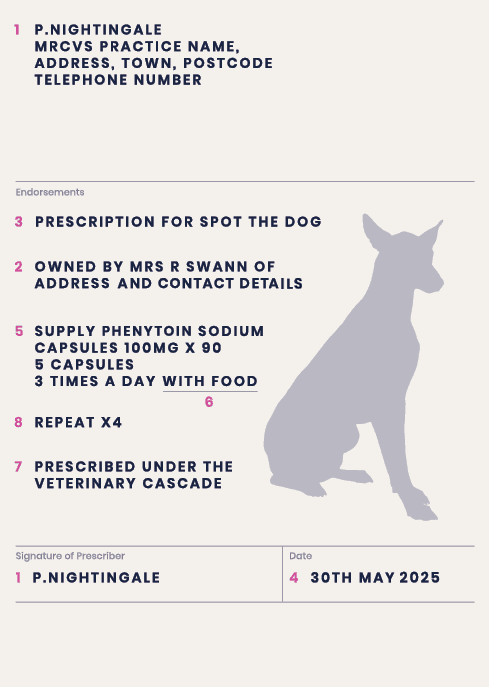
The following must be present for a veterinary medicine prescription to be valid:
- Prescriber
- Full name, address, contact details, professional registration number (if available) and handwritten signature or electronic signature of the prescriber.
- Where Schedule 2 or 3 CDs have been prescribed, the Royal College of Veterinary Surgeons (RCVS) registration number of the prescriber must also be included.
- Animal owner or keeper – full name, address and contact details.
- Identification and species – of the animal or group of animals to be treated and the address (if different from the owner’s address).
- Date – issue date required:
- Prescriptions are valid for six months or less, if indicated by the prescriber.
- For repeatable prescriptions, if the first dispense takes place during the prescription validity period, the remaining repeats on the prescription may be dispensed beyond the validity period. For further information see the Veterinary Medicines Directorate (VMD) guidance on retail of veterinary medicines.
- Prescriptions for Schedule 2, 3 and 4 CDs are valid for 28 days.
- Medicine
- Name, quantity, pharmaceutical form, strength, dosage regimen; VMD advises that ‘as directed’ is not an acceptable administration instruction.
- Any necessary warnings – to ensure correct use, including, where relevant, the prudent use of antimicrobials.
- For antibiotics – where appropriate, a statement must be included confirming if antibiotics have been prescribed for prophylactic purposes or metaphylactic purposes (where applicable).
- Withdrawal period – for food-producing animals, the withdrawal period or a statement that the withdrawal period is equal to zero days where appropriate (e.g., the time that must elapse between when an animal receives a medicine and when it can be used for food).
- Repeats –
- If the prescription is repeatable, the number of times it can be repeated
- For written repeatable prescriptions, if the first dispense takes place during the prescription validity period, the remaining repeats on the prescription may be dispensed beyond the validity period.
- If the prescriber wants the repeats to be dispensed beyond the validity period, they could, where appropriate, add additional information to the prescription stating the following to clarify the treatment period:
- Duration of the repeats (for example, one year).
- End point of the repeats (specific day/month/year).
- If the prescriber wants the repeats to be dispensed beyond the validity period, they could, where appropriate, add additional information to the prescription stating the following to clarify the treatment period:
- Notes on repeats:
- It is an offence to submit a written prescription to a retailer more than once if the prescription is not a repeatable or an instalment prescription – you may want to make animal owners aware of this rule.
- Repeat prescriptions aren’t allowed for Schedule 2 or 3 CDs.
- For all written prescriptions – these words must be included: “It is an offence under the Veterinary Medicines Regulations (VMR) 2013 for a person to alter a written prescription unless authorised to do so by the person who signed it.”
- The cascade – where appropriate, a statement must be included highlighting the medicine is prescribed under the veterinary cascade (e.g., ‘prescribed under the cascade’ or other wording to the same effect). For further information on the cascade, see the section below.
Electronic signatures
The pharmacy should make sure they have the original hard copy prescription before supplying the medicine. However, electronic transmission for written prescriptions is acceptable if it is an agreed and familiar practice between the prescriber and pharmacy, or if the product is needed urgently to avoid an animal suffering.
VMD has clarified that the following are acceptable as electronic signatures:
- A prescription that is printed out, signed in ink by the prescriber, then scanned and emailed to a pharmacy.
- A prescription that is written within a Word document or other suitable document template, then an electronic image (such as a JPEG) of the prescriber’s signature is added by the prescriber before emailing to the pharmacy (an electronic signature cannot be prepopulated on a prescription template and would need to be added by the prescriber, which could be a vet, pharmacist or other SQP depending on the product being prescribed).
Mitigating risks
VMD’s guidance on retail of veterinary medicines has a section on prescription tampering which includes how to reduce or discourage unauthorised alterations for both prescribers and dispensing pharmacies.
Please note: the definition of an ‘advanced electronic signature’ is different for prescriptions for human medicines. Further information can be found in the MEP (section 3.3.1).
Controlled drugs
- For Schedule 2 and 3 CDs.
- A standardised form is not required.
- A declaration that the items are “prescribed for the treatment of an animal or herd under his/her care” must be included.
- Usual CD prescription requirements also apply, (e.g., total quantity in words and figures – see the MEP).
- Repeat prescriptions aren’t allowed.
- The RCVS registration number of the prescriber must be included.
For Schedule 2, 3 and 4 CDs:
- Prescriptions are valid for 28 days from the appropriate date.
- It’s considered good practice for only 30 days’ worth of treatment to be prescribed, except in situations of long-term ongoing medication, (e.g., treatment of epilepsy in dogs). If more than 30 days’ worth is prescribed, the prescriber should be able to justify it.
- Prescriptions are retained for five years and submitted to the relevant NHS agency.
It’s an offence to supply Schedule 2 or 3 CDs against an electronic or faxed prescription; the original prescription must be obtained before the CD is dispensed and retained for at least five years.
Pharmacists should use their professional judgment when dispensing veterinary medicines. If there are any concerns about the prescription, or the suitability of the medicine then you should contact the prescriber before supplying the medicine. Pharmacists are empowered to refuse to sell or supply any medicines if the sale or supply is contrary to the pharmacist’s clinical judgement. You should take each situation on a case-by-case basis.
- Written prescriptions for Schedule 2 and 3 CDs need be signed in indelible ink by the prescriber – they may be handwritten, typed in a computerised form, or computer-generated.
The cascade
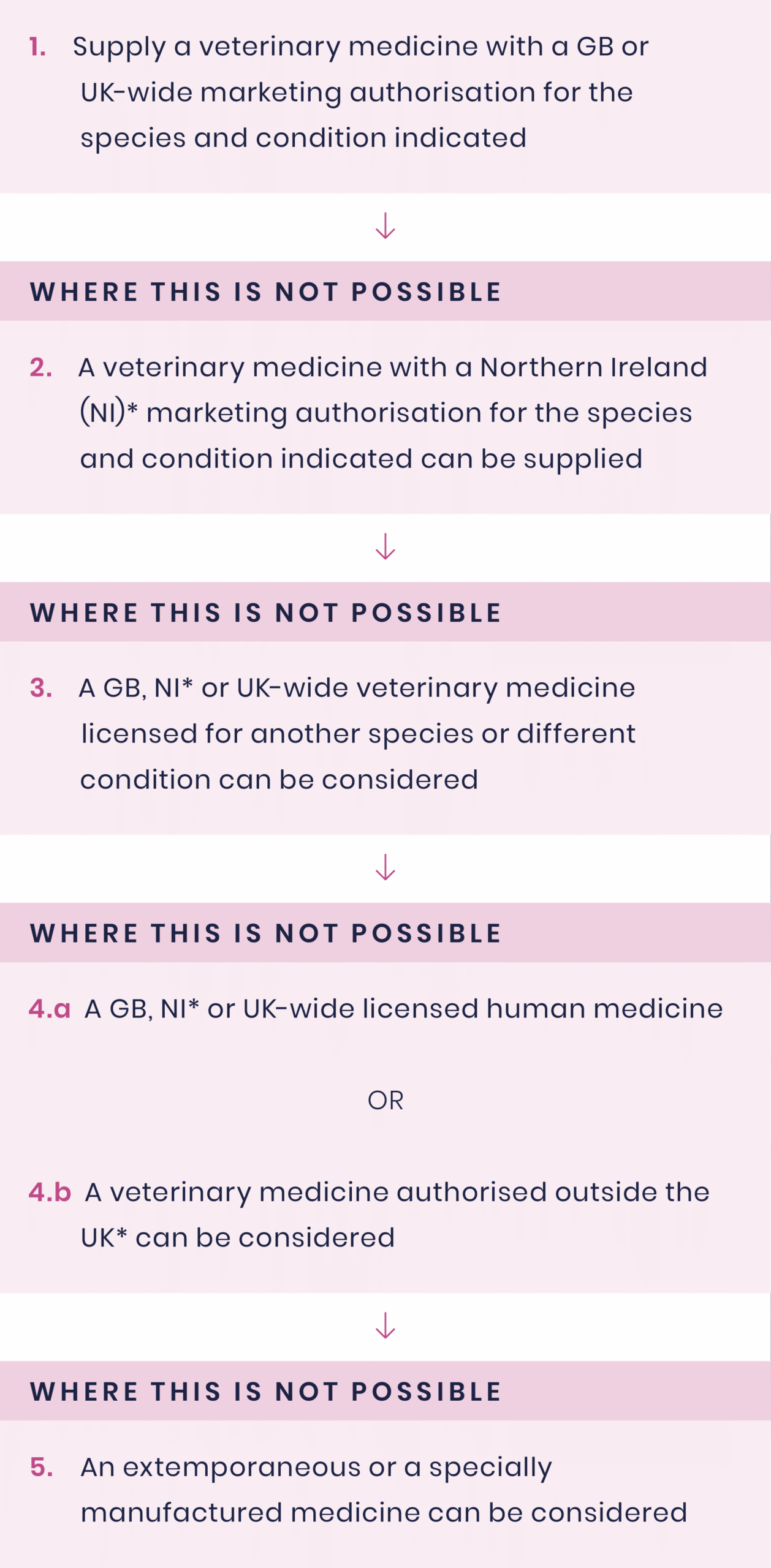
A veterinary medicine, with a Great Britain or UK marketing authorisation, must be supplied where one exists and is clinically appropriate. The cascade is an exemption within the VMR, which specifies that where a licensed veterinary product is not available, other medicines, in a strict order of preference, can be considered.
Pharmacists may supply a POM-VPS, NFA-VPS or AVM-GSL medicine for use under the cascade only if it is prescribed by a vet against a written prescription.
Unless the prescription specifically states that it’s ‘for administration under the cascade’ (or using similar wording) the following can’t be supplied against a veterinary prescription:
- Prescriptions for veterinary medicines licensed for another species, or for another clinical condition in the same species.
- Extemporaneously prepared human medicines.
Please note it is an offence to misuse the cascade. The cascade must only be used in accordance the VMR. This does not change the VMD guidance ‘The cascade: prescribing unauthorised medicines’, which can be found on the VMD website, where in exceptional emergency situations vets may recommend an animal owner to use a human medicine they already have in their possession commonly found around the home (e.g., antihistamine tablets). If a human medicine is not already in the owner’s possession, then it will need to be prescribed under the cascade, and the usual prescribing and supply rules apply.
*For products not authorised in Great Britain or UK-wide (including those licensed in NI only) a special import certificate is required. Further information is available on the VMD website.
Although the wording on the prescription is a legal requirement, it’s important that it reflects the actual cascade. For example, if a prescription is written generically with the cascade wording present, but a licensed veterinary medicine exists, then the cascade requires the licensed product to be supplied rather than a medicine only licensed for human use.
Labelling
When a medicine is supplied by a pharmacy for use under the cascade, the following details must appear on the dispensing label, unless they already appear on the packaging and are not obscured by the dispensing label:
- Name of the prescribing veterinary surgeon.
- Name and address of the animal owner.
- Name and address of the pharmacy.
- Identification and species of the animal or group of animals.
- Date of supply.
- Expiry date of the product.
- The name or description of the product or its active ingredients and content quantity.
- Dosage and administration instructions.
- If appropriate, special storage instructions.
- Warnings for the user (e.g., related to administration, disposal, target species, etc.).
- Withdrawal period (if relevant) (e.g., the time that must elapse between when an animal receives a medicine and when it can be used for food).
- The words ‘for animal treatment only’.
- The words ‘keep out of reach of children’ – we recommend including this on the dispensing label.
If the medicine isn’t prescribed under the cascade, you don’t legally have to label it. However, we advise that it would be appropriate to generate a dispensing label for all veterinary medicines, particularly for individual animals (pets). Care should be taken so the dispensing labels don’t obscure any information on the packaging.
Record-keeping
Records of receipts and supplies of POM-V and POM-VPS products must be kept and show the:
- Name of the medicine.
- Pharmaceutical form and strength.
- Batch number.
- Expiry date.
- Date of receipt or supply.
- Quantity received or supplied.
- Name and address of the supplier or recipient.
- If there is a written prescription, record the name and contact details of the prescriber and keep a copy of the prescription (please note it’s not mandatory to keep the original prescription by the pharmacy except for Schedule 2 and 3 CDs). VMD has clarified, that for written repeatable prescriptions, the regulations don’t prevent pharmacists from returning a prescription that has outstanding repeats to the animal owner if they wish to obtain the remainder from another pharmacy.
If a veterinary medicinal product is supplied against a prescription that is not a written prescription (i.e., a verbal prescription or a record of a verbal prescription in the clinical notes), the person prescribing it must record the reason for prescribing it.
You can either keep all documents that show all the required information or make a record in the private prescription book (records can be kept electronically) as soon as is reasonably practicable.
Records and documents must be kept for at least five years.
Reporting adverse reactions
Veterinary medicines can cause adverse reactions in humans, as well as in animals exposed to a veterinary medicine. Suspected adverse drug reactions in humans are often associated with a failure to read and/or adequately follow product guidance information. Examples include animal sprays and ‘spot-ons’ onto human skin.
Both animal and human adverse reactions to veterinary medicinal products should be reported. You can report a suspected problem with an animal medicine on the VMD website.
Audit
Pharmacies that supply POM-V and POM-VPS medicines must undertake an annual stock audit.
Selling veterinary medicines over the internet
Online retailers of veterinary medicines in England, Wales and Scotland must be registered with VMD.
The internet retailer’s website must also include the following information:
- The statement ‘registered internet retailer of veterinary medicines’ on all parts of the website where products are offered.
- Contact details of the secretary of state.
- A link to the published register.
Guidance on the legal requirement for selling and advertising veterinary medicines over the internet is available on the VMD website.
VMD accredits UK-based retailers of veterinary medicines who meet the Accredited Internet Retailer Scheme. Further information on this can be found on the VMD website.
Categories of veterinary medicines and their characteristics
- NFA-VPS – medicine for non-food animals that can be supplied by a veterinary surgeon, a pharmacist, or a SQP. A written prescription is not required. These medicines should not be accessible by the public in a pharmacy.
- POM-V – POMs that can only be prescribed and supplied by a veterinary surgeon or supplied by a pharmacist with a written prescription.
- POM-VPS – POMs that can be prescribed and supplied by a veterinary surgeon, a pharmacist, or an SPQ on an oral or written prescription. A written prescription is only required if the supplier is not the prescriber.
- AVM-GSL – an authorised veterinary medicine that is available on general sale.
- Exempt medicines under Schedule 6 of the VMR – Exemptions for small pet animals – an unlicensed veterinary medicine that does not require a marketing authorisation because it meets criteria laid out in Schedule 6 of the VMR – Exemptions for small pet animals. Further details are available on the VMD website.
- Unauthorised veterinary medicine – an unlicensed medicine that does not have a marketing authorisation and is not eligible for exemption via Schedule 6 of the VMR. It can only be prescribed by a veterinary surgeon under the cascade. This includes any human medicine used for animals.
Further information
RCPharm
- MEP
- Veterinary Pharmacology and Therapeutics (2018, tenth edition) e-book
External
- British Veterinary Association.
- National Office of Animal Health (NOAH) – data sheets of AVMs to assist prescribing and support responsible use.
- RCVS – including CD guidance A–Z.
- RCVS – standards and advice update (2024).
- VMD – resources including a data base of veterinary medicinal products.
- VMD – AIRS – list of accredited internet retailers.
- VMD – Marketing Authorisations Veterinary Information Service (MAVIS) – MAVIS newsletters.
- VMD – Report illegal animal medicines – how to report suspected illegal activity, including alteration of prescriptions and prescription fraud.
- VMD – Retail of veterinary medicines – prescribing or supplying veterinary medicines including requirements for registration and inspection of premises.
- VMD – Veterinary Medicines Advice for Pharmacists – withdrawn as of 2018; however, it still contains useful information on the requirements for prescribing and supplying veterinary medicines by pharmacists.
- VMD – Veterinary medicines guidance – collection of veterinary medicines guidance.
- VMD – Controlled drugs: recording, using, storing and disposal – legal requirements to follow when working with CDs in veterinary medicine, for vets and pharmacists.
Training
The following is not endorsed by RCPharm but may be helpful:
- RCVS Knowledge – Managing Veterinary Medicines: Staying Legal and Promoting Safety – free online course aimed at all prescribers of veterinary medicines (vets, pharmacists and SQPs). The course covers all aspects of veterinary medicine regulation, such as storage, dispensing and safe use, including updates on antimicrobial resistance.

Share your suggestions
Submit an idea for learning content, events, guidance or resources.