Medicines optimisation: Helping patients to make the most of medicines
Published: 1 May 2013
This was published when the organisation was the Royal Pharmaceutical Society.
Endorsed by NHS England, the Royal College of General Practitioners, Royal College of Nursing, Academy of Medical Royal Colleges, and Association of the British Pharmaceutical Industry.
Foreword
The NHS Constitution establishes the principles and values of the NHS in England. It sets out rights to which patients, public and staff are entitled, and pledges which the NHS is committed to achieve, together with responsibilities, which the public, patients and staff owe to one another to ensure that the NHS operates fairly and effectively.
Set in this context, the evidence base, which clearly demonstrates that there is much to be done to help patients, the public and society more broadly get the best outcomes from medicines, is concerning. From patients receiving insufficient information about their medicines to too many hospital admissions caused by the adverse effects of medicines which could have been prevented, professionals and patients need to work much closer together to improve the quality of medicines use.
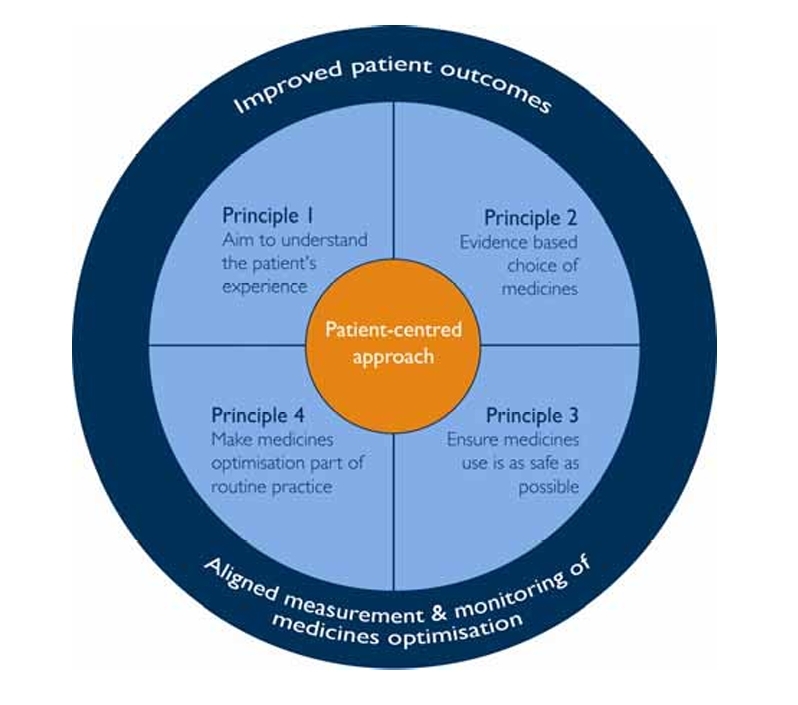
This important document represents a collaboration between patients and the health professionals that care for them. It sets out four simple but important principles of ‘medicines optimisation’ that could revolutionise medicines use and outcomes: aim to understand the patient’s experience, evidence-based choice of medicines, ensure medicines use is as safe as possible, make medicines optimisation part of routine practice. We would encourage everyone to adopt these principles whether prescribing, dispensing, administering or taking medicines.
Given that medicines remain the most common therapeutic intervention in healthcare, and colleagues in research and the broad pharmaceutical industry have worked hard to discover and develop safe and effective medicines, we must all work even harder together to ensure that individual patients and society gets as much value out of that effort as possible, and resources are used wisely and effectively.
By Sir Bruce Keogh – national medical director (NHS England), Jane Cummings – chief nursing officer (NHS England), and Keith Ridge – chief pharmaceutical officer for England.
Introduction
Medicines play a crucial role in maintaining health, preventing illness, managing chronic conditions and curing disease. In an era of significant economic, demographic and technological challenge it is crucial that patients get the best-quality outcomes from medicines. However, there is a growing body of evidence that shows us that there is an urgent need to get the fundamentals of medicines use right*. Medicines use today is too often suboptimal (see Box 1) and we need a step change in the way that all healthcare professionals support patients to get the best possible outcomes from their medicines.
Medicines optimisation represents that step change. It is a patient-focused approach to getting the best from investment in and use of medicines that requires a holistic approach, an enhanced level of patient-centred professionalism, and partnership between clinical professionals and a patient.
Medicines optimisation is about ensuring that the right patients get the right choice of medicine, at the right time. By focusing on patients and their experiences, the goal is to help patients to: improve their outcomes; take their medicines correctly; avoid taking unnecessary medicines; reduce wastage of medicines; and improve medicines safety. Ultimately medicines optimisation can help encourage patients to take ownership of their treatment.
However, the medicines optimisation approach will require multidisciplinary team(s) working to an extent that has not been seen previously. Healthcare professionals will need to work together to individualise care, monitor outcomes more carefully, review medicines more frequently and support patients when needed.
The pharmaceutical industry also has a key role to play in medicines optimisation through transparent and value for money partnerships with the NHS that help secure better outcomes for patients.
Medicines optimisation differs from medicines management in a number of ways, but most importantly it focuses on outcomes and patients rather than processes and systems. This focus on improved outcomes for patients is likely to help ensure that patients and the NHS get better value from the investment in medicines.
Medicines optimisation looks at how patients use medicines over time. It may involve stopping some medicines as well as starting others, and considers opportunities for lifestyle changes and non-medical therapies to reduce the need for medicines. By improving safety, adherence to treatment and reducing waste, the medicines optimisation approach will help to ensure that by working together we support patients to get the best outcomes from their medicines.
*A summary of evidence that shows the extent of the problem with medicines use and examples of medicines optimisation interventions can be found on the Royal Pharmaceutical Society (RPS) website.
Purpose of this guidance
This good practice guidance provides four guiding principles for medicines optimisation that will help all healthcare professionals to support patients to get the best outcomes from their medicines use.
The principles describe how healthcare professionals can enable patients to improve their quality of life and outcomes from medicines use by having a sustained focus on the need to optimise patients’ medicines.
The guidance has been developed with input from healthcare professionals, patients, patient groups, lay representatives and the pharmaceutical industry.
“There is increasing recognition that finding out whether and how patients take their medication is part of our jobs as healthcare professionals.”
– Suzanna Jacks – GP – Chepstow
Are we really making the most of medicines? (Box 1)
Do patients take their medicines?
- Only 16% of patients who are prescribed a new medicine take it as prescribed, experience no problems and receive as much information as they need1;
- Ten days after starting a medicine, almost a third of patients are already non-adherent – of these, 55% don’t realise they are not taking their medicines correctly, whilst 45% are intentionally non-adherent1.
How well do we use medicines?
- A study conducted in care homes found that over two thirds of residents were exposed to one or more medication errors2;
- Over half a million medication incidents were reported to the National Protective Security Authority between 2005 and 2010. 16% of them involved actual patient harm3;
- In hospitals the General Medical Council’s EQUIP study demonstrates a prescribing error rate of almost 9%4;
- In general practice an estimated 1.7-million serious prescribing errors occurred in
20105.
Is the NHS getting the best value from medicines?
- In primary care around £300m per year of medicines are wasted (this is likely to be a conservative estimate) of which £150m is avoidable6;
- At least 6% of emergency readmissions are caused by avoidable adverse reactions to medicines7.
Are patients getting the right medicines?
- Analysis of the NHS Atlas of Variation highlights unwarranted variations in the prescribing of some medicines across England.
Four guiding principles for medicines optimisation
To empower patients and the public to make the most of medicines, healthcare professionals need to understand the concept of medicines optimisation. The four guiding principles outlined here describe medicines optimisation in practice (see Figure 1) and the outcomes it is intended to impact.
Pharmacists can provide leadership and support for medicines optimisation but the principles need to be used by everyone involved in the patient’s care. As well as informing the practice of frontline healthcare professionals, the principles can be used by those developing pathways and services.
They will help ensure that services provide opportunities for discussions about a patient’s medicines with the patient or carer, between healthcare professionals and when patients move between care settings; recognising that support for medicines use may be needed at different points in the patient pathway.
The four principles are consistent with existing national guidance and good practice guidance that supports medicines optimisation8,9, 10, 11, 12, 13, 14, 15.
Figure 1. Summary of the four principles of medicines optimisation.
Principle 1: Aim to understand the patient’s experience
To ensure the best possible outcomes from medicines, there is an ongoing, open dialogue with the patient and/or their carer about the patient’s choice and experience of using medicines to manage their condition; recognising that the patient’s experience may change over time even if the medicines do not.
Up to half of all patients do not take their medicines as recommended7.
“A patient recently home from hospital kept missing his dose of antipsychotic medicine because it was labelled ‘Take one tablet in the morning’. He frequently woke after midday. Because he had been advised to take the tablet in the morning he missed it for three days running. I suggested he change the time to one that suited him like 1pm, the timing wasn’t really important (as long as it didn’t make him drowsy) just that he took it once a day. Changing the timing of the dose to fit in with his lifestyle helped him to adhere to his medication and improved his chances of a positive outcome from treatment.”
– Specialist psychiatric pharmacist
Outcomes this principle is intended to influence:
- Patients are more engaged, understand more about their medicines and are able to make choices, including choices about prevention and healthy living;
- Patients’ beliefs and preferences about medicines are understood to enable a shared decision about treatment;
- Patients are able to take/use their medicines as agreed;
- Patients feel confident enough to share openly their experiences of taking or not taking medicines, their views about what medicines mean to them, and how medicines impact on their daily life.
Principle 2: Evidence-based choice of medicines
Ensure that the most appropriate choice of clinically and cost-effective medicines (informed by the best available evidence base) are made that can best meet the needs of the patient.
If the National Institute for Health and Care Excellence (NICE) has given a medicine a positive appraisal through its technology appraisal process it must automatically be included on your local formulary15.
“A multidisciplinary team (GP, social services, community matron and practice nurse) regularly reviews patients at high risk of hospital admission. They recently referred to me a patient taking 35 medicines. My recommendations included reduction of antipsychotic medication due to its effects on cardiac risk and diabetes control; stopping medicines that were no longer needed, caused possible aggravating side effects or were contraindicated. I also recommended the patient’s inhaler technique and insulin device use were checked, and suggested adding a steroid to regular use of short-acting beta agonists. The review resulted in the patient having to take fewer medicines, a better quality of care and a reduction in the likelihood of him being admitted to hospital.”
– Clinical Commissioning Group support pharmacist
Outcomes this principle is intended to influence:
- Optimal patient outcomes are obtained from choosing a medicine using best evidence (for example, following NICE guidance, local formularies etc.) and these outcomes are measured;
- Treatments of limited clinical value are not used and medicines that are no longer required are stopped;
- Decisions about access to medicines are transparent and in accordance with the NHS Constitution.
Principle 3: Ensure medicines use is as safe as possible
The safe use of medicines is the responsibility of all professionals, healthcare organisations and patients, and should be discussed with patients and/or their carers. Safety covers all aspects of medicines usage, including unwanted effects, interactions, safe processes and systems, and effective communication between professionals.
When admitted to hospital most patients have a medicine omitted or a wrong dose recorded. Patients taking several medicines for long-term conditions are most likely to have errors16.
“A patient was admitted to hospital with low blood pressure. When I reviewed (reconciled) the medication the patient brought in with them, there were two boxes of the same blood pressure medicine in different packaging. After a recent hospital admission the patient had been discharged with a box of the medicine but because it looked different to the box they received from their community pharmacy the patient thought they were different and had been taking them both at home. This was an unnecessary readmission that could have been avoided if healthcare professionals had communicated more effectively with the patient and each other.”
– Lead pharmacist – NHS Foundation Trust
Outcomes this principle is intended to influence:
- Incidents of avoidable harm from medicines are reduced;
- Patients have more confidence in taking their medicines;
- Patients feel able to ask healthcare professionals when they have a query or a difficulty with their medicines;
- Patients remain well and there is a reduction in admissions and readmissions to hospitals related to medicines usage;
- Patients discuss potential side effects and there is an increase in reporting to the Medicines and Healthcare products Regulatory Agency;
- Patients take unused medicines to community pharmacies for safe disposal.
Principle 4: Make medicines optimisation part of routine practice
Health professionals routinely discuss with each other and with patients and/or their carers how to get the best outcomes from medicines throughout the patient’s care.
When patients don’t take their prescribed/dispensed medicines in line with recommended advice, it costs the NHS an estimated £500m a year in lost patient benefits1.
“One of my elderly patients had been taking mood stabilisers for several years. Her care worker contacted me to let me know that the patient’s mood was becoming erratic. When we spoke I found that the patient was drinking directly from her liquid medicine bottle rather using a syringe. This accounted for her erratic behaviour. We discussed the patient’s medicines and modified them to find an alternative to the oral liquid. The care worker is now liaising with the patient’s community pharmacist and both are monitoring her more closely. This close liaison between the care worker and the healthcare team has helped to ensure that the patient’s medicines remain optimised.“
– GP
Outcomes this principle is intended to influence:
- Patients feel able to discuss and review their medicines with anyone involved in their care;
- Patients receive consistent messages about medicines because the healthcare team liaise effectively;
- It becomes routine practice to signpost patients to further help with their medicines and to local patient support groups;
- Interprofessional and inter-agency communication about patients’ medicines is improved;
- Medicines wastage is reduced;
- The NHS achieves greater value for money invested in medicines;
- The impact of medicines optimisation is routinely measured.
Using the principles to reflect on your practice
Use the four principles for medicines optimisation to reflect on your practice. Think about one day of your practice and answer the following questions:
- Did you discuss with any patients their experiences of medicines use? For example, their views about what medicines mean to them, how medicines impact on their daily life, or whether or not they are able to take their medicines?
- Did you discuss with any patients or colleagues how to make medicines use as safe as possible?
- Did you ensure medicines used are clinically and cost-effective? For example did you review any ‘high-risk’ patients’ medicines (see Principle 3 for an example)?
- Did you liaise with any other professionals about optimising a patient’s medicines? For example, did you signpost any patients to sources of additional support for medicines use?
- On reflection were there opportunities to apply the principles to your practice that you missed?
- How will you try and ensure that you incorporate the principles into your daily practice?
- Have you recorded any data to contribute to the evidence base around medicines optimisation?
References
References
- Patients’ problems with new medication for chronic conditions – British Medical Journal (BMJ) Quality & Safety – PubMed
- Care homes’ use of medicines study: prevalence, causes and potential harm of medication errors in care homes for older people – BMJ Quality & Safety – PubMed
- A review of medication incidents reported to the National Reporting and Learning System in England and Wales over six years (2005-2010) – British Journal of Clinical Pharmacology – PubMed
- An in-depth investigation into causes of prescribing errors by foundation trainees in relation to their medical education (EQUIP Study) – University of Manchester
- Investigating the prevalence and causes of prescribing errors in general practice – General Medical Council
- Evaluation of the Scale, Causes and Costs of Waste Medicines – York Health Economics Consortium/UCL School of Pharmacy
- Adverse drug reactions as cause of admission to hospital: prospective analysis of 18,820 patients – BMJ – PubMed
- Medicines adherence: involving patients in decisions about prescribed medicines and supporting adherence – NICE
- Technical patient safety solutions for medicines reconciliation on admission of adults to hospital – NICE
- NHS Outcomes Framework 2013 to 2014 – GOV.UK
- A single competency framework for all prescribers – NICE
- Keeping patients safe when they transfer between care providers – getting the medicines right – RPS
- Improving the use of medicines for better outcomes and reduced waste – GOV.UK
- Accelerating adoption of innovation in the NHS – GOV.UK
- Developing and updating local formularies – NICE
- Dodds LJ. Unintended discrepancies between pre-admission and admission prescriptions identified by pharmacy-led medicines reconciliation: results of a collaborative service evaluation across East and SE England. IJPP 18 (Supp 2) September 201 pp9-10 (study link no longer available)
About us
The Royal Pharmaceutical Society (RPS) is the professional body for pharmacists and pharmacy in Great Britain. We represent all sectors and specialisms of pharmacy in Great Britain and we lead and support the development of the pharmacy profession to deliver excellence of care and
service to patients and the public. This includes the advancement of science, practice, education and knowledge in pharmacy and the provision of professional standards and guidance to promote and deliver excellence. In addition we promote the profession’s policies and views to a
range of external stakeholders in a number of different forums.
About the authors
Catherine Picton BSc MBA MRPharmS is a pharmacist with a wide range of experience in healthcare delivery and management.
Heidi Wright BPharm MRPharmS is a pharmacist with a range of practical experience in different sectors of pharmacy and knowledge of the wider healthcare systems.

Share your suggestions
Submit an idea for learning content, events, guidance or resources.