Introduction to research
Published: 8 September 2022
Updated: 25 October 2022
This was published when the organisation was the Royal Pharmaceutical Society.
It is widely recognised that research-active organisations deliver better outcomes for patients and, therefore, all health professionals have a key role in leading or supporting the delivery of research. Pharmacy professionals are ideally placed to deliver high-quality research in the healthcare environment.
What do we mean by research?
Research is the process of retrieving new knowledge which can be generalised or transferred. We do research by addressing clearly defined questions using systematic and rigorous methods.
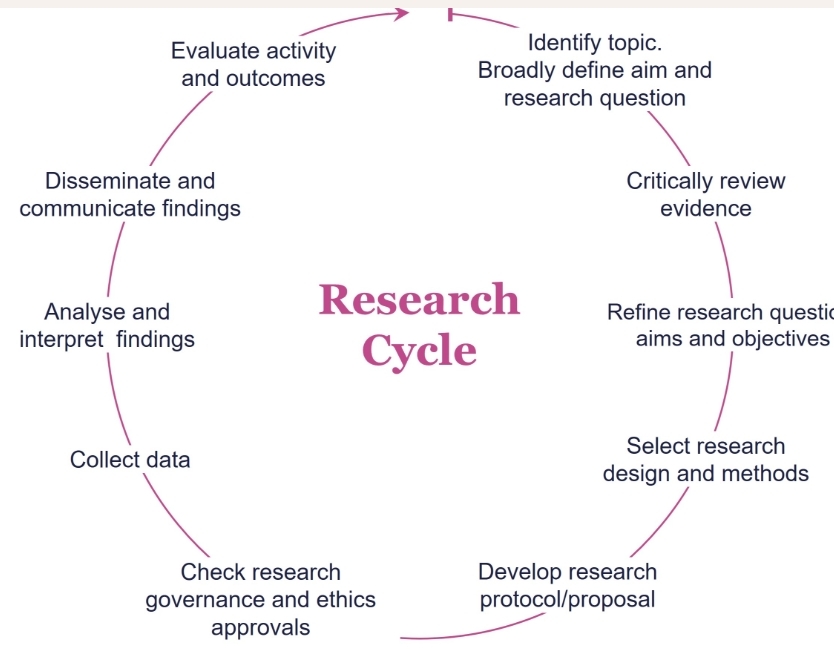
To get you more familiar with some of the more common research terms and concepts, let’s take a look at the main stages of the research process (ordered):
- Start by formulating clear research questions using existing evidence and published literature.
- Develop clear aims, objectives, and your research approach.
- Collect and analyse data in a systematic and consistent way.
- Generate new information and draw conclusions that can then be generalised, transferred, or used to develop new research questions.
Writing down your research plan is an important part of the research process. Your research protocol is the detailed plan of your study and every study should have a protocol. Your protocol is effectively a route map to remind you of what you are doing and why.
Types of research
There are many different types of research. How research is categorised will depend on the scope and setting of practice, the specific aims and objectives of the research, or the methods used.
The following are the types of research most relevant to pharmacy:
- Health and social care research: seeks to generate new knowledge, or answer key questions, that could lead to changes, or improvements, in health and social care systems, for example, by better understanding diseases, treatments and policies or care, and how these can be improved. Another commonly used term for this sort of research is health services research. When conducted in a pharmacy setting, this type of research is sometimes referred to as pharmacy practice research, or more broadly, pharmacy research.
- Preclinical research: drug discovery and formulation development, including in vitro and in vivo safety and efficacy testing.
- Clinical research: clinical trials to test, for example, the safety and efficacy of medicines – these studies can also focus on collecting ‘real-world’ evidence (e.g. COVID-19 treatment and prevention studies).
Research can also be categorised as:
- Basic or fundamental research focuses on understanding or predicting phenomena with the aim of improving scientific theories. The question was not developed with the intention of applying the findings for a practical purpose.
- Applied research has the potential to solve practical problems, for example, to improve health, care, or wellbeing. The research has a clear practical application.
- Translational research enables the transfer of knowledge from basic research to human benefit, ‘bench to bedside’, and could involve both basic and applied research.
Like clinical practice, research crosses many disciplines and is continuously evolving. Pharmacy professionals can bring a unique perspective due to their knowledge and expertise in medicines. There is a great demand for innovation in pharmacy practice and pharmacy services and, therefore, an increasing need for pharmacy professionals to conduct and lead research in this area.
Is my project research?
Knowing the difference between research, audit, and service evaluation, or quality improvement, can often be confusing for people. However, understanding the main differences is a key requirement to being able to plan and design a study.
Regardless of the approach, or tool employed, your project should always follow a systematic method, use a specific protocol to generate data, comply with ethical standards and yield high-quality data that is valid and reliable.
Who should do research and why?
All healthcare professionals should be engaged in research
Many people think that research is only undertaken by academics or research specialists as this is a large part of their day-to-day role. This is a misconception.
Healthcare is better if we are all actively engaged in research, and that also includes all pharmacy professionals, regardless of their sector or career stage.
In order to continue to advance healthcare and to respond to the complex needs of patients, continued research on healthcare quality, cost, and outcomes is essential. For example, research is required to understand the unique characteristics of pharmacy-based services: what is effective? What is not and why? Under what conditions and for which patients? Every medicine that is prescribed, every treatment administered, every assessment, or medical test ever performed had to be discovered, developed, and thoroughly evaluated before being put into practice. Conducting high-quality research enables the generation of good evidence, which allows us to practise the best healthcare.
Research can also involve re-evaluating existing treatments, or even testing a treatment that is currently used for one condition in a different one, or in a different population. For example, a treatment that is effective in adults may not be safe, and/or effective in children. Research can also be about gaining an understanding of people’s knowledge, views, attitudes, and expectations of treatments and services.
Using, participating and leading research in pharmacy
Although the majority of pharmacy professionals will have some experience of using research to inform practice, not many are actively engaged in research as part of their day-to-day roles.
This has to change. Why?
- Studies have shown that research-active organisations achieve better patient outcomes, and that includes the pharmacy sector.
- Pharmacy professionals have a breadth of knowledge and expertise across a range of academic disciplines and that can add value by bringing a range of perspectives to a research project.
- As research becomes a core activity across all healthcare settings, practitioners have more opportunities to engage in the full spectrum of research, from preclinical research (e.g. drug discovery and development) to more patient-facing activities, such as clinical trials and medicines optimisation.
- Research can provide a huge boost to your career, and is a core competency for pharmacists (see RCPharm frameworks).
- For some more senior roles (e.g. consultant pharmacist) practitioners must demonstrate specific research outcomes, such as actively contributing to, or publishing, a study.
How can I get more involved in research?
All pharmacy professionals should engage in research
Here are a few ways to get involved:
- Reading and reviewing research and using evidence to inform best practice.
- Getting involved in established research projects in your workplace, for example, communicating, or promoting a local research project, providing support to recruit participants, or getting involved in collecting data.
- Undertaking postgraduate education and training that involves research and/or attending relevant conferences and events with a research component.
- Getting advice from experienced colleagues, working with your local university or your professional body, to start your own project.
Planning research
Research on the quality, outcomes and cost of pharmaceutical care is essential in order for pharmacy practice to continue to evolve in response to changes to healthcare needs, policy and economic constraints. Research is required in order to understand the unique characteristics of pharmacy-based services: what is effective, what is not, under what circumstances and for which patient groups.
Research is the process of retrieving generalisable new knowledge by addressing clearly defined questions using systematic and rigorous methods.
Both qualitative and quantitative research use scientifically robust methods to collect and analyse data in order to further understand different phenomena and/or the relationships between them. In contrast, both audit and service evaluation aim to measure standards of care, typically in a localised setting. Audit aims to measure current practice against agreed standards; service evaluation looks to see whether a service delivers its objectives.
What are the building blocks of research?
The problem and the research question
The starting point of any research is to decide what topic you want to explore and why. Ask the following:
- Why are you doing the research? Why now?
- Who, or what, do you want your research to influence, or change?
- What outcomes are needed to be able to influence, and how are you going to achieve them?
Getting to these specifics can be a challenging task, so let’s try and break these stages down further:
- Identify the problem.
- Understand the existing evidence.
- Use the evidence to focus your topic further and define your research idea.
- Define clear, focused research questions to address the problem identified.
- Define research aims, objectives and methodology to answer your questions.
Find out how you can transform your ideas into a research project here.
Methodological approach
Once you have developed your research question and given some thought to your aim(s) and objectives, the next stage is to choose a suitable research design and methodology (and methods).
You will probably be aware of some of the more common methods used in pharmacy practice research but may be unclear on what method to use for your own project. You can learn a lot about different methodologies and methods through other people’s research, so you should take a look at the existing literature and evidence on your topic.
Whatever method(s) you choose, your approach should be driven by your research question and not by what is possible to measure. You should also be clear how each component of the study contributes to the end result.
Find out more about research methods here.
Who can help?
Once you have developed an initial plan, you can start thinking about what resources are needed for your research project. Conducting systematic and robust research can be a daunting task at first, so it is essential to ensure that you have the right people around you. When starting out in research it is important that you identify a supervisor and a mentor to support you through the process. You will also need support from key stakeholders in your area of interest.
Find out more about building a research team here.
Do I need ethics approval?
Research frequently requires review by a research ethics committee who will analyse the risks and benefits of your research, while balancing the interests of the research subject or participant. Audit and service evaluation are expected as part of quality assurance and, as such, may be exempt from formal ethics approval.
Note that, if you intend to publish your work, you will be asked for details of a formal ethical approval, or an independent review, confirming that you were exempt from ethics approval, so make sure that you always do the necessary checks.
Find out more about UK research governance and ethics approvals here.
Sharing and promoting your research findings
Effectively communicating your research is a vital step to showcase best practice and innovation in pharmacy and to ensure that your results impact policy and practice. While peer-reviewed publications are considered the gold standard (since it’s also a way to validate your work), there are many ways to disseminate your research findings.
Find out more about disseminating and communicating research here.
What is the value and wider relevance of research?
Good-quality research is important so that any data produced is robust and can stand up to scrutiny, particularly, if it is to be used to inform practice and policy decisions. Policymakers often draw on research findings and conclusions to inform policy decisions.
Another important point to consider is the value of different types of studies, for example, the challenges of generalising from small trials with self-selected participants compared to larger studies involving whole populations. The former is more likely to provide positive results, as participants will be more interested in, and committed to, the project. The larger studies are more likely to be more reflective of, subsequent, national implementation but may be more conservative in their estimate of patient benefit. These are all factors that must be taken into account by researchers and policymakers.
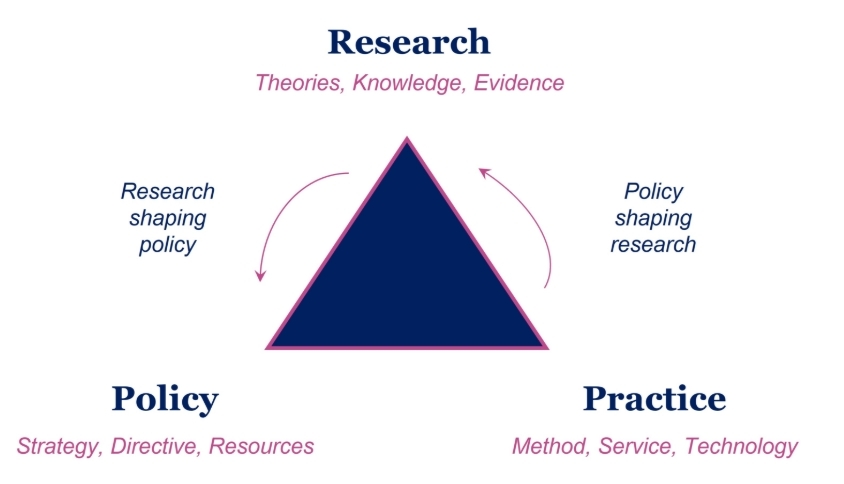
Service change does not just happen because a profession wants it to, or because the public want it, or even because there is a service need. All three things need to happen together and lead to a change. For example, changes in response to COVID-19 were able to happen quickly because all three criteria (service need, public need, professional ambition) all came together.
Sometimes, health and social care systems have sufficient time to identify a problem, and to then commission research to inform a change in policy. Examples of this include a drive for research on multimorbidity reflecting an ageing population, or to tackle important issues such as health inequalities.
Research priorities, therefore, need to be closely aligned to health and social care priorities so that we can quickly and effectively respond to patient needs. This is one of the key roles of research funders.
Research funding aligned to health and care priorities
Formal research funding can be accessed through organisations that invest their money in people and/or projects, aligned to their research strategy and priorities. These are usually driven by evidence and the opinion of the subject-matter experts who are involved in the decision-making process and agree on areas or topics that that should be prioritised for research funding.
However, not all research is funded in the same way. Students often conduct research as part of a course, or qualification. You may also be asked to conduct research as part of your practice role, or just simply out of interest. Conducting audits, service evaluations, or quality improvement projects as part of your role will also help develop your research skills. Small studies can be done using existing data available within the practice context (pending appropriate approvals). Research undertaken without external research funding should, ideally, also focus on important or topical issues.
Whether you are receiving external research funding or not, working on a large- or small-scale project, it’s important that you always follow systematic and robust research processes to ensure that your findings are valid and generalisable, or transferrable.
Find out more about research funding here.
A review of research terminology
Aim – general statement about what you hope to achieve with your research.
Objectives – short statements describing how the aim will be achieved.
Methodology – broad term that encompasses:
- The choice of method(s) used to gather data to answer a research question.
- The rationale for your choices, including strengths and weaknesses and potential challenges.
Method – the specific technique(s) used to generate the data with which to answer the research question, including how you will select the sample, and how you will collect and analyse the data.
Study design – ensures that the research question can be answered in an objective and valid way.
Conclusions – a summary of the new information generated by the study, that can then be generalised, transferred, or used to develop new research questions.
We offer a range of research support services to help you develop your research potential.
If you need help getting started, get in touch with our research team at [email protected].

Share your suggestions
Submit an idea for learning content, events, guidance or resources.