Royal College of Pharmacy issues joint statement on GP walk-in centres
Published: 27 August 2026
The Royal College of Pharmacy in Scotland has today issued a joint statement setting out our concerns about the roll out of GP walk in centres across Scotland, alongside our colleagues at Royal College of General Practitioners in Scotland and Chartered Society of Physiotherapy.
Our organisations represent members who are deeply committed to ensuring that patients can access the right care, from the right professional, at the right time, and that they receive the highest possible standard of care. However, as a collective we do not believe that GP walk-in centres are the solution to current access challenges in primary care.
Alongside general practice, community pharmacies across Scotland already provide a wide range of walk-in services that closely mirror those offered by walk-in GP centres. Significant effort has gone into promoting Pharmacy First and Community Pharmacies to patients over the years, and we are concerned that the pilot will create confusion about where a patient’s first port of call should be. Through Pharmacy First care is available at more than 1,200 locations across Scotland at a cost of approximately £7.5 million. By comparison, the initial 16 walk-in GP centres are estimated to cost £36 million. This represents a significantly more expensive service that duplicates existing provision.
Furthermore, evidence also suggests that walk-in GP centres can exacerbate health inequalities. Such services are often used disproportionately by people who are generally healthier, more affluent, and more able to navigate healthcare options, frequently for conditions that are self-limiting and may not have required medical intervention. Community pharmacies buck the inverse care law because their distribution is heavily concentrated in high-deprivation neighbourhoods where health needs are greatest.
Rather than investing in walk-in GP centres, resources could be directed towards a range of proven measures that would improve access, strengthen existing services, and support higher-quality patient care. From a community pharmacy perspective, the College would like to see investment in a digital and interoperable shared patient record so that all community pharmacists have access to the necessary information that they need to support clinical decision making.
We, alongside our General Practice and Physiotherapy colleagues, are fully committed to improving both the speed and quality of patient access to healthcare services. However, we do not believe that walk-in GP centres are the solution to this complex and multifaceted issue. Instead, we believe the Programme for Government 26/27 should focus on the measures outlined above to deliver more meaningful and lasting improvements for patients, clinicians and the wider health system.
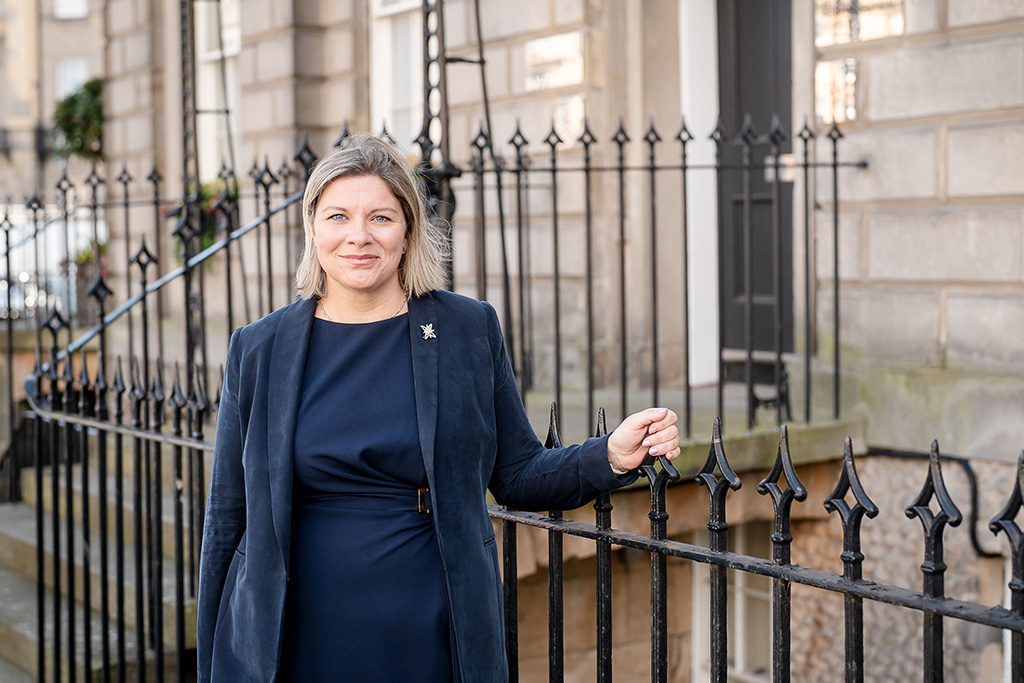
Director for Scotland at the Royal College of Pharmacy Laura Wilson, speaking about the joint statement, said:
“As a group of Royal Colleges and professional bodies, we are fully committed to improving access to and quality of primary care services, so patients can see the right healthcare professional at the right time, and right place.
“Community pharmacies across Scotland are based on local high streets and in other community spaces. These services have high footfall and already provide a wide range of walk-in services for typical conditions such as urinary tract infections, respiratory and chest infections, ear, nose, and throat issues, skin conditions, and eye infections.
“GP walk in centres duplicate this offering and have the potential to divert a significant amount of resources away from where they are needed most. From a health inequalities perspective, Community pharmacies buck the inverse care law because their distribution is heavily concentrated in high-deprivation neighbourhoods where health needs are greatest.
“Instead of investing to duplicate resource, we would prefer to see investment directed into revolutionising the existing primary care offering; including by creating interoperable digital systems which allow for patient information to be shared with community pharmacy teams so that pharmacists have access to all the information required to be able to effectively treat patients in the community.”
Read more news stories.
Related news
Pharmacy bodies launch community pharmacy manifesto
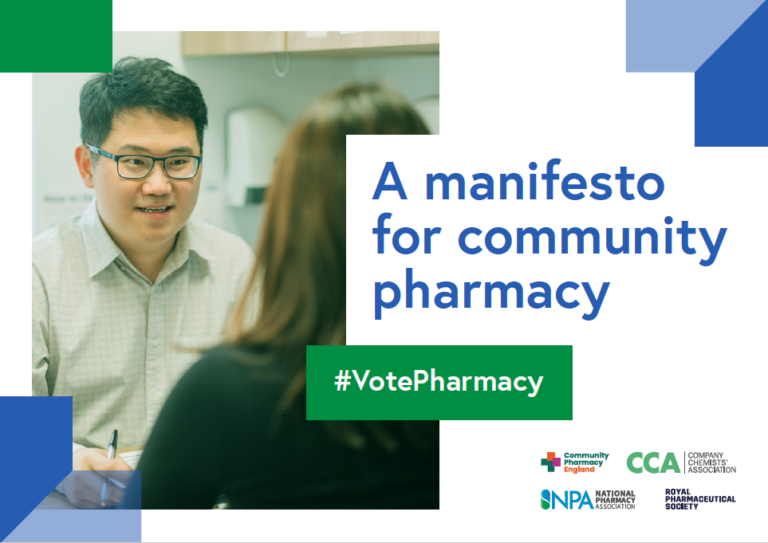
This news story was published when the organisation was the Royal Pharmaceutical Society. Community Pharmacy England, the Company Chemists’ Association, the National Pharmacy Association and the Royal Pharmaceutical Society have today published a joint manifesto for community pharmacy, ahead of the next general election. Pharmacy teams can use the manifesto to engage with political parties and candidates in the run-up to the election. The #VotePharmacy manifesto and other resources can be accessed from a new online general election hub, www.votepharmacy.org. The hub includes advice about engaging with candidates. Election candidates will be asked to show their support and back a six-point plan to “unleash the potential of community pharmacy”: Fill the funding gap, and commit to long-term sustainable funding, so pharmacies can deliver more of the NHS care patients need. Support and enhance the community pharmacy workforce to ensure that pharmacists and their teams can continue to meet the needs of patients now and in the future. Ensure that patients can access the medicines they need, including an end-to-end review of the medicines supply chain. Rollout an enhanced Pharmacy First service for England, mirroring the highly successful approaches taken in Scotland and Wales. Empower community pharmacists to do more, with an ambitious roadmap for independent prescribing. Make pharmacies centres for public health, prevention and reducing health inequalities. Tase Oputu, Chair of the Royal Pharmaceutical Society in England, said: “Community pharmacy plays a central role in the care of millions of patients each year, boosting vaccine uptake, tackling health inequalities and ensuring vital access to medicines. “But the system is also under pressure, and sustainable funding and support for the workforce will be crucial. “As more pharmacists become prescribers, it is vital the next government makes the most of this opportunity to transform patient care and ensure a positive future for community pharmacy at the heart of the nation’s health service.” All of these issues are highlighted in the RPS general election manifesto. Read more RCPharm news stories.
Professor Mahendra G Patel OBE awarded Honorary Fellowship by the Royal College of GPs
This news story was published when the organisation was the Royal Pharmaceutical Society. The Royal College of General Practitioners (RCGP) has awarded an Honorary Fellowship to Professor Mahendra G Patel OBE, recognising his exceptional contributions to healthcare, research equity and cross-professional leadership. Mahendra is an RPS Fellow, former member of the RPS English Pharmacy Board and previously held the post of RPS Treasurer. This accolade is the RCGP’s highest award for non-GPs. Starting in community pharmacy, Mahendra transitioned to academia, where he pioneered the National Institute for Health and Care Excellence (NICE) Student Champions Programme, embedding evidence-based practice and tackling health inequalities across the curricula of 40 medical, pharmacy, nursing and dental schools. He earned one of the first NICE Fellowships for his early leadership. As a Board member for RPS England, Mahendra led the development of national diabetes initiatives and a diabetes toolkit, while forging partnerships across professional boundaries and internationally. During the pandemic he played a crucial role in increasing diversity for the major 'PANORAMIC' and 'PRINCIPLE' COVID-19 trials, efforts which were recognised by the World Health Organization and the United Nations. He is the founding director of the Centre for Research Equity, Nuffield Department of Primary Care Health Sciences at the University of Oxford, shaping national research policy, collaborating with the RCGP and forming strategic partnerships across the UK. As co-lead of the NIHR-supported Race Equity Incubator, he is driving efforts to strengthen research capacity and capability while fostering equitable career progression for Black and minority ethnic healthcare professionals. A member of the UK Pharmacy Professional Leadership Advisory Board, Mahendra is a strong supporter of RPS becoming the Royal College of Pharmacy. He is also a BMJ NHS Commissioner and Professional Advisor to England’s Chief Pharmaceutical Officer. HSJ named him as one of the 50 most influential BAME figures in UK healthcare today. Professor Mahendra G Patel OBE said: “This stands as one of the proudest moments of my career, and for the pharmacy profession I represent, as RPS progresses to become the Royal College of Pharmacy. I hope this recognition becomes a catalyst: for closer collaboration, for shared leadership, and for inspiring members of both our professions to think beyond traditional boundaries – at every stage of their careers. “At a time of extraordinary pressures on general practice and pharmacy, joined-up thinking and integrated leadership across our professions has never been more urgent. I’ve always sought to break silos, widen access, and drive equity, with a clear focus on improving health outcomes by tackling the deep-rooted inequalities that persist across our communities. This Fellowship, for me, is not the culmination of that long journey, but the beginning of a renewed and fresh commitment.” RPS President Professor Claire Anderson said: “I’d like to offer my warmest congratulations to Mahendra on this prestigious Fellowship, which marks his huge contribution to the profession and healthcare. His work continues to inspire a new generation of pharmacists and researchers committed to equity, innovation, and collaborative leadership. Long may it continue.”