UKPPLAB
A New Future for Pharmacy Professional Leadership in the UK
Published: 12 February 2026
UKPPLAB Board members
| Sir Hugh Taylor (Chair) | Independent Chair | UK Pharmacy Professional Leadership Advisory Board |
| Martina Aikon Ex-Officio Member – Sir Hugh Taylor (Chair) | President | British Pharmaceutical Students’ Association |
| Professor Claire Anderson Ex-Officio Member – Professional Leadership Body | President | Royal Pharmaceutical Society |
| Raymond Anderson Independent Expert Member | Director Associate Consultant | Northern Pharmacies Ltd Health and Social Care Leadership Centre, Belfast |
| Laura Angus Independent Expert Member | Chief Pharmacy Officer/ Director of Pharmacy and Medicines Optimisation | NHS Humber and North Yorkshire Integrated Care Board |
| Rebecca Chamberlain Independent Expert Member | Accreditation and Recognition Panel Team Leader (Chair) | General Pharmaceutical Council |
| Dr Jeanette Dickson Ex-Officio Member – Professional Leadership Body | Chair of Council | Academy of Medical Royal Colleges |
| Professor Christine Gilmour Independent Expert Member | Fellow | Royal Pharmaceutical Society |
| Nicola Greenhalgh Ex-Officio Member – Specialist Professional Group | President | College of Mental Health Pharmacy |
| Mildred Johnson Independent Expert Member | Chief Pharmacist/ Clinical Director of Pharmacy and Medicines Optimisation | Maidstone & Tunbridge Wells NHS Trust |
| Amy Laflin Ex-Officio Member – Professional Leadership Body | President | Association of Pharmacy Technicians UK |
| Sheelin McKeagney Ex-Officio Member – Professional Leadership Body | President | Pharmacy Forum Northern Ireland |
| Dr Berwyn Owen Independent Expert Member | Director | Fferyllfa Penygroes Pharmacy, Caerna |
| Professor Mahendra Patel OBE Independent Expert Member | Director | Centre for Research Equity, University of Oxford |
| Joan Saddler OBE Ex-Officio Member – Chair of the Patient and Public Reference Group | Co-Chair | NHS Equality and Diversity Council |
| Shilpa Shah Independent Expert Member | Chief Executive | Community Pharmacy North East London |
| Panayiotis Sphikas Independent Expert Member | Head of Pharmacy Operations | University College London Hospitals NHS Foundation Trust |
| Dr Graham Stretch Ex-Officio Member – Specialist Professional Group | President | Primary Care Pharmacy Association |
| John Warburton Ex-Officio Member – Specialist Professional Grou | Chair | UK Clinical Pharmacy Association |
| Ellen Williams Independent Expert Member | Director of Regional Pharmacy Training | Pharmacy Workforce Development South, University Hospitals Bristol and Weston NHS Foundation Trust |
| Joseph Williams Ex-Officio Member – Specialist Professional Group | Immediate Past Chair | British Oncology Pharmacy Association |
A New Future for Pharmacy Professional Leadership in the UK
A statement from the UK Pharmacy Professional Leadership Advisory Board
As a Board we unanimously agree that the proposed Royal College of Pharmacy provides a unique opportunity to transform the landscape of pharmacy professional leadership in the UK. We set out our rationale in December 2025.
The Royal College has the potential to become the sustainable, inclusive and effective future model of pharmacy professional leadership we were tasked to create, meeting the aspirations of professionals working in pharmacy, and pharmacist and pharmacy technician trainees and students, for the benefit of patients and the public.
To turn that potential into reality, the Royal College will have to be ambitious and inclusive in its approach from the outset.
That will require early action and we set out below our recommendations for securing progress on:
- Shaping the strategy of the future Royal College of Pharmacy: to support the development of a bold, eye-catching and attractive offer to pharmacists and pharmacy technicians for the benefit of patients and the public.
- Shaping the form of the future Royal College of Pharmacy: to create the opportunity for it to become an inclusive professional leadership home for all pharmacists, pharmacy technicians, pharmaceutical scientists, pharmacy trainees and students, and others.
Transformation will not happen overnight. It will require continued close collaboration between the future Royal College and all the current professional leadership bodies (PLBs) and specialist professional groups (SPGs), based on a collective commitment: to inclusivity, mutual respect and transparency; to effective engagement with professionals on the front line and colleagues across pharmacy; and to putting patients and the public at the heart of the work.
We believe the collective will is there to make that happen.
Recommendations
We recommend
- That the future Royal College should explicitly endorse the principles of the Vision and Common Purpose for Pharmacy Professional Leadership to which all the organisations on the Board have signed up – and adopt them as foundational for its future strategy and all its activities.
- Collaboration and co-creation should continue to be watchwords as further work is done on the strategy for the future Royal College. Service to patients and the public should be embedded in its processes and engagement, according to the Vision and Common Purpose for Patients and the Public. It should be owned by all those engaged in professional leadership across the pharmacy spectrum in the UK – both when it is agreed and as it evolves.
- The Royal College should take the opportunity of its first few months of operation to mount an engagement exercise on outline proposals for its strategy, alongside the inclusion process we describe below – very much in listening mode and with the aim of identifying tangible early actions which would enable it to demonstrate progress.
- We commend to the future Royal College the following five ambitions in shaping its strategy, which it could prioritise as early tangible actions in its first three years of operation, and the three-stage inclusion process.
Shaping an ambitious strategy
The Royal Pharmaceutical Society has already engaged on the strategy for the future Royal College. The Association of Pharmacy Technicians UK has published its strategy, and other organisations on the Board have been engaging with their members. As a Board we have taken insights from our own engagement exercises through webinars, at conferences and with our Pharmacy Stakeholder Forum and Patient and Public Reference Group.
These lead us to recommend a way forward for the strategy process and to propose strategic ambitions for the future Royal College to prioritise in terms of engagement and early action.
Five strategic ambitions
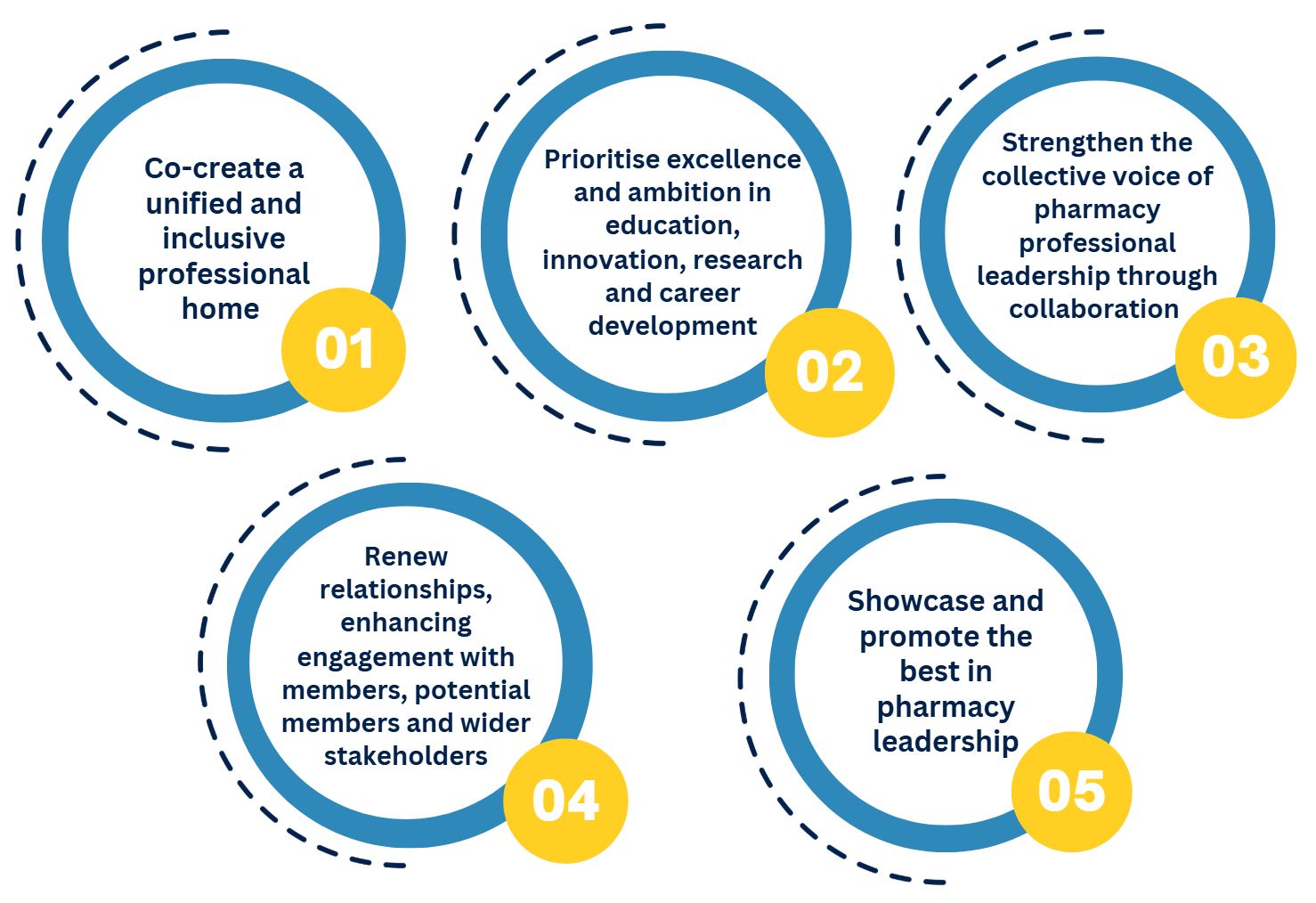
1. Co-create a unified and inclusive professional home for pharmacists, pharmacy technicians, pharmaceutical scientists and pharmacy trainees and students together for the benefit of patients and local communities
We set out detailed proposals below for a three-stage inclusion process which the Royal College should lead in close collaboration with other organisations and which would create the opportunity for this to happen.
2. Prioritise excellence and ambition in education, innovation and research, supporting pharmacy professionals to learn, develop and access new career opportunities
People told us they would like the Royal College to:
- Prioritise the development of post-registration and career pathways for pharmacists and pharmacy technicians, including a standardised approach to credentialing across all sectors of practice, embedded with employers.
- Lead ambitious developments in future pharmacy practice and more agile ways of working so pharmacy is shaping the future to come, while supporting pharmacy professionals to practice with confidence and to flourish and progress in professional careers that provide opportunity for all.
- Work in partnership to support innovation and promote clinical, scientific and digital excellence, e.g. an Innovation Academy and Conference.
3. Strengthen the collective voice of pharmacy professional leadership through collaboration: achieving greater recognition for pharmacy, while respecting and reflecting the plurality of different voices in the pharmacy professions, and ensuring both professions are distinctly and equitably represented.
People told us they would like the Royal College to:
- Lead a step change in the profile and contribution of pharmacy professional leadership within pharmacy and the wider health system, making a demonstrable impact on national policy, workforce strategy and regulation across the UK.
- Celebrate and promote the distinct yet complementary roles played by pharmacists and pharmacy technicians, generalists and specialists and the wider pharmacy team, across all sectors of practice and professional careers, patient-facing and otherwise, building a greater sense of community and support alongside clear models of scope of practice.
- Use its collective strength to advocate for pharmacy, establishing itself as an authoritative voice on medicines for healthcare, grounded in a research base and supporting a ‘one stop’ facility for quick access to authoritative generalist and specialist advice on pharmacy for patients and the public, central government, other health bodies and the media.
4. Renew relationships, enhancing engagement with members, potential members, the wider pharmacy and healthcare systems and with patients and the public.
People told us they would like the Royal College to:
- Build strong and trusting relationships with patients, communities, the whole pharmacy team, other healthcare professions, and other countries, enabling co-production, and sharing learning and resources.
- Establish a new and vital approach to communications and engagement with members and fellow pharmacy professionals, including a renewed focus on community pharmacy engagement, revitalising interest in professional leadership and its benefits and building a greater sense of community and support.
- Improve public and stakeholder perceptions through a programme of brand and organisational development.
5. Showcase and promote the best in pharmacy leadership, representing pharmacy well on national and international stages, and increasing pride in professional leadership.
People told us they would like the Royal College to:
- Involve the best people in pharmacy leadership with high-level experience, excellent leadership and communication skills, a patient-centred focus and a commitment to collaborative working.
- Continue to strengthen the UK pharmacy’s presence on national and international stages through global collaboration to position the UK as a world leader in practice and science.
- Make the case for visible and effective pharmacy professional leadership in all systems and organisations delivering patient care and population health at national and regional level and support members to take on leadership roles, to help pharmacy teams across the UK work as part of multiprofessional teams to give the best care and support to people and communities.
Shaping an inclusive professional leadership home
We are all committed to establishing a Royal College of Pharmacy that is inclusive in its approach to membership, representation and governance. We have all, including all PLBs and SPGs on the Board, also signed up to a three-stage inclusion process which we believe will deliver a Royal College of which pharmacists, pharmacy technicians, pharmaceutical scientists and pharmacy students will be proud.
We have provided an outline of the three-stage inclusion process here and as a next step, a collective agreement – a Concordat which provides more detail – will be formally agreed and published to coincide with the launch of the Royal College.
The inclusion process will enable all the organisations involved to consult with, be informed by and fully engage their members. It needs to give all the organisations involved time to do that well and effectively. But momentum is vital – and the process sets an ambitious timetable to ensure momentum is not lost.
Three-stage inclusion process
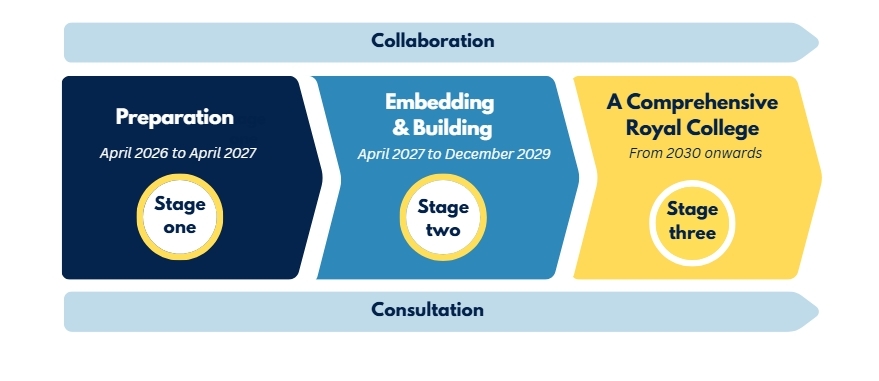
Stage one: Preparation
(April 2026 to April 2027)
Goal: To open up the opportunity for the Royal College of Pharmacy to become, as soon as possible after its launch, a UK body inclusive of pharmacy technicians, Northern Ireland and SPGs – subject to engagement and consultation with memberships and the wider pharmacy community and to the appropriate governance processes of the organisations involved.
This will require extensive liaison and collaboration between the Royal College and the other PLBs and SPGs – and engagement and consultation with members.
Liaison
- Bilateral engagement between the Royal College and APTUK on possible terms for the inclusion of pharmacy technicians as members of the Royal College, including the representational and governance implications of such a change, as reflected in APTUK’s published strategy – and an agreed membership offer, to be put to a vote of the APTUK membership and a vote of the Royal College by means of a special resolution.
- Bilateral engagement between the Royal College and the Pharmacy Forum of Northern Ireland (PFNI) on the potential for extending Royal College membership to pharmacists in Northern Ireland and on forming, if agreed, a National Council for Northern Ireland within the Royal College structure. [The position of pharmacy technicians would need to be treated separately if and when they become a regulated profession in Northern Ireland and in the light of other developments in the inclusion process.]
- The SPGs currently represented on the Board will come together with other SPGs, which are bodies set up for the primary purpose of pharmacy professional leadership to benefit patients, to form a Forum of Specialist Associations. This will act as a liaison point for continued collaboration with the Royal College and other PLBs through the proposed inclusion process.
- Engagement between the Royal College and the Forum of Specialist Associations, including bilateral engagement where necessary, to agree a process and terms and membership offer under which at the outset of Stage 2:
- the Forum could be brought inside the Royal College, within its governance model and as part of its professional leadership function;
- the SPGs represented on the Forum could become part of the Royal College through their membership of the Forum, while continuing to retain their identity and to operate as independently financed and constituted organisations (subject to any governance and constitutional changes required to reflect their role and status within the Royal College);
- their members could become members of the Royal College as well as of their SPG or equivalent on the basis of a new and compelling membership offer to be co-created as part of the engagement and consultation process. Pharmacy technician membership of the Royal College would be a condition of any such agreement.
- All these potential agreements will involve the co-creation of attractive and high-value member offers which enable access to a wide range of expertise and specialist knowledge, professional support, career development and collaborative working to achieve shared goals.
Collaboration
Other key requirements of this Stage, to be covered in the proposed Concordat, will include:
- Continued collaboration between the Royal College and other leadership organisations, modelled on how the Co-Creation Liaison Group and the Board have worked; featuring regular meetings to ensure continued collaboration on current developments in pharmacy professional leadership and to review and discuss progress on the development of the Royal College’s strategy and on collective progress towards Stage 2 of the inclusion process.
- Engagement and consultation with other stakeholders in pharmacy and beyond, including patients and the public, potentially adapting the Stakeholder Forum and the Patient and Public Reference Group that the Board has established. It should also involve discussion of arrangements under which people working in pharmacy outside the two regulated professions could also be associated with and supported by the Royal College.
Stage two: Embedding and Building
(April 2027 to December 2029)
Goal: To build an inclusive, collaborative and integrated Royal College of Pharmacy as a stable, sustainable and thriving model of pharmacy professional leadership.
- Subject to the outcomes of Stage 1 and the associated consultation processes, this stage would be characterised by first embedding the changes and then, as appropriate, building on them through further and deeper integration.
Embedding
- Key features of the Royal College could then include:
- A broader membership, covering all parts of the UK and including registered pharmacy technicians and members of SPGs who have also become members of the Royal College under a membership offer co-created and agreed in Stage 1 of the process.
- A National Council for Northern Ireland within the Royal College governance model.
- Distinct and equitable professional leadership representation for pharmacy technicians in the governance model (for example at Council, Senate and Board or equivalent level).
- A formal role within the Royal College’s governance and professional leadership model for the Forum of Specialist Associations.
Building
- The bodies represented on the Forum of Specialist Associations would also commit to further discussions during Stage 2 on the case and scope for fuller, closer integration within the Royal College.
- This could include evaluation of the scope for evolving a faculty structure – while retaining the routes these organisations have to the frontline, including the networks and other support mechanisms they have fostered and recognising the need to strengthen parallel links to those working in community pharmacy. Again, any proposed changes to the governance and constitution of the bodies involved would be subject to their own governance processes and engagement.
- A further and final decision point should be agreed – to be no later than 31st December 2029 – on a settled model for the integration of SPGs.
Stage three: A comprehensive Royal College
(From 2030 onwards)
Goal: The Royal College would be established as a collaborative, inclusive, integrated and thriving professional leadership organisation, recognised for its excellence in medicines.
Continuity
- The end of Stage 2 would see the foundations of the new and inclusive Royal College established and in a steady state, ready to embark on a further developmental journey to future excellence.
Evolution
- A new strategy would need to be developed for 2030 onwards.
Making it happen
The RPS, APTUK, PFNI, BPSA and SPGs have all confirmed their willingness to support this process of co-creation which could lead to a Royal College of Pharmacy that is more inclusive in its approach to membership, representation and governance; and to commit in principle to follow the three-stage inclusion process, subject throughout to consultation with their members.
Our hope is that all pharmacists, pharmacy technicians and pharmaceutical scientists will share our vision of an inclusive and excellent Royal College of Pharmacy; that they will affirm that support in the consultation processes to come; and that as the opportunity for a wider membership becomes available and the Royal College demonstrates the step change in ambition and impact that is needed, its membership will grow and flourish.
This is a generational opportunity to transform the landscape of professional leadership in pharmacy. Together we can make it happen.