Post-registration foundation pharmacist curriculum
This was originally published when the organisation was the Royal Pharmaceutical Society, some updates will follow soon.
What is the post-registration foundation pharmacist curriculum?
The curriculum is underpinned by the Foundation Pharmacist Framework (2019), which was produced from an evidence-based role analysis of the current and future roles of post-registration foundation pharmacists practising in all sectors across the UK.

The curriculum includes independent prescribing to reflect the core changes in pharmacist practice which are included in the new GPhC initial education and training (IET) standards, and develops leadership, management, education and research capabilities. It bridges the period until the new IET standards have been fully implemented, offering a structured pathway for newly qualified pharmacists.
The content of the curriculum will be revised to keep pace with these changes. It will support pharmacists to develop the skill set to progress to RCPharm advanced practice credentialing pathways.
The curriculum was developed through a collaborative approach with UK and sector-wide representation on the programme task and finish groups. It is accompanied by a topic guide which provides additional information to support achieving some of the outcomes.
Overview of the credentialing process
Post-registration foundation pharmacist credentialing is the first stage in our post-registration professional development pathway for patient-focussed pharmacists across all sectors in the four UK nations. The level of practice described in the curriculum is the end point of early post-registration practice. The post-registration foundation pharmacist credentialing process is open to all pharmacists, both member and non-members of RCPharm.
The curriculum has been developed in line with the curriculum development quality framework, which defines the standards to be met by any RCPharm post-registration pharmacy curriculum.
Post-registration foundation pharmacist curriculum programme of learning
How is the curriculum structured?
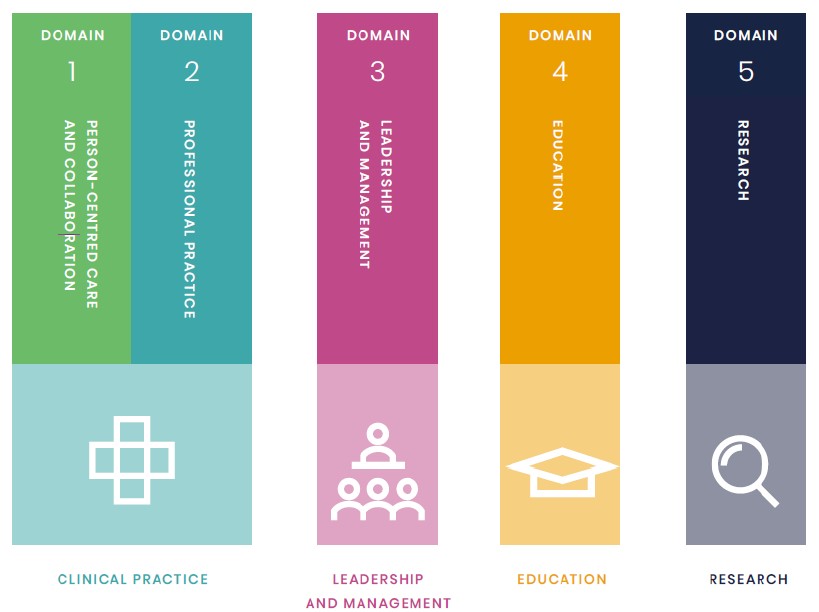
The curriculum outcomes are based on the Foundation Pharmacist Framework and have been structured into five common domains, mirroring the domain structure of the new GPhC IET standards and the RPS advanced and consultant level curricula.
These also align closely to multi-professional frameworks.
The outcomes are accompanied by descriptors which articulate the level and breadth of performance required, making the development pathway in each domain explicit from post-registration foundation to advanced and consultant level practice.
Key definitions
Domains: Collections of commonly themed capabilities and outcomes. There are five domains in the post-registration foundation pharmacist programme of learning.
Capabilities: High-level, complex professional capabilities are flexible and adaptive in a wide range of contexts and synthesise the knowledge, skills, behaviours and experience pharmacists need to manage real-life scenarios. Each of the domains in this programme of learning is made up of between one to four capabilities and there are 13 capabilities in total.
Outcomes: Describe what is to be achieved by pharmacists by the end of the programme; these describe the knowledge, skills, behaviours and experience of those who successfully complete the programme of assessment.
Descriptors: Detail the level and breadth of performance required to satisfactorily meet the curriculum outcomes. They provide greater details for pharmacists undertaking the programme on what is expected of them in practice to reach the required standard.
The curriculum also defines the core clinical assessment skills in which post-registration foundation pharmacists must become competent by the end of their training. The skills included are those used most frequently in clinical practice and support identifying an acutely unwell or deteriorating person.
The topic guide includes a core set of clinical assessment skills in which post-registration foundation pharmacists must be able to perform with limited supervision / assistance by the end of their training. The skills included are those used most frequently in clinical practice and support identifying an acutely unwell or deteriorating person.
How can training against the curriculum be delivered?
The curriculum has been designed to offer significant flexibility in how learning and training is delivered. Examples include, but are not limited to:
Commissioned training programmes
- The statutory education bodies may commission training providers to deliver education and training against the RPS curriculum outcomes. This could be at a national, regional or local level.
Employer led training programmes
- Some employers may choose to develop their own training programme which meets the RPS curriculum outcomes. The employer would need to commission an HEI to deliver the independent prescribing element and may involve training providers in delivering other areas of the curriculum and / or deliver this training in-house.
Training provider training programmes
- Training providers develop and deliver a full training programme that meets the RPS curriculum outcomes. The training provider would market their own training programme.
Individual led approach
- If an individual does not have access to a formal post-registration foundation training programme, they could use the curriculum to create their own development pathway. This would involve undertaking a standalone independent prescribing course and planning how to undertake learning and development to be able to achieve the non-independent prescribing outcomes e.g. through experiential learning and/or formal training.
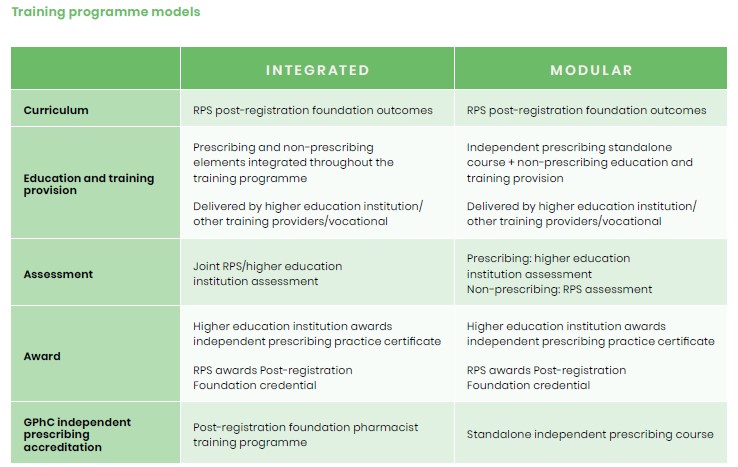
The two overarching models for education and training provision relating to the prescribing and non-prescribing elements outcomes are:
Support requirements
What are the key infrastructure recommendations for training programmes?
Supervision
Learners should be supported by adequate educational and practice supervision including a designated prescribing practitioner for the independent prescribing component.
Learning experiences
Learners will need exposure to a variety of formal and vocational learning experiences to demonstrate the curriculum outcomes. This includes the learning requirements for undertaking formal independent prescribing training and to support developing non-clinical capabilities.
e-Portfolio
Evidence for the outcomes that will be assessed by the RPS must be in an e-Portfolio (RPS e-Portfolio or alternative e-portfolio)
Programme of assessment
How will the curriculum be assessed?
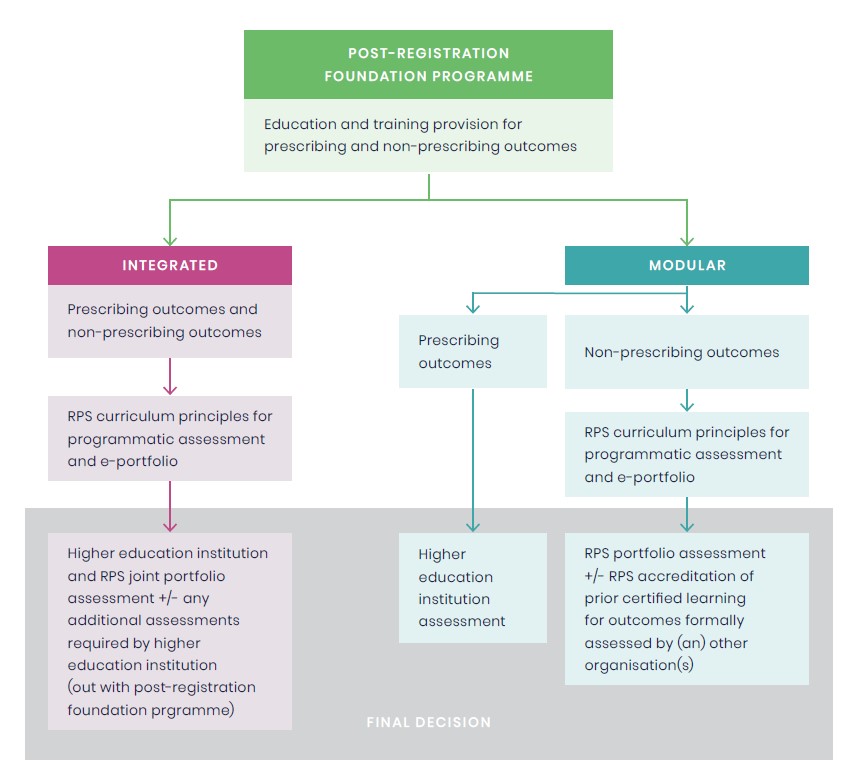
The assessment strategy will vary depending on the training programme model and is summarised in the diagram below.
The following principles and recommendations apply to the areas of the curriculum that will be assessed by the RPS.
- Our recommended assessment strategy is an evidence based programmatic assessment which builds up an authentic picture of the learner’s ability by undertaking multiple low stakes assessments throughout the duration of their training programme.
- Supervised learning events can be used to demonstrate learning and may be undertaken remotely using digital technologies to ensure all learners have sufficient opportunities to undertake assessments.
- The final credentialing decision will be made by a clinical competency committee. Individuals must have demonstrated all of the curriculum outcomes and been awarded (either previously or simultaneously) the Practice Certificate in Independent Prescribing by their HEI, before the RPS awards the credential for the wider post-registration foundation pharmacist programme.
- Accreditation of Prior Certified Learning (APCL) will be awarded for individuals who have completed a standalone independent prescribing course and will be considered for other areas of the curriculum as appropriate.
Assessment strategy
Resources
- e-Portfolio guidance – getting started in three easy steps
- RPS post-registration foundation pharmacist credentialing e-Portfolio starter guide
- RPS post-registration foundation pharmacist credentialing e-Portfolio guide for learners
- RPS post-registration foundation pharmacist credentialing e-Portfolio guide for educational supervisors and designated prescribing practitioners
- RPS post-registration foundation pharmacist credentialing e-Portfolio guide for ticketed collaborators
- RPS post-registration foundation pharmacist credentialing e-Portfolio quick guide for collaborators
- RPS Credentialing Evidence Planning Tool
- Patient survey use flow diagram
- Multi-source feedback user flow diagram
- Intermediate progress review user flow diagram
- Post-registration foundation curriculum equality impact assessment (EQIA)
- Post-registration foundation executive summary
- Post-registration foundation topic guide
- Post-registration foundation assessment regulations
- RPS Clinical Assessment Skills additional guidance
- Supervised Learning Events (SLEs) Word templates (available on request)
- Legacy Foundation Framework (FPF) (no longer active)