Research workshop: top tips for writing conference abstracts, posters, and manuscripts
Published: 10 June 2025
This was published when the organisation was the Royal Pharmaceutical Society.
Overview
This session was co-presented by Professor Diane Ashiru-Oredope, Ms Lauren Ross and Dr Zita Zachariah. The speakers explored:
- Ways to communicate research findings through outputs such as conference abstracts/posters, peer-reviewed publications.
- Top tips to ensure your key messages are accurately communicated.
- The importance of knowledge dissemination and network development.
The blog below summarises the presented content and key takeaways.
Defining research and research-associated activities
The importance of research in pharmacy is at the heart of the RCPharm Science & Research Team’s work; however, we know that there are significant barriers to pursuing research while working in clinical practice. Research-related activities, such as audits or Quality Improvement (QI) studies, were highlighted at the beginning of the workshop as a fantastic opportunity to develop research skills and translate clinical problems into projects.
The findings from these projects can also be published and shared to support profession-wide learning and to help you network and identify others in the profession who are conducting research in similar fields.
| Research | Clinical audit | Service evaluation | Business case | QI | Project management | |
|---|---|---|---|---|---|---|
| Defined as | Evaluates practice or compares alternative practices, with the purpose of contributing to a body of knowledge by asking what you should be doing (RQIA) | A way of finding out whether you are doing what you should be doing by asking if you are following guidelines and applying best practice (RQIA) | A way to define or measure current practice within a service (CNLW) | A detailed written proposal for the creation of a new service, the development of an existing service or to secure the ongoing provision of a current service (BHF) | The application of a systematic approach that uses specific techniques to improve quality (Health foundation) | Project management is the process of leading the work of a team to achieve all goals within the given constraints |
| Asks the question | What is the best that can be achieved? | Are we doing what we’re meant to be doing? | What standard does this service achieve? | How can we acquire what we need? | How can we do this better? | How do we implement this change? |
| Useful for | ‘Proving’ new practices | Understanding current practice | Understanding a service as a whole | Articulating when additional resource is required | Making quality of care better | Making changes that are known to result in the desired outcome |
| Does it test or try things? | Involves rigorous testing, primarily of the same hypothesis | Does not involve testing, trialling or experimentation | Does not involve testing, trialling or experimentation | May test or trial on a small scale to demonstrate benefit | Involved flexible testing and experimentation | Does not involve testing |
| Additional information | Highly structured, can sometimes reflect ‘ideal’ conditions | Measures performance against an agreed standard | Measures practice but not against an agreed standard. A broader scope that an audit | Includes measurement. Works best when people who work in the system are actively involved | Works well for known changes (e.g. implementation of technology) | |
| Example | A score of <5 on NEWS 2 is a robust way of detecting patients at clinical risk of deterioration due to sepsis | How many of our patients’ NEWS 2 charts are being completed correctly? | Do the patients on our ward receive the care they should? | We require additional staffing as NEWS 2 charts are not completed due to inadequate staffing | How do we improve how well we complete the NEWS 2 charts? | Implementing a new handheld device to replace paper NEWS 2 chart. |
Source: NHS Lothian Quality/ https://qilothian.scot.nhs.uk/what-is-qi
Why is knowledge mobilisation important?
Professor Ashiru-Oredope explored the importance of knowledge mobilisation in supporting the expansion of profession-wide understanding on a topic. It can:
- Optimise the use of knowledge from research.
- Connect academic research with non-academic decision makers.
- Generate impact through research-informed decision-making.
- Focus actions to ensure they benefit individuals and the broader population.
- Bring different communities together to share knowledge to catalyse change.
Research findings can have a substantial impact, regardless of the size of the research project. Findings can be published in academic journals to increase the profession’s evidence base, or published as a report to influence public understanding, policymakers, or clinical decision-makers.
What are the different types of knowledge mobilisation activities?
Push activities
- Creating and disseminating research products.
Pull activities
- Encouraging local demand for research evidence.
- Building local capacity for research use.
- Facilitating local research implementation.
Linkage and exchange activities
- Knowledge brokerage.
- Linking across different environments.
Other activities
- Can involve practitioners or policy makers, patients, service users, or members of the public.
- Advocating and advancing knowledge mobilisation.
Research and writing key tips
Professor Ashiru-Oredope shared some key tips for writing research manuscripts and reports:
- You are building on the foundation of others, so learn from them – existing evidence, style and format of writing.
- Always start with a review, even if it is basic.
- Read what is published in one or two target journals.
- Use referencing tools to cite work appropriately – ensure you do not plagiarise.
- Writing is a complicated process – brainstorming, organising, reading, challenges and frustration are all part of this process.
- Have writing teams you can divide actions between. Make sure you hold each other accountable.
- Data visualisations and figures are powerful (and reduce word count).
When it comes to journal publications, Professor Ashiru-Oredope encouraged attendees not to be afraid of rejection, to aim high, and to make sure the motivation behind submission is to share findings for the benefit of the profession.
Professor Ashiru-Oredope also encouraged the audience to be aware of ICMJE authorship criteria and to ensure they are reviewing manuscript drafts and are listed as authors on research publications they have worked on. She noted that in the past, pharmacists had not been included as authors, despite their significant efforts on the project. Recognition and representation are important, and pharmacy researchers deserve to be acknowledged for their expertise.
Conference abstracts
Professor Ashiru-Oredope provided a brief overview of the common structure of conference abstracts, as shown here:
Authors: Authors of work should identify with the ICMJE definition of authorship, which states that authorship should be based on:
1. Substantial contributions to conception and design, acquisition of data, or analysis and interpretation of data.
2. Drafting the submitted abstract (and presentation) or revising it critically for important intellectual content.
3. Approval of the version to be submitted/presented.
Title: Ensure your title is clear, concise and indicated what the research is about. Avoid the use of acronyms.
Word count: Word count can vary depending on the conference, but is typically 250-500 words. Make sure you check your word count before submitting an abstract. Word counts typically don’t include your abstract title, author list, sub-headings, or references.
While this is the most common structure, the word count and formatting guidance for abstracts can vary, so it’s important to check each conference’s specific guidance.
Professor Ashiru-Oredope also shared that tools and structures, such as the “Nature summary paragraph”, can also be useful when approaching writing a conference abstract.
Conference posters
A conference poster is a great way to share your research. Not everyone will conduct pioneering studies which will be published in a high-impact journal. Still, the dissemination and communication of smaller studies, incremental improvements in care, or early data, is just as valuable.
Ms Ross shared the benefits and importance of disseminating research using poster abstracts, sharing that presenting poster abstracts can be a great opportunity as:
- It is a less intimidating way for early-career researchers to share new findings and ongoing research projects.
- It provides an ideal opportunity for professionals to network.
- Feedback and experience gained can help you progress.
Ms Ross expanded on the importance of ensuring your poster has visual impact. The layout should be designed so that the audience can easily understand the sequence of information presented.
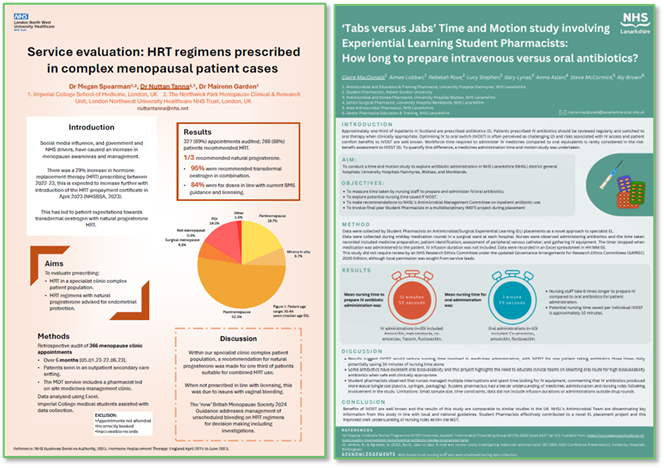
Ms Ross went on to share the #BetterPoster design, which is another possible way to design conference posters. Developed by Mike Morrison, a psychology PhD student, in 2019, the #BetterPoster style was created to make poster sessions more efficient.
- Posters should maximise the amount of insight for people attending a poster session.
- Detailed information should still be present, but not the core of the poster.
- These design goals should be easy to achieve and accessible to new and old scientists.
Although a great opportunity to share their research, many early-career pharmacists struggle to develop conference abstracts and posters. Ms Ross ran through some common pitfalls which are commonly seen in RCPharm Conference submissions, to help attendees understand what to look out for when submitting their abstracts and developing their posters:
- Not following the conference-specific guidance.
- Illegible figures and text.
- Complex structure and/or jargon that makes your poster difficult to follow.
- Not enough methodological detail, meaning readers can’t assess study validity.
- Formatting inconsistencies.
- Referencing errors.
Oral abstracts
Some conferences also allow abstract presenters the opportunity to present an oral abstract. Ms Ross explained that oral abstracts are short, formal presentations based on the submitted abstract delivered to conference delegates, typically during a plenary session.
Although both are fantastic research dissemination opportunities, presentations differ from posters (and papers) in a number of ways:
- They have a more clearly defined audience and a specific objective.
- They normally include interaction in the form of questions and answers.
- More information can be presented than on a poster; however, you are restricted by time.
Ms Ross explained the typical structure of oral abstracts, stressing that listeners only retain a very small percentage of what they hear. As such, it is important to make sure you keep your presentation concise and your slides easy to follow by only including key messages.

Ms Ross shared some top tips for presenting oral abstracts at conferences, based on learnings from the 2024 RCPharm Annual Conference:
- Research your audience so you know you are pitching to the right level.
- Practice your presentation as much as you can to get comfortable with the content.
- Make sure you can cover all your content within the allotted time – being cut off is a possibility.
- Use large fonts and visuals (e.g. images and graphics) to keep your audience engaged.
- Be ready to answer questions on your research, but also know it is okay to not have all the answers.
- Include your contact information so those who are interested can follow-up with you.
- Make sure you submit a final copy of your presentation in the requested format.
Ms Ross concluded her presentation by encouraging attendees to look into conferences that align with their research interests and to build networks to support their development.
RCPharm journals
Dr Zachariah, the Managing Editor of the RCPharm journals (published by Oxford University Press) shared information on the scopes of the four RCPharm journals and what peer reviewers look for when assessing a publication.
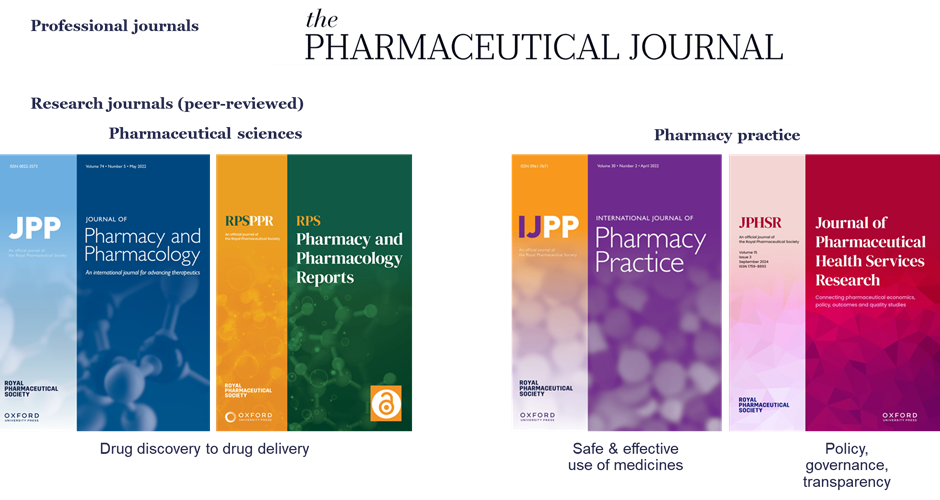
You can find out more about the RCpharm journals here.
Dr Zachariah ran through the lifecycle of a manuscript, from submission to publication and discussed the need to prepare a research publication, keeping in mind the roles of key players in the manuscript assessment process:
| Editors | Reviewer | Reader |
|---|---|---|
| – Is the research correct and robust? – Can the paper be easily understood? – Are there any new insights? – Were all the relevant ethical guidelines followed? – Is it of interest to the journal’s readership? – Is it within the journal’s scope? | – Assess originality, importance, likely impact. – Evaluates the strengths and weaknesses of the paper. – Do not oversell your results. – Do not ignore inconvenient references/ negative results. | – Reads and potentially cites your paper in their own work. – Post-publication peer-review. |
Dr Zachariah concluded her presentation by providing encouraging tips to help authors maximise the impact of their manuscripts and understand how to create an impactful title. She encouraged the use of keywords and language which emphasise the importance of the research. She ended by encouraging those in the audience to submit their work to journals and share their findings so the profession can learn and grow.
Learn more and access research guidance at the below resources: