Medicine shortages
Our work to highlight how medicine shortages affect patient care, the pressures on pharmacy teams, and recommendations to inform action.


From our President Tase Oputu
On 15 April 1841, a dedicated group of London chemists and druggists came together to form a professional body. Today, 185 years later, I am immensely proud to welcome you…

What’s next for a community pharmacist prescribing service in England?
This episode of The PJ Pod reflects on the ‘Community pharmacy independent prescribing pathfinder programme’…

Credentialing
We provide a standardised credentialing framework for pharmacists’ post-registration education and training, enabling them to be recognised for their advancing professional capabilities.
News
The latest news and updates from Royal College of Pharmacy
-
Prescription charge price hike harms patients, says RPS
This news story was published when the organisation was the Royal Pharmaceutical Society. Responding to the news that prescription charges in England will rise from £9.65 per item to £9.90 from 1 May 2024, and the 12-month Prescription Prepayment Certificate will also increase from £111.60 to £114.50, Tase Oputu, Chair of the Royal Pharmaceutical Society (RPS) in England, said: "Amid an ongoing cost of living crisis, the rise in prescription charges in England will hit working people on low incomes the hardest. “Every day pharmacists are asked by patients who are unable to afford all the items in their prescription which ones they could 'do without'. Patients shouldn’t have to make choices which involve rationing their medicines. No one should face a financial barrier to getting medicines which a health professional has prescribed as necessary. “The consequences of the relentless rise in prescription charges are well-known. If you can’t afford your medicines, your condition can worsen which leads to poor health, lost productivity and increases the risk of hospital admission, piling pressure on the NHS. “Prescriptions are free in Scotland, Wales and Northern Ireland. If they were free in England too then no one would have to worry about payment decisions affecting their health. “In a general election year, I hope that political parties can commit to properly reviewing this complex and unjust system. It is high time this stealth tax was abolished.” A recent survey of pharmacists by RPS and the Pharmacists' Defence Association showed that more than one-third of pharmacists (35%) said they have seen an increase in patients declining prescriptions in the past 12 months. The vast majority of respondents (97%) have seen cases where patients decline some of the medicines on a prescription owing to cost, one-quarter (26%) of whom said they saw this often. Prescription charges are one of the key issues in our general election manifesto. Find out how you can support the campaign at www.rpharms.com/manifesto. Read more RCPharm news stories.
-
Pharmacy bodies launch community pharmacy manifesto
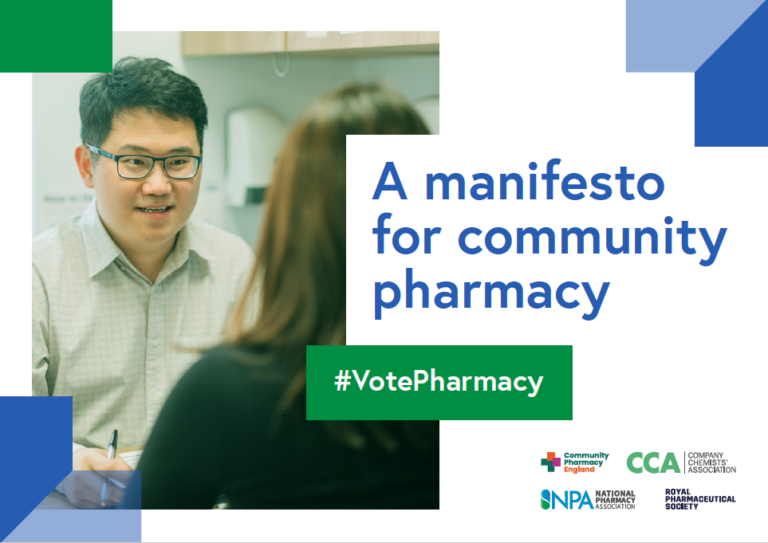
This news story was published when the organisation was the Royal Pharmaceutical Society. Community Pharmacy England, the Company Chemists’ Association, the National Pharmacy Association and the Royal Pharmaceutical Society have today published a joint manifesto for community pharmacy, ahead of the next general election. Pharmacy teams can use the manifesto to engage with political parties and candidates in the run-up to the election. The #VotePharmacy manifesto and other resources can be accessed from a new online general election hub, www.votepharmacy.org. The hub includes advice about engaging with candidates. Election candidates will be asked to show their support and back a six-point plan to “unleash the potential of community pharmacy”: Fill the funding gap, and commit to long-term sustainable funding, so pharmacies can deliver more of the NHS care patients need. Support and enhance the community pharmacy workforce to ensure that pharmacists and their teams can continue to meet the needs of patients now and in the future. Ensure that patients can access the medicines they need, including an end-to-end review of the medicines supply chain. Rollout an enhanced Pharmacy First service for England, mirroring the highly successful approaches taken in Scotland and Wales. Empower community pharmacists to do more, with an ambitious roadmap for independent prescribing. Make pharmacies centres for public health, prevention and reducing health inequalities. Tase Oputu, Chair of the Royal Pharmaceutical Society in England, said: “Community pharmacy plays a central role in the care of millions of patients each year, boosting vaccine uptake, tackling health inequalities and ensuring vital access to medicines. “But the system is also under pressure, and sustainable funding and support for the workforce will be crucial. “As more pharmacists become prescribers, it is vital the next government makes the most of this opportunity to transform patient care and ensure a positive future for community pharmacy at the heart of the nation’s health service.” All of these issues are highlighted in the RPS general election manifesto. Read more RCPharm news stories.
-
New report emphasises importance of research in pharmacy practice
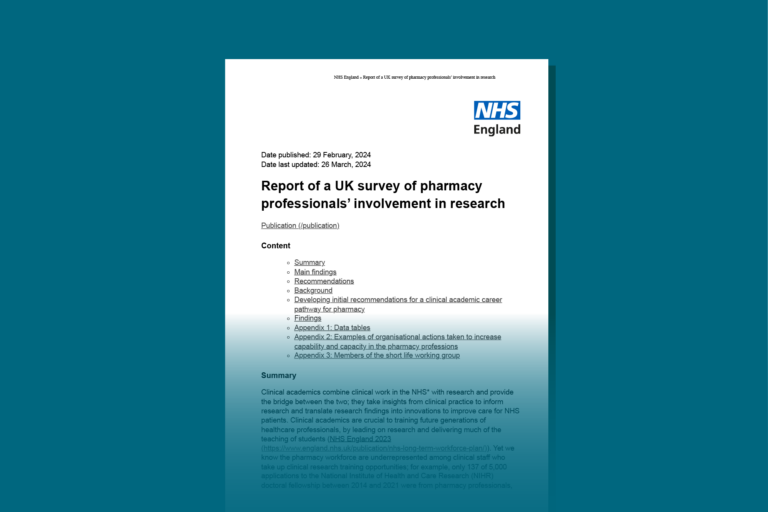
This news story was published when the organisation was the Royal Pharmaceutical Society. The Royal Pharmaceutical Society welcomes the release of NHS England's report on the involvement of pharmacy professionals in research. The report proposes the implementation of a clinical academic training pathway for pharmacy professionals by 2030. RPS President, Professor Claire Anderson, along with Joseph Oakley, Associate Director for Assessment and Credentialing, and Professor Parastou Donyai, RPS Chief Scientist, participated in the working group responsible for developing the report. RPS President, Claire Anderson, said: “The RPS was delighted to contribute a co-chair and have representation on the short-life working group that produced the report. We wholeheartedly welcome its recommendations. Research is an essential pillar of professional practice, driving continued professional innovation and advancement in care for patients. “The RPS is committed to enhancing pharmacists’ research capabilities. Research is a common domain across the RPS post-registration curricula due to its importance for professional innovation and advancing patient care. We recently worked with NIHR to create e-learning modules for pharmacists starting their research journeys, along with support services and guidance for members. “Professional engagement with research, supported by a network of clinical academics, is vital for the profession’s growth; pharmacists are uniquely placed within the healthcare system to drive forward the evidence base on the safe and effective use of medicines. The report’s suggestion to embed RPS curricula frameworks into pharmacists’ job descriptions by 2026 aligns with our mission to integrate research activities across all pharmacy sectors. This initiative will grow a cohort of research-engaged pharmacists ready to lead the pharmacy research agenda. “Recognising pharmacists’ challenges in balancing research amidst busy frontline roles, we advocate for protected learning time, as outlined in our policy and echoed by the report. Adequate funding is crucial to overcoming these barriers and delivering the report’s vision.” Read more RCPharm news.



Have any questions or comments on the new Royal College website?
Please visit our support page or email [email protected]

We are the Royal College of Pharmacy, the professional leadership body for pharmacists and pharmaceutical scientists. We exist to advance the safe and effective use of medicines, drive excellence in patient care and support pharmacists to deliver the highest standards of practice.
As the third largest workforce in healthcare, pharmacy plays a vital role in the health system, and as experts in medicines, pharmacists and their teams are central to patient care and public health. Our mission is to put pharmacy at the forefront of patient care, advancing the safe and effective use of medicines to the benefit of patients and the public.