Medicine shortages
Our work to highlight how medicine shortages affect patient care, the pressures on pharmacy teams, and recommendations to inform action.


From our President Tase Oputu
On 15 April 1841, a dedicated group of London chemists and druggists came together to form a professional body. Today, 185 years later, I am immensely proud to welcome you…

What’s next for a community pharmacist prescribing service in England?
This episode of The PJ Pod reflects on the ‘Community pharmacy independent prescribing pathfinder programme’…

Credentialing
We provide a standardised credentialing framework for pharmacists’ post-registration education and training, enabling them to be recognised for their advancing professional capabilities.
News
The latest news and updates from Royal College of Pharmacy
-
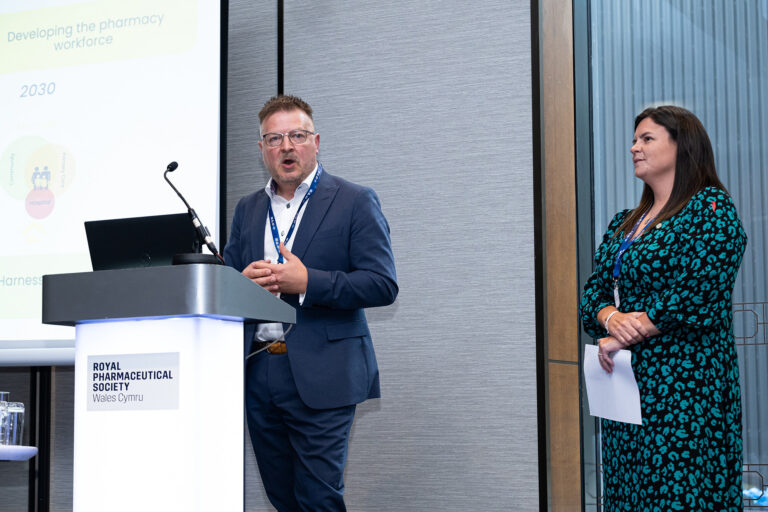
Next Steps for Pharmacy in Wales’ 2030 Vision announced at RPS Wales Conference
This news story was published when the organisation was the Royal Pharmaceutical Society. RPS Wales will once again take the lead in developing updated 3-year goals to help enable pharmacy in Wales to reach its 2030 vision, outlined in ‘Pharmacy: Delivering a Healthier Wales’ (PDaHW). The announcement was made by RPS Wales Director, Elen Jones, and Chair of the Welsh Pharmaceutical Committee Jonathan Simms at the recently held RPS Wales Conference. This iteration of PDaHW builds on the original 10-year plan, published in 2019 and the two series of stepping stone goals from 2019-2022 and 2022-2025. As well as the announcement on the next steps for the 2030 vision, the RPS Wales conference celebrated the significant advancements across pharmacy in Wales that PDaHW has helped push forward in recent years. It featured: Four presentations on the strategic developments undertaken by Digital Health and Care Wales, Health Education and Improvement Wales, the newly established NHS Wales Joint Commissioning Committee and an overview of the Transforming Access to Medicines (TRAMS) programme undertaken by the NHS Wales Shared Wales Services Partnership Eight quick-fire PDaHW Trailblazer talks from pharmacists and pharmacy technicians from all over Wales highlighted high quality and innovative practice aligned to the PDaHW vision. Commenting on the conference and the PDaHW announcement, Elen Jones said: “It was such a thrill to welcome nearly 200 members of pharmacy teams from all over Wales to our conference. I’d like to thank all the speakers who helped made the day such a success, especially to our inspiring PDaHW Trailblazers who all did an amazing job brining the 2030 vision to life”. “I’d like to thank the Welsh Government and the Welsh Pharmaceutical Committee for once again entrusting RPS to take this work forward. Like me, I’m sure everyone left the conference incredible proud to be pharmacists and pharmacy technicians working in Wales and inspired to move onto the next phase of our 2030 vision”. “Work on the new three-year goals will begin in early 2025. As always, we want to make sure the new goals reflect the views and ambitions of pharmacy teams in Wales. Therefore, we will be hosting a number of engagement events across Wales so that everyone has an opportunity to have their voice heard. Look out for dates and venues on your RPS member emails and on our RPS Wales social media”. Read more RCPharm news stories.
-
RPS launches two new advanced pharmacist curricula
We have launched two new pioneer curricula that define advanced pharmacist practice in mental health and critical care.
-

One in five patients in England struggle to access medicines
This news story was published when the organisation was the Royal Pharmaceutical Society. New data from the Office for National Statistics reveal that 20% of patients in England face difficulties accessing their medicines due to shortages in the supply chain, posing significant challenges for them and pharmacy teams. The survey, 'Experiences of NHS healthcare services in England', shows that 20% of adults who used prescription dispensing services at a pharmacy in the last 28 days experienced delays in getting the medicines they needed: 13.6% of patients had to return to the same pharmacy on a different occasion 3.6% had to visit multiple pharmacies 3.2% were forced to seek a different service, such as a GP or urgent care 1.8% could not access a pharmacy and took no further action. The figures highlight the challenges faced by patients in the face of medicine shortages and the extra burden on pharmacy teams to manage and resolve these issues. Of those who experienced difficulties in obtaining their NHS prescriptions, 13.4% were resolved the same day, 28.5% the next day, 36.1% within three to four days, 8.3% after six days or later, and 13.6% took seven days or longer to be resolved. Encouragingly, 85% of patients reported being satisfied with pharmacy services, reflecting the dedication and value of pharmacists and pharmacy teams in the community. However, there is a clear need for systemic change to address the root causes of these supply issues. RPS Director of England James Davies said: "Patients rightly expect that when they are prescribed a medicine, they will receive it without undue delay. “Medicine shortages have grown substantially in recent years, which is placing a significant strain on both patients and pharmacy staff. It’s thanks to the dedication and hard work of pharmacy teams that many of these problems are being addressed quickly, often by the next day. "We urge manufacturers, wholesalers and the Government to work together to improve the supply chain. We also want to see changes to the law that would allow pharmacists in England to make minor amendments to prescriptions. This would enable patients to access their medicines more quickly without needing to return to their GP. “Changes are urgently needed to ensure patients receive their medications promptly and to reduce the strain on the whole of the NHS caused by medicine shortages.” Find out more about our investigation into medicines shortages. Read more RCPharm news.




Have any questions or comments on the new Royal College website?
Please visit our support page or email [email protected]

We are the Royal College of Pharmacy, the professional leadership body for pharmacists and pharmaceutical scientists. We exist to advance the safe and effective use of medicines, drive excellence in patient care and support pharmacists to deliver the highest standards of practice.
As the third largest workforce in healthcare, pharmacy plays a vital role in the health system, and as experts in medicines, pharmacists and their teams are central to patient care and public health. Our mission is to put pharmacy at the forefront of patient care, advancing the safe and effective use of medicines to the benefit of patients and the public.