UKPPLAB
Report of the UK Commission on Pharmacy Professional Leadership
Published: 6 February 2023
Sections on this page
Acknowledgements
Note on terminology
Foreword
Executive summary
Acknowledgements
Acknowledgements
The Co-Chairs and Commission members would like to thank the UK Chief Pharmaceutical Officers – Andrew Evans, Cathy Harrison, Alison Strath and David Webb – and the Commission’s Secretariat – Trevor Beswick, Melanie Boast, Lisa Byers, Rob Coward, Cleo Gurbuz, James Humphreys, Fiona Kirkpatrick, Vicky Milnes and Marian Salek – for their advice, support and input.
Note on terminology
Note on terminology
In this report, the term pharmacy ‘professional leadership bodies’ (or ‘PLBs’) refers collectively to the Association of Pharmacy Technicians UK, the Pharmacy Forum Northern Ireland and the Royal Pharmaceutical Society. The term pharmacy ‘specialist professional groups’ (or ‘SPGs’) refers to other professional organisations whose purpose is pharmacy professional leadership for the benefit of patients and the public, for example within a specialism such as mental health.
Foreword
1. Pharmacy has a long and proud history supported by professional leadership bodies (PLBs) and specialist professional groups (SPGs) for pharmacists and pharmacy technicians which have evolved over time, with their own professional identities.
2. However, technological advances, expanding professional roles, fundamental changes to initial education and training, multiple healthcare challenges, together with changing public expectations, have combined to create a unique set of challenges and opportunities for the UK pharmacy professions and the urgent need for a review and reset.
3. The public, patients, the NHS and other employers, regulators and Government all depend on the healthcare professions to provide authoritative leadership, scientific insight and a coordinated voice. But pharmacy has a profusion of PLBs and SPGs which are insufficiently co-ordinated and, coupled with in some cases low engagement within the professions they represent, this has led to an inability to deliver effectively the primary purposes of professional leadership.
4. In June 2022, the four UK Chief Pharmaceutical Officers (CPhOs) established an independent Commission with professional leadership expertise from across pharmacy and beyond to consider the future of professional leadership. The Commission, together with its five Working Groups, has undertaken a consultative process and in-depth discussions, engaging with pharmacists and pharmacy technicians, patient groups, and many other stakeholders. The pharmacy PLBs and SPGs have engaged positively with the Commission and shared a desire to improve professional leadership for the greater good. We have used the term ‘pharmacy PLBs’ throughout this report, without necessarily implying that the relevant comment or conclusion applies to any individual pharmacy PLB.
5. The report provides a blueprint set out within five overarching recommendations for the functions and a direction of travel that are essential for the future of pharmacy professional leadership, covering: Leadership, policy and professionalism; Regulatory support; Regional, country and international relations and engagement; Scope of practice for future pharmacy professionals; and Professional education and training. The Commission recognised that some of this work is already underway; but, as the respondents to its Call for Evidence made clear, current pharmacy professional leadership is fragmented, does not project a unified or harmonious leadership voice, and is unable to meet in full the needs of patients and the public. It has also been affected by a lack of clarity between, on the one hand, leadership and representation of the professions (properly the role of pharmacy PLBs and SPGs) and, on the other, representation of individual professionals as employees (properly the role of trade unions). Additionally, there is a lack of awareness within the professions of the role of pharmacy PLBs in supporting effective professional regulation.
6. The Commission has concluded that a step-change is required to implement its recommendations and build on the trust and positivity created by this process. This would be achieved through the creation of a coherent, federated, UK-wide professional leadership framework with strong governance, led by a transitional, collaborative Pharmacy Leadership Council which would both preserve the separate identities of PLBs and SPGs and be able to take the professions forward to provide even better care for patients and the public.
7. The vision is the pharmacy PLBs and SPGs coming together across the four countries with mutual respect and equal status to work for a common purpose: to lead and represent the pharmacy professions effectively for the benefit of patients and local communities, working alongside other important stakeholders.
8. We have deliberately kept the recommendations to five overall to ensure the focus is on developing collaboration through working in partnership on a realistic number of initiatives.
9. We would like to thank all those who gave time and careful thought to: the responses to the Call for Evidence, the papers, conversations, meetings, and webinars that informed this report, including contributions from the PLBs, SPGs and other important stakeholders. The very diverse backgrounds of the Commission and its Working Groups served to ensure a breadth of debate, and to strengthen the unanimity of its recommendations.
10. Pharmacy is at its time of greatest opportunity; pharmacy professional leadership as a whole urgently needs a strong, united voice advocating for how the pharmacy professions can contribute to providing the right care at the right time and in the right place across the NHS and UK healthcare more broadly, working together effectively, and supported by employers, to realise the opportunities. To achieve this, PLBs will need new members and more resources, and therefore we encourage pharmacy professionals to join a PLB or SPG and become a part of the change that we all need to see over the next five years.
Co-Chairs of the UK Commission on Pharmacy Professional Leadership
Nigel Clarke
Former Chair of the General Pharmaceutical Council
Professor Dame Jane Dacre
Professor of Medical Education
University College London
Executive summary
11. The UK pharmacy professions continue to experience change at an unprecedented rate. This includes: the expansion of clinical roles and greater professional autonomy for pharmacists and pharmacy technicians in all parts of the NHS; both professions joining primary care and GP practice teams to provide access to patient-centred medicines expertise; and new initial education and training standards for pharmacists, which mean they will be independent prescribers from day one of registration from 2026. There are also ongoing legislative changes to increase the clinical contributions of pharmacy technicians to patient care and service delivery. Further, the professions are experiencing the impact of developments in medicines, data and technology on the delivery of health care, including genomics and personalised medicine. Whilst the detail may differ, pharmacy professionals in every UK nation are playing increasingly important roles in health systems.
12. This has placed very great demands on the three main pharmacy professional leadership bodies: the Association of Pharmacy Technicians UK, the Pharmacy Forum Northern Ireland and the Royal Pharmaceutical Society. Against this background, the UK’s four CPhOs set up the UK Commission on Pharmacy Professional Leadership in the summer of 2022. Its task was to produce recommendations for the purpose, functions and governance of future pharmacy professional leadership in the UK.
13. The Commission was chaired jointly by Nigel Clarke, former Chair of the General Pharmaceutical Council, and Professor Dame Jane Dacre, Professor of Medical Education, University College London and a former President of the Royal College of Physicians. The members of the Commission were appointed by the four UK CPhOs from a range of backgrounds including pharmacy technicians, pharmacists, patient and public representatives, academics, regulators, employers and education providers.
14. The Commission has engaged widely with the pharmacy professions and others, including a call for evidence with over 1,200 online responses and webinars using Mentimeter polling involving more than 460 people, further engagement webinars involving 650 people and discussions with a wide range of pharmacy bodies. It convened five Working Groups on Leadership, Policy and Professionalism; Regulatory Support; Regional, Country and International Relations and Engagement; Scope of Practice for Future Pharmacy Professionals; and Professional Education and Training. Drawing on the evidence and the Working Group discussions, the Commission reached five core conclusions:
- Despite the commitment of many talented pharmacy professionals both within the PLBs and SPGs, there was insufficient collective leadership with the credibility and resources needed to fulfil their roles and responsibilities and help shape the future of pharmacy and wider healthcare. Governments and senior NHS leaders depend on authoritative professional leadership to bring about successful, evidence-based policy and guidance development and delivery. The disjointed voice of the pharmacy professions is holding back pharmacy from making the best contribution to UK healthcare.
- Healthcare regulators benefit from the support of PLBs to help set professional standards, including for public expectations of care and for values and behaviours; but in pharmacy, the development of these standards has taken place without a unified professional view, which in turn means they are not necessarily recognised or adopted consistently. This lack of support for the regulatory process from the PLBs undermines the quality of professional leadership and patient safety, care and trust.
- Significant numbers of pharmacy professionals choose not to join a PLB. This disengagement from the professional leadership bodies undermines their ability to exercise authoritative leadership.
- Changes in healthcare technology and practice mean that the ways of working or ‘scopes of practice’ of the professions need to evolve, and PLBs have a critical role in this. The pharmacy PLBs have yet to define fully the scope of practice of pharmacists or pharmacy technicians, to disseminate effectively examples of best practice in innovation, or to support their implementation. The lack of a defined scope of practice holds back innovation in service design and effective integrated team working.
- Similarly, healthcare regulators and employers need the collaboration of PLBs to develop relevant curricula and standards for education and training. Again, in pharmacy, comprehensive curricula have yet to be developed. This lack of progress in education and training is holding back individual pharmacy professionals and limiting the wider contribution of the professions to healthcare, as well as leading to unwarranted variability and a lack of consistency between sectors and countries.
15. In response, the Commission is recommending the creation of a new federated professional leadership framework. Initially, this will comprise a collaborative Pharmacy Leadership Council comprising the PLBs and SPGs, an independent Chair and other expert members, with clear and defined goals based on the Commission’s recommendations, to enable the pharmacy PLBs and SPGs to enhance collaboration, while maintaining their individual identities. This would provide the structure for addressing the Commission’s recommendations. The Council and federated framework would be underpinned by a new ‘duty to collaborate’ for the pharmacy PLBs and SPGs and would be supported by a secretariat.
16. To achieve this vision, the Commission is therefore making five recommendations to the UK CPhOs. The appointments to the transitional Council would be the responsibility of the CPhOs and the ownership of the other recommendations would belong to the Council.
The recommendations
1. Leadership, policy and professionalism
1. Leadership, policy and professionalism
To convene a transitional, collaborative Pharmacy Leadership Council tasked with developing an inclusive Federation involving existing UK pharmacy professional leadership bodies and specialist professional groups, with an independent chair and other expert members.
- The Council would lead delivery of the Commission’s vision and recommendations for the benefit of patients and the public.
- This professional leadership framework would include robust processes for governance and accountability, and outline a clear identity for the Federation and its unique proposition and goals.
2. Regulatory support
2. Regulatory support
Through the Council, to continue to facilitate the development of professional standards to support the practice of pharmacy to develop in the public interest, with standards on professional values and behaviours a priority.
- Professional leadership bodies and specialist professional groups are expected to have a ’duty to collaborate’ with each other and the regulators and to manage conflicts of interest effectively.
- The development of standards would include a process to quality assure, accredit, update or endorse professional standards including standards developed by special interest groups or faculties.
3. Regional, country and international relations and engagement
3. Regional, country and international relations and engagement
Through the Council, to lead an approach to develop a coordinated and authoritative voice for pharmacy professional leadership, enabling Federation members to work together to support and develop greater engagement with priority audiences including:
- Patients, the public, governments and third parties.
- Pharmacy professional leadership bodies, specialist professional groups and individual pharmacy professionals across all career stages.
- Across countries (including internationally) and with other professions.
4. Scope of practice for future pharmacy professionals
4. Scope of practice for future pharmacy professionals
Through the Council, to enable professional leadership bodies and specialist professional groups to be aspirational for and optimise the contribution of pharmacy professionals, supporting the vital role and expertise of pharmacy professionals in the safe and effective use of medicines, promoting excellence, and championing research, clinical academic development, innovation and the development of new areas of practice, and supporting their adoption.
- This includes putting in place the infrastructure to keep abreast of current and emerging research, medicines and practice; and commissioning scopes of practice, best practice standards and guidance.
- The work would need to include and represent the diversity of patient- and non-patient-facing practice within the professions across the continuum of pharmacy and medicines practice, supported by visible role models.
5. Professional education and training
5. Professional education and training
Through the Council, to contribute to the collaborative development of aligned UK curricula for post-registration education and training for integrated pharmacist and pharmacy technician practice.
- This will include: post-registration practice standards; credentialing or its equivalents, linked to the further development of career pathways including specialisms; and an assessment process aligned to current and future service need.
- There is a need to facilitate a UK educational infrastructure to support recording and assessment of post-registration education and training activities for pharmacists and pharmacy technicians and ensure equity of access for both professions to enhance professional mobility.
1. Introduction
17. In healthcare, there are PLBs, for example, the medical royal colleges, which take an overarching leadership role to promote patient safety, quality of care and professionalism in their respective professions. They work with others such as the statutory regulators, the NHS, Government, education and training organisations, employers and trade unions, and their leadership is vital in ensuring that the way in which members of their respective professions practise achieves the best possible outcomes for patients. It is also common for there to be faculties or similar groups and associations within the colleges to represent a specialism within a particular field. PLBs have a clear remit to lead and represent their professions, support professionals, and work alongside other organisations which represent individual professionals as employees or commercial interests.
18. PLBs work in a complex and evolving environment and their roles have changed over time: in most cases1, professional regulation has been separated from professional leadership, as with the General Medical Council and the medical royal colleges, to avoid actual and perceived conflicts of interest.
19. PLBs are important because patient care that is safe, effective, and up to date is in part dependent on an individual professional’s commitment to continuing professional development and lifelong learning. Career frameworks are typically aligned to that development. In medicine, the regulator of the profession looks to the royal colleges to oversee postgraduate development. The position is different in pharmacy. As clinical practice in pharmacy began to develop, pharmacy leaders set up specialist groups, separate to the PLBs, to share learning and to develop the training needed to fulfil their clinical ambitions. This is when bodies such as the UK Clinical Pharmacy Association, the College of Mental Health Pharmacy and, in due course, the Primary Care Pharmacy Association and British Oncology Pharmacy Association emerged. These bodies have over the years developed into authoritative, specialist professional groups, providing leadership associated with their specialist areas.
20. In addition, the UK governments decided to strengthen arrangements for the continuing professional development of community pharmacists and pharmacy technicians so that new clinical services were delivered safely and effectively. This is when the Centre for Pharmacy Postgraduate Education and its Devolved Administration equivalents were commissioned.
Leadership in pharmacy
21. The three PLBs (the Association of Pharmacy Technicians UK, the Pharmacy Forum Northern Ireland and the Royal Pharmaceutical Society) and SPGs have all helped the pharmacy professions to develop clear identities and a reputation as safe and effective healthcare practitioners. Throughout their history, these organisations have worked in partnership with regulators, Government, the NHS and others to set and drive up standards of practice for the public good and contribute to education and training.
22. Since the establishment of the General Pharmaceutical Council as the regulator for pharmacists and pharmacy technicians in Great Britain in 2010, the pharmacy professions have experienced significant levels of change. This includes: the expansion of clinical roles and greater professional autonomy for pharmacists and pharmacy technicians in all parts of the NHS; both professions joining primary care and GP practice teams to provide access to patient-centred medicines expertise; and new initial education and training standards for pharmacists, which mean they will be independent prescribers from day one of registration from 2026. The initial education and training standards for pharmacy technicians were revised in 2017, and further change is on the way to increase the clinical contributions of pharmacy technicians to patient care and service delivery. The pharmacy professions are also experiencing the wider impact of developments in medicines, data and technology on the delivery of health care, including personalised and genomic medicine. There is a variation in how change is playing out in each of the UK’s health systems.
23. While there have been similar changes for doctors, nurses and other healthcare professions in the same timeframe, what is striking about the pharmacy professions is the relationship between the scale of the challenge on the one hand, and the capacity for change on the other.
24. For some years, there have been concerns about the capacity of the pharmacy PLBs to respond adequately to the demands that change has brought. This is compounded by the relatively low levels of membership and a consequential lack of resources needed to fulfil their responsibilities.
25. Against this background, the four UK CPhOs concluded that it was necessary to review the preparedness of pharmacy PLBs and reset to achieve the scale of the change that is required. They therefore established in June 2022 an independent UK Commission on Pharmacy Professional Leadership to bring all the parties together and to act as a catalyst for change.
The commission
26. The independent Commission was co-chaired by Nigel Clarke, former Chair of the General Pharmaceutical Council, and Professor Dame Jane Dacre, Professor of Medical Education, University College London Medical School and former president of the Royal College of Physicians. The Commission’s terms of reference set out the overall purpose of professional leadership, which is to:
“Influence, promote, and support the delivery of the highest possible standards
of professional practice to continue to drive up the quality of patient care.”
27. The Commission co-chairs and 21 members were appointed by the CPhOs for their relevant leadership expertise and perspectives, including the Presidents or Chairs of the regulators, PLBs and SPGs. Members were appointed on behalf of all pharmacy professionals and were not representative of particular countries, organisations, sectors or roles, and reflected the NHS’s values of equality, diversity and inclusion. The full Commission membership is set out in Annex A.
28. The co-chairs invited leaders from other PLBs outside pharmacy to attend and advise the Commission on specific topics. These individuals, drawn from a range of organisations, presented evidence but were not members of the Commission and did not contribute to final decisions. The Commission’s scope reflected the different regulatory and professional leadership arrangements in Great Britain and Northern Ireland. The four UK CPhOs acted as advisors to the Commission and attended the meetings, including Working Groups.
29. The final report of the Commission was to be presented to the CPhOs. Influence, promote, and support the delivery of the highest possible standards of professional practice to continue to drive up the quality of patient care.
Approach
30. The Commission concentrated on five themes:
- Leadership, Policy and Professionalism. How professional leadership arrangements focus on and deliver excellence in the care of patients and the public in all practice settings and the aspiration from their members to achieve high standards.
- Regulatory Support. The professional leadership requirements of Governments, the NHS, patients, and regulators relating to leadership, standards, quality, practice, inequality, diversity and inclusion, expert advice, and organisational governance. This involved engaging with key medical royal colleges and other PLBs to find out what excellence looks like for other professions.
- Regional, Country and International Relations and Engagement. Engagement with members and stakeholders, identity, reputation and standing, learning from others, collaborative working, networking and global influence, and developing a vision and influencing policy development relating to medicines and pharmacy practice.
- Scope of Practice for Future Pharmacy Professionals. How professional leadership arrangements support pharmacy professionals in developing and delivering high standards of science and practice in clinical and academic settings and in research and development roles, and support expansion of practice, and a focus on research and development, innovation and improvement in all settings.
- Professional Education and Training. The professional leadership requirements of Government, the NHS, patients and regulators relating to education and training.
31. Each of these was the subject of dedicated Working Group discussions. These are reported in
Chapters 3 to 7.
Evidence
32. The Commission had several sources of evidence and insight. These included presentations from other Professional Leadership Bodies on their roles and functions; five themed Working Groups; and a Call for Evidence. This was in addition to the experience of those contributing directly to the work of the Commission and valuable position statements from the pharmacy PLBs and SPGs themselves, and from other pharmacy organisations, such as trade unions, businesses and NHS pharmacy teams.
Other professional leadership bodies
33. The Commission was grateful for presentations from the following PLBs for other healthcare disciplines, explaining their background, formation, purpose, functions and governance arrangements.
- Dr Fiona Donald, President at the Royal College of Anaesthetists.
- Toby Underwood, Head of Professional Standards at the Royal Society of Chemistry.
- Dr Simon Thornton-Wood, Chief Executive at the College of General Dentistry.
34. The presentations provided insight into how the PLBs had been established and how their functions and governance enabled them to address their core purpose.
Working groups
35. The co-chairs established five Working Groups to address different aspects of professional leadership, reporting back to the Commission. Each of the Working Groups included members from relevant organisations, plus individuals, frontline staff and patients. The membership of these groups is set out in Annex B2.
Call for evidence
36. To ensure widespread engagement with the pharmacy professions and other stakeholders, and to ensure that its deliberations were informed by evidence, the Commission asked an independent organisation, the NHS South, Central and West Commissioning Support Unit (SCW), to run an independent Call for Evidence. This comprised two stages:
- First, pharmacy professionals were invited to participate in webinars in each of the UK nations during September 2022. These provided an opportunity to learn about the Commission and contribute views on priorities for the future leadership of pharmacy. A total of 463 pharmacy professionals attended the webinars, which involved Mentimeter polling. As part of the webinar, participants were surveyed on their views about the functions of a pharmacy professional leadership body.
- Second, pharmacy professionals, other healthcare professionals and patient groups were invited to complete an online survey, and 1,243 did so. This ran from 17 August to 28 September 2022 and was publicised through various routes, including communications to all pharmacy professionals from pharmacy regulatory bodies, the PLBs and a widespread cascade through NHS and other stakeholder channels.
37. This evidence was reviewed by the SCW team to identify key findings and themes. Reports from the SCW team were presented at Commission and working group meetings to ensure the views of professionals and stakeholder organisations were represented during deliberations. Respondents provided basic information about their length of service and primary job role. The majority of respondents were pharmacists (82%), with the balance (18%) being pharmacy technicians. A full report on the Call to Evidence has been published separately3.
2. The role of professional leadership bodies
Call for evidence
38. In addition to the 463 colleagues participating in the webinars, the Call for Evidence involved 1,243 separate online survey responses from individuals and pharmacy organisations in the four UK countries. While recognising that the responses to the Call for Evidence do not represent a statistically representative sample of all pharmacy professionals, nonetheless a large majority (97%) of respondents welcomed the Commission, viewing it as an important opportunity to discuss future leadership of pharmacy. A large majority of respondents (97%) welcomed the Commission, viewing it as an important opportunity to discuss the future leadership of pharmacy. A representative selection of comments from respondents have been included.
Leadership, policy and professionalism
39. A majority of respondents (86%) considered PLBs as important in supporting and promoting the highest standards of professional practice and patient care. Respondents expressed support for pharmacy professional leadership to provide a strong and cohesive voice for both professions. For example, 91% of respondents wanted the PLBs to influence national policy development, but in many cases they felt that the pharmacy PLBs simply did not have the capacity to do this across the board. Many respondents felt that there needs to be greater coordination between the professional leadership bodies. However, most respondents did not express a particular view on specific future arrangements, only that they felt having a coordinated and authoritative voice (however this is achieved) was important.
40. Respondents also expressed their desire for PLBs to operate at a UK level, whilst allowing for diverse approaches across the UK nations. There was praise for many individuals who took up leadership roles in the PLBs and elsewhere, but also criticism of leadership as a whole.
“Leadership feels disengaged from what’s actually happening on the ground. The changes within pharmacy are significant and the support to go alongside that feels lacking.”
“There is no visible holistic leadership and it’s a ‘club’ that people feel excluded from, not led by.”
“[Pharmacy PLBs are] uncoordinated, fragmented, divergent, lacking credibility and authenticity.”
Regulatory support
41. One of the key issues identified by the Commission was the interdependency between regulators, PLBs and SPGs. The two pharmacy regulators are the General Pharmaceutical Council (covering England, Wales and Scotland) and the Pharmaceutical Society of Northern Ireland. Respectively, they regulate registered pharmacists, pharmacy technicians and premises in Great Britain, and registered pharmacists and premises only in Northern Ireland, and work to ensure people receive safe and effective pharmaceutical care and have trust in pharmacy4.
42. The roles of regulators, PLBs and SPGs, and the relationship between them is illustrated by Figure 1 below.
Figure 1. Roles of regulatory, leadership and other professional bodies
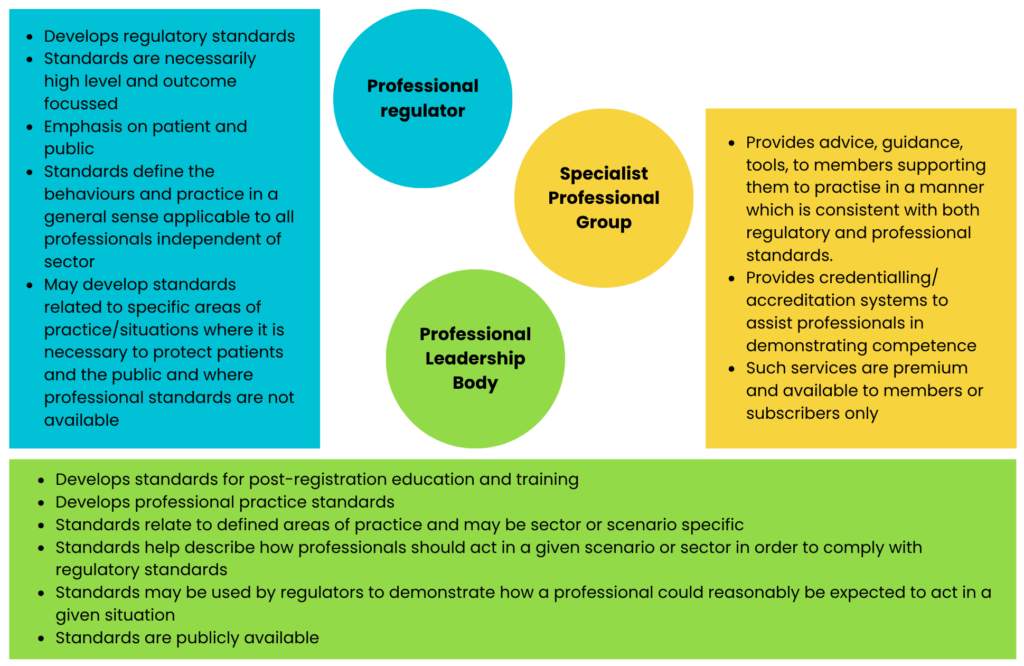
43. Figure 1 does not include the complementary roles of the community pharmacy trade bodies, which work to represent the interests of their members, or the community pharmacy negotiating bodies in England, Scotland, Wales and Northern Ireland. The Commission also recognised the distinct role of trade unions such as the Pharmacists’ Defence Association and the Guild of Healthcare Pharmacists, which represent the interests of employees.
44. Effective regulation depends in part on having standards agreed within the professions against which to measure performance. In the Call for Evidence, 80% of participants considered that pharmacy PLBs should play a part in setting standards for the professions and respondents indicated that PLBs should promote excellence by supporting professionals in moving beyond minimum regulatory standards to strive for excellence. At present, these professional standards are not sufficiently broad or comprehensive. The Commission heard clearly that the pharmacy PLBs need to prioritise the development of professional standards, working more closely with the regulators and the other SPGs.
45. Regulators and PLBs must also collaborate to promote awareness of the importance of the professions and public trust in professionals. There is also value in developing inter-professional trust as pharmacy professionals increasingly take on new roles and work in multi-disciplinary teams.
46. Professional leadership has a role in helping to challenge poor practice and providing compassionate and practical support to struggling pharmacy professionals. It was considered important that PLBs promote excellence at all levels of practice and not only through advanced practice. Respondents also felt that PLBs had a valuable role to play in supporting professionals to meet their regulatory requirements, including through relevant and practical guidance.
Regional, country and international relations and engagement
47. While most survey respondents (88%) believed that pharmacy PLBs should be responsible for engaging with the professions as a key role, only around a quarter (24%) felt connected to a PLB. Those responding to the survey wanted PLBs that represented the professions effectively by reflecting their views and giving them a ‘professional home’.
48. A common perception amongst many respondents was that currently there is too much fragmentation within pharmacy professional leadership, with responsibility for different elements of pharmacy leadership across the UK nations being split between several different PLBs and organisations. There was a need for an effective, authoritative, coherent and consistent pharmacy voice on key decision-making bodies for the wider healthcare sector.
49. It was indicated that work is needed to improve the credibility of PLBs as representatives of the pharmacy professions as a whole. There was also a very significant agenda for breaking down professional silos and for engagement internationally.
“I would like the voices to be heard from all sectors of the pharmacy workforce.”
50. This would also contribute to making pharmacy a more attractive and satisfying place to build a career, which in turn would contribute to the significant challenges in healthcare over the recruitment and retention of pharmacists and pharmacy technicians.
Scope of practice for future pharmacy professionals
51. A large majority of respondents (89%) agreed that PLBs should play a part in supporting expansion of pharmacy practice. Defining scopes of practice for pharmacists and pharmacy technicians would help with this and support better team working. A similarly high proportion (81%) considered that pharmacy PLBs should be responsible for promoting equality, diversity and inclusion across the workforce. This requires PLBs to consider the development of the whole pharmacy workforce at all levels of practice. Respondents considered it important that the pharmacy professions have clear career pathways and opportunities for progression, linked to their professional education and development.
“As a pharmacy technician, I feel that once I reach a certain Band, my career just comes to a plateau. There is little or no room for progression.”
Professional education and training
52. Respondents strongly agreed that pharmacy PLBs should support professionals in their education, training and development. Training should promote excellence in practice and include leadership development at all levels. Participants were in general very positive about the quality of training materials and guidance provided by PLBs, for example in supporting revalidation; but many were concerned or frustrated about career pathways. For example, a majority of pharmacy technicians said that lack of a clear learning pathway was a key obstacle in professional education and training.
53. The view was expressed that PLBs should have a role in standardising professional education and qualifications and ensuring professional standards are met through credentialing individuals or an equivalent method. Survey responses further highlighted the desirability of pharmacy PLBs providing access to a range of virtual and face-to-face training opportunities and education resources.
Pharmacy technicians
54. Pharmacists and pharmacy technicians shared many of the same views and concerns. But the Call for Evidence demonstrated the additional frustrations felt by many pharmacy technicians about the limited opportunities and pathways for professional development and career development and how this prevented them from making their full contribution within healthcare. For example, while pharmacy technicians in hospitals or in industry could have very high levels of responsibility, there were few equivalent roles in primary care and a lack of opportunity to contribute clinical knowledge and skills as registered healthcare professionals. This meant that senior pharmacy technicians would be very unlikely to want to move from one area of practice to another, which contributed to the ‘silo’ problem identified by many across both professions. This was in part an issue of status and extended to the PLBs themselves. To enable pharmacy PLBs to work together more effectively in the future, a culture that promoted parity of esteem between pharmacists and pharmacy technicians was essential.
“In the sector, [pharmacy] technicians are vitally important to effective leadership and often have lots of experience which is often overlooked.”
Student/trainee and foundation pharmacists, pre-registration pharmacy technicians and early career professionals
55. A notable feature of the response to the Call for Evidence was the limited participation of student/trainee and foundation pharmacists, pre-registration pharmacy technicians and others in their early careers. These groups accounted for less than 2% of total responses. Under 7% of respondents had fewer than five years’ experience as a pharmacy professional. This lack of participation in the Commission’s evidence collection processes was addressed by a webinar with trainee and early career pharmacy professionals. These discussions indicated that the purpose and functions of pharmacy professional leadership are less well understood among these groups. This issue was considered in the Commission’s deliberations with a view to making leadership more inclusive of and visible to professionals undertaking initial education and training and during their early careers.
Medical professional leadership bodies
56. To provide a framework for comparison, the Commission received presentations from three PLBs for other disciplines, including one medical royal college.
57. Medical royal colleges vary widely in many ways, including the number of members, their income and paid staff, their profile, their member services, the amount of volunteer time they can call on and their structures of governance. Nevertheless, the medical PLBs have much in common in how they see their roles and responsibilities, including: working with regulators to develop professional standards; policy development and public affairs; working with higher education institutions and others on education and training programmes; assessment and credentialing; fostering research and innovation in knowledge, including redefining the roles and responsibilities of medical professions and specialisms (‘scope of practice’); collaboration to encourage the sharing of good practice and avoid the development of an inward-looking or defensive professional culture; and communications and engagement with a wide range of audiences, from Government ministers to members of the public, to promote understanding of and confidence in the professions.
58. Perhaps the strongest theme was that patients and the public are at the centre of what the PLBs do – whether in promoting and helping to assure excellence and safe practice, or in understanding what the respective professions contribute to society. Raising standards, improving education or accelerating innovation may be good in themselves, and may be good for the medical professions and for individual professionals, but they are fundamentally done for the benefit of patients and society.
59. This is reflected in the way in which PLBs constitute themselves, how they work and how they hold themselves accountable.
60. PLBs had to demonstrate that they were working for the interests of the patient and the public, and not promoting the profession in ways detrimental to those interests. They had to demonstrate that they were representative of the whole profession, and not one section within it. And they had to avoid being captured by vested interests which – though legitimate in themselves – are the province of other bodies.
Benchmarking the pharmacy PLBs
61. The medical PLBs provide a benchmark against which the role, structure and performance of the pharmacy PLBs could be assessed. This was not a rigid process: one clear message from these comparisons is that each medical PLB reflects the specific circumstances of its profession, such as the regulatory environment. Nevertheless, if a PLB diverges significantly from these norms, there needs to be a clear justification.
62. When compared to this benchmark, the Commission found that the pharmacy PLBs were not approaching their roles and responsibilities in the same way as medical PLBs or adopting comparable high aspirations for excellence. In the case of pharmacy postgraduate education, where medical PLBs would usually be closely involved, there has been less progress within pharmacy, leading to an impact on integrated career pathways, continuing professional development and career progression.
63. The governance of PLBs gave rise to concerns over whether they were structured to sufficiently focus on independent representation of the professions for the patient and public good without being unduly influenced by vested interests. Further, many of the decision-making committees and expert groups within pharmacy PLBs were led by pharmacists, and professional leadership and subject matter expertise from pharmacy technicians was often absent. This could lead to one profession making decisions on behalf of another – a theme echoed in the Call for Evidence.
“As a pharmacy technician, I often feel that important decisions are made regarding my profession WITHOUT having input from our professional body or there being sufficient pharmacy technicians in positions of influence.”
64. The most fundamental concern was the extent to which the pharmacy PLBs could truly claim to speak for their members, given the low proportion of pharmacy professionals who chose to join them, and the high level of disengagement amongst professionals found during the Call for Evidence. Disengagement risked undermining the pharmacy PLBs at every turn. For example, fewer members would mean less resource (including the time of volunteers) to help develop standards, curricula or scopes of practice. This in turn would make the PLBs feel less relevant to potential members, so creating a negative spiral. Similarly, fewer members and higher levels of disengagement made it more likely that the PLBs would lose sight of important responsibilities or be unable to support adequately important groups of professionals (for example, those working in the pharmaceutical sciences), attract the right leaders or wield sufficient influence with Government.
65. These concerns could be linked to real-world outcomes. For example, disengagement and the current fragmentation mean professionals have less potential access to professional development, potentially leading to a lower standard of care for patients; or to pharmacists and pharmacy technicians feeling unsupported, and perhaps leaving the profession.
66. Effective PLBs offer a wide range of benefits, such as professional skills development, career development, education, networking, events and conferences, learning opportunities and – above all – development of professional standards and guidance to ensure excellence in patient care. Where PLBs are less effective, or where professionals are disengaged from those PLBs, those benefits are put at risk. Conversely, if the pharmacy PLBs could be supported to accelerate progress in areas such as professional standards and education, they would become more relevant to professionals, and this would bring in greater resources, so allowing progress to accelerate further. It is this virtuous cycle that the Commission intends to create.
3. Leadership, policy and professionalism
Chairs’ introduction
As with all the other Working Groups, we benefited from the findings from the Call for Evidence.
The discussions and rich feedback that emerged from the series of webinars, all of which we had attended, gave us a wider and deeper understanding of the views of pharmacists and pharmacy technicians from diverse backgrounds and areas of practice, pertaining to the current state of pharmacy professional leadership.
The level of dissatisfaction with the current offerings was clear throughout. Clear accountability, robust governance and credible leadership are crucial elements in ensuring excellent professional leadership. Therefore, our recommendations concentrate on these.
We trust that they resonate with everyone and that you are able to join in as we embark on the next phase of our professional leadership journey.
Dr Raliat Onatade
Group Chief Pharmacist and Clinical Director for Medicines Optimisation, Barts Health NHS Trust (Chair)
Professor Mahendra G Patel OBE
Pharmacy and Inclusion and Diversity Lead, PANORAMIC PRINCIPLE Trials, University of Oxford (Deputy Chair)
67. The Working Group considered how professional leadership arrangements should deliver excellence in the care of patients and the public in all practice settings. It also discussed how PLBs could support the aspirations of their members to achieve high standards, and the specific roles of pharmacy PLBs and SPGs, including how they could be supported most effectively to add value to the professions.
68. Early on, the Working Group identified two key themes.
- The first was about engagement in the professional leadership function within and across the professions, without which a PLB would be neither credible nor effective. Currently, fewer than half of pharmacy professionals are members of a PLB. A strong and united PLB function would encourage more pharmacy professionals to engage with a PLB and raise the standards of practice, which would improve patient safety. This cannot be mandated, as PLB membership will always be a voluntary activity, so must be seen to be in the individual professional’s interest.
- The second was whether a single PLB was feasible and acceptable. As discussions continued, a third theme emerged regarding identifying and cementing the vision for pharmacy professional leadership, taking the professions into the future with positivity, belief and belonging. This overlapped with the ‘Professional Home’ discussions in the Regional, Country and International Relations and Engagement Working Group.
69. The Working Group discussed the merits of a collaborative model of pharmacy PLBs and SPGs, and relationships between the two professions and what good professional leadership should look and feel like. Some in the pharmacy professions argue for a single body, perhaps on the model of a royal college, with specialist groups or faculties; others believe that this risks further marginalisation, particularly of pharmacy technicians. The Working Group concluded that the focus should be on function before form; and on the alignment of aims and values. Parity of inclusion and mutual respect are vital. The priority was therefore for the existing PLBs and SPGs to:
- Share a common purpose to ensure professional practice develops in the patient and public interest.
- Have systems of governance and accountability which protect the integrity of the body and its purpose.
- Have a membership which was representative and authoritative in the areas of practice about which it defines standards.
70. This could be achieved through a federated professional leadership framework, with a new collaborative Pharmacy Leadership Council to provide leadership and foster collaboration. In this context, the term ‘federal’ did not imply concentration of power in a central body, but an arrangement whereby a number of organisations could work together effectively, while maintaining their separate identities and undertaking their own activities independently as appropriate. The Council would always be advisory. The constituent bodies would remain ‘sovereign’, and they would choose to join and could choose to leave.
Framework for collaboration
71. This Federation would comprise organisations that have as their primary purpose one or more professional leadership functions for a group of pharmacy professionals for the benefit of patients and the public. The Federation’s primary mission and role would be to lead, assure and support, and so help ensure high standards of patient safety and quality of care.
72. It would have a convening function to ensure the constituent members’ roles and responsibilities were clearly identified and carried forward. The remit of this collaborative Pharmacy Leadership Council would be to influence, promote, and support the delivery of the highest possible standards of professional practice to continue to drive up excellence in patient care by implementing the recommendations of the Commission.
73. The federated model would ensure a single authoritative voice for the professions when needed, but also allow for individual voices and requirements of the different professions and specialist groups to be heard and highlighted. The model should ensure joint decision-making between bodies who should be expected to observe the high-level principles and values as set out in the Nolan principles of public life. All organisations which are part of the Federation would be equal partners and would have appropriate representation on the Council, exhibiting mutual respect and having their views and opinions considered in the development of a common identity and goals. These new relationships would be underpinned by the principles of equality, diversity and inclusion, meaningful communication, transparency and robust governance and accountability.
Governance
74. With respect to its ways of working, governance, accountability and reporting arrangements, the new Council would have a robust federated professional leadership framework in place to ensure objectives are delivered.
75. The Council would initially be appointed for up to a five-year transitional period by the UK CPhOs and its membership would be broad, balanced and must comprise people with outstanding expertise and credibility in their area of professional expertise or practice. Members should also have the appropriate leadership skills and experience, with the inclusion of early career professionals and under-represented groups. Membership should include an independent chair, the leaders from constituent member organisations, and other expert pharmacy professionals and lay members. The appointments process for the transitional Council would be led by the CPhOs and should be inclusive and transparent and give due consideration to how the Council communicates and works effectively at a UK level as well as at, and across, country and regional level.
Relationship with existing bodies
76. The Council should work collaboratively with stakeholders across the UK and internationally to foster authoritative, credible and high-quality leadership, which is vital for the public, patients and the pharmacy professions and the UK medicines agenda. In thinking about the Council’s ways of working, the Working Group concluded that it should remain fully engaged with members of the professions, patients and the public as the new arrangements are developed, building on the work of the Commission. This would include the creation of an inclusive stakeholder forum to ensure that as wide a range of pharmacy bodies and others with a direct interest in the work of the Council are heard.
Timescales
77. Collaboration between the current PLBs and SPGs is essential to achieve the recommendations outlined in this report, as no single current PLB can deliver the functions as described by the Commission. This will require a strong culture of trust. The necessary culture change will take time, so a three- to five-year transition period will be necessary to deliver on the Commission’s recommendations and to build better harmony amongst the pharmacy professions, with the ability to create consensus on important issues. This will require an independent Chair in the first instance, who would steer the continued debate on organisational form, and facilitate the development of the Commission recommendations into a five-year strategy.
Conclusions
78. The conclusions were based on pulling together existing PLBs and SPGs with a common purpose. The need for a truly collaborative approach is clear, as are the benefits of working together. The concept of a ‘duty to collaborate’ is vital. The Commission is therefore proposing a federal approach convened and supported by a new collaborative Pharmacy Leadership Council. The Commission is not dictating the precise form of the Council, instead setting out its thinking in more detail in Chapter 8. A three- to five-year transition phase found favour, with independent leadership, to develop the essential shared goals and a viable strategy and business plan for continued independent function.
Recommendations
To convene a transitional, collaborative Pharmacy Leadership Council
tasked with developing an inclusive Federation involving existing UK
pharmacy professional leadership bodies and specialist professional
groups, with an independent chair and other expert members.
- The Council would lead delivery of the Commission’s vision and
recommendations for the benefit of patients and the public. - This professional leadership framework would include robust
processes for governance and accountability, and outline a clear
identity for the Federation and its unique proposition and goals.
Indicative timeline
Nine months to set up the Council and framework as part of a three- to five-year transition period.
“Sitting on the leadership, professionalism and policy working group was a real privilege. Not only did it enable me to offer my pharmacy network a ‘once in a lifetime’ opportunity to contribute to the exciting development of future pharmacy leadership, it also brought together a group of likeminded pharmacy professionals and offered an opportunity to deliberate, challenge and reflect a shared vision.“
Dawn Cassidy, National Chief Pharmacy Technician, Practice Plus Group, Health in Justice
“Pharmacy professional leadership is important to ensure high standards of safety, quality and care of people, carers and their medicines at all times and provide a supportive and inclusive climate for all members of the pharmacy professions. I hope that the work of the commission will ensure visible, inclusive and effective pharmacy leadership at all levels and across all home nations.“
Heather Smith, Consultant Pharmacist: Older People, West Yorkshire Integrated Care Board
4. Regulatory support
Chairs’ introduction
Regulatory bodies exist to protect the public, but that is not about protecting the public from health professionals. It is professionals who protect the public by the care they give and the values that underpin their professionalism. Regulatory and leadership bodies both have important supportive roles to play and, like the professions themselves, ultimately we are all working for the public. As Regulators, we want pharmacists and pharmacy technicians to be empowered and confident to develop their practice and enjoy rewarding and enriching careers, with all the recognition they so much deserve. Time and again we witnessed in our discussions the need to find effective ways to empower and support pharmacists and pharmacy technicians in all sectors and fields of practice, in ways that are inclusive in every possible sense. We hope our recommendations make a useful contribution to taking forward the Commission’s important agenda, in the interests of the professions and the public.
Gisela Abbam
Chair, General Pharmaceutical Council (Chair)
Dr Jim Livingstone
Former President, Pharmaceutical Society of Northern Ireland (Deputy Chair)
Regulation and Leadership
79. The Working Group considered the professional leadership requirements of patients, the NHS, Government and other stakeholders relating to the regulation of the pharmacy professions. Support for the regulators was discussed in the context of a range of matters including functions of PLBs, the number of PLBs and other professional organisations within the pharmacy professions, constitution and governance, and standards for post registration education, curricula, and credentialing.
80. The Working Group considered the role of regulatory standards, including the example of how pharmacy teams led the rapid setting up of vaccination services in the most challenging circumstances during the COVID-19 pandemic. These included a huge demand for services, novel medicines, complex handling and logistics, and a long list of risks to be identified and managed. The regulatory standards provided a framework alongside professional leadership and collaboration with commissioners and colleagues from all sectors and all health professions. A rigid ‘template’ issued by a regulator alone could not have empowered or enabled pharmacists and pharmacy technicians to achieve so much: professional, policy and commercial leadership all provided essential elements.
81. Bodies that set themselves up as pharmacy PLBs should have functions that are consistent with their primary purpose to ensure professional practice develops in the public interest. Whilst a PLB will advocate for the profession and offer its support to its members, such functions should not conflict with its primary purpose and will not include any contribution to collective bargaining on pay and conditions. Pharmacy PLBs need to demonstrate the credibility and authority necessary for the interdependency with regulators to be effective. At present, progress on this is being held back by silo working and competition between PLBs and with other organisations.
82. This would require a change in culture, and the Working Group explored the concept of a ‘duty to collaborate’. This was inspired by the way the duty of candour has clarified the expectation that healthcare professionals would be open and honest with patients and with colleagues when things go wrong, and so has supported culture change around patient safety. Similarly, the duty to collaborate would formalise the implicit expectation that individual pharmacy professionals, and their professional leadership bodies, would collaborate between themselves and with others for the good of their professions, patients and the public.
Professional Standards
83. The regulators and PLBs also share a role in promoting public trust in the pharmacy professions, with PLBs working for the benefit and protection of the public interest by upholding standards within the professions. On matters of education, curricula and credentialing; whilst currently not directly a matter for regulatory support, the Working Group identified the potential for the regulator to use these as a means of assuring the proficiency of individual practitioners to take on specific roles particularly as pharmacy practice evolves.
84. There is an interdependency between regulation and professional leadership where pharmacy PLBs should own standards relating to values and behaviours of registered pharmacy professionals in the public and professional interest. There was agreement within the Commission that the standards set by a PLB should be developmental. These standards must be credible and would be used to support the regulator in its role of quality assuring both professional and public expectations of practice.
“Regulation by its nature tends toward the status quo; leadership ought to be about moving forward, visionary, influencing, advocating and developing standards.”
85. A key role for PLBs in supporting regulation is the setting of professional standards (as distinct from regulatory standards) relating to defined areas of practice. These professional standards (which may be articulated as guidance or guidelines) relate to defined areas of practice and may be sector or scenario-specific. They aid with the interpretation of regulatory standards in the context of defined areas of practice by taking regulatory standards, which are necessarily high-level and outcomes-focused, and describing how they might be applied in a professional context. The interdependent relationship between regulators and PLBs means professional standards may be used by Regulators to demonstrate how a professional could reasonably be expected to act in a given situation. (In this context, the Working Group discussed the need for regulators and PLBs to collaborate on a more consistent shared language when it comes to “standards”, “guidance” and “guidelines”.)
Conclusions
86. The PLBs should enable the development of professional standards across the breadth of professional practice and should put a system in place, following best practice, to quality-assure, update, accredit or endorse professional standards developed by special interest groups or faculties. Due to pharmacy practice covering two professional groups, different sectors, and generalist and specialist practice, this will require the development of standards across the breadth of professional practice. Having systems which support this will be essential. This could include, but not be limited to, supporting special interest groups and/or faculties within a professional leadership body. Quality assurance of standards developed in this way would be necessary and there would be economies of scale in having shared administrative and quality assurance systems across these groups. A priority for the PLBs should be the development of professional standards relating to the practice of pharmacy professional values and behaviours.
Recommendations
Through the Council, to continue to facilitate the development of
professional standards to support the practice of pharmacy to develop in the public interest, with standards on professional values and behaviours a priority.
- Professional leadership bodies and specialist professional groups are expected to have a ’duty to collaborate’ with each other and the regulators and to manage conflicts of interest effectively.
- The development of standards would include a process to quality
assure, accredit, update or endorse professional standards including standards developed by special interest groups or faculties.
Indicative timeline
Enhanced standards within three to five years and the duty to collaborate, consult on and publish within one year.
“Pharmacy and its role in delivering excellence in patient care is transforming rapidly. The Commission has provided a useful forum to explore how professional leadership needs to evolve to keep in step. I want pharmacy professional leadership that is inclusive, independent and respected across healthcare, advancing and supporting pharmacists and pharmacy technicians for the ultimate benefit of patients.“
Professor Claire Anderson, President, Royal Pharmaceutical Society
“It’s been a privilege to input into the commission – in particular, the regulatory support working group. It was positive to experience collaborative working from across the world of pharmacy and hear different perspectives. I am hopeful that the findings will be used to create some much-needed, meaningful change across the leadership of our profession.“
Roz Gittins, President, College of Mental Health Pharmacy
“It is necessary that there is trusted leadership and formal governance process within the pharmacy profession. This allows the profession to increase its capabilities and grow its resources. As carer, service user, and trustee of large Patient Participation Group Network in South England, I was invited to join the working group to help develop key objectives and responsibilities for the Pharmacy Professional Leadership programme.“
Rashmi Kumar, Trustee – Patients and Public Participation Groups Network in South London, South East London Integrated Care Partnership Board
“Professional leadership enables us all to meet our personal aspirations and demonstrate the great care we all provide to the public. Without it we will never be valued as we all should. Working on the group has allowed me to support our ability to develop alongside a regulator who protects the public but supports us to provide the highest quality of care.“
Professor Ashok Soni OBE, President, National Association of Primary Care
“Professional leadership needs to evolve to ensure pharmacy technicians have the guidance, support, influence and representation to deliver optimum patient care. The work of the UK Commission is an important step in the journey for the professional recognition of pharmacy technicians.“
Claire Steele, President, Association of Pharmacy Technicians UK
5. Regional, country and international relations and engagement
Chairs’ introduction
Our first task was to ensure our Working Group had a diverse set of voices that would be able to bring a range of views to our discussions. The patient voices in our group were very adept at reminding us of our core purpose and having patients at the centre of all we do. Our thanks go to each and every one in our group who contributed actively, diligently and passionately to the debates. Throughout the process we had honest and candid conversations on the current state of play and promoted the blue-sky thinking needed to create better relations and engagement for our professions. We hope the group’s deliberations resonate with you. We are never going to get it 100% right the first time, and we need to be open and honest enough to reflect on when we are getting it wrong and when things need to change.
Dr Catherine Duggan
Chief Executive, International Pharmaceutical Federation (Chair)
Reena Barai
Superintendent Pharmacist, S.G. Barai Pharmacy (Deputy Chair)
Disconnected professions
87. The Working Group focused on understanding the very low level of engagement with PLBs amongst pharmacy professionals. Currently, fewer than half of pharmacy professionals are members of a PLB. Even when membership rates are high – and in Northern Ireland, all pharmacists are members of their PLB – there can be low levels of engagement amongst the membership with the work of the PLB. Engagement can also vary amongst different cohorts: for example, the proportion of newly qualified pharmacy technicians joining the Association of Pharmacy Technicians UK is growing. Yet overall, the Call for Evidence showed that while 88% of the respondents believed that engagement was a key role for professional bodies, only 24% felt connected to a PLB.
“I don’t think I want to be too hard on [the PLB], what they do is of good quality and well thought out… But they seem to have lost their way in engaging the membership in what they’re doing.”
“I feel like their [the PLBs] impact on our day- to-day roles is minimal and awareness is low. Therefore, engagement and the scope of pharmacy leadership feels limited.”
88. The Working Group recognised that for pharmacy professionals to engage with a PLB, a PLB needs to engage with professions effectively, reflect the views of the professionals and provide them with a ‘professional home’. See Figure 2 below.
Figure 2: A professional home

Engagement
89. The Working Group deliberated the most effective ways of engaging with the pharmacy professions at different career stages, outside the professions and across geographical boundaries. This led to three conclusions:
- First, there is a need to engage with patients and the public in a meaningful way. Not only will this lead to PLBs being a credible voice to patients but also support professionals to be the ‘go-to’ professional for patients on advice and support with medicines, further strengthening their clinical relationships. Alongside this, the need to engage with Government and third-party sector bodies/groups came up as part of our priority ‘external’ engagement and relations recommendation.
- Secondly, there is a need to engage ‘within’ the pharmacy professions, across the various sectors of pharmacy, across countries and across career stages. The Working Group discussed whether every professional needs to be part of a PLB for it to be credible and how engagement within the professions needs to provide a ‘win-win’ so that every professional feels they want and need to be part of it.
- Thirdly, there is a need to be ‘outward-looking’: that is, engaging across the UK and the English regions and with other professions. For too long the pharmacy professions have worked in silos, and being more outward-looking would allow them to learn from others, collaborate on mutual and global initiatives and support the development of portfolio careers. This led to a wide debate on how, depending on where you are in your career, your understanding of the need for engagement and desire to do it may differ.
90. This was demonstrated by the way the Commission had brought professionals together from the four countries of the UK and the opportunities for exchanges and networking this had created. This approach needed to be continued, reflecting the need for engagement within the pharmacy professions and the benefits of being more outward-looking. Similarly, the Call for Evidence showed the appetite within the respondents for more local and specialist engagement and networking.
91. The Call for Evidence made clear that the respondents were looking for a more unified voice and credible and authoritative leadership. Consultation and responsiveness were important, but this was not about being driven by which voices spoke the loudest or most often. Leadership has to be authoritative and have a clear vision of the professions to pursue, setting a direction of travel and bringing people along. Similarly, engagement needs to be just as attentive to those who are not, for whatever reason, able or willing to express them forcefully.
International
92. Members of the Working Group highlighted the importance of an international perspective in pharmacy professional leadership, bringing benefits to the NHS and patients in the UK. There has been significant work within the global health partnership community demonstrating that international collaboration and engagement helps with career development, retention, motivation, confidence and job satisfaction, as well as building key leadership skills5. The benefits of effective PLB leadership at a global level in bolstering public confidence in the pharmacy professions were also noted.
93. An international view is also essential in the context of global health. As illustrated by the worldwide COVID-19 pandemic and antimicrobial resistance, infectious diseases know no boundaries. Being involved in international debate and research in relation to medicines, public health and disease is a core PLB function.
Conclusions
94. The pharmacy PLBs will need to improve engagement in every quarter to enable the Commission’s recommendations to be delivered. However, to do this PLBs need a unity of vision, a clear identity and authoritative leadership, and clarity and consistency in what is to be portrayed in order to bring people with them. Without undermining professional identities PLBs should ensure there is a clear purpose set out for the pharmacy professions and the PLBs, locally, regionally, nationally and internationally, ensuring it is understood and supported; this will require a continuous focus on strategic and high-quality communications and engagement with all stakeholders.
95. There is a need to revisit local networks, improve geographical and regional reach, and to redress any London-centricity in the approach taken to achieve these recommendations, as well as develop appropriate engagement mechanisms and structures to enshrine the collaborative behaviours that the PLBs will need to adopt. This would naturally include promoting formal membership of the pharmacy PLBs, but there would also be other ways to increase engagement and participation. The notion of a ‘Pharmacy Home’ where all pharmacy professionals felt comfortable and valued in their role, and to which professionals choose to belong, was attractive, as it allows the preservation of the professional identity of pharmacists and pharmacy technicians. This would enhance the ability of pharmacy professionals to speak confidently and with authority.
Recommendations
Through the Council, to lead an approach to develop a coordinated and authoritative voice for pharmacy professional leadership, enabling Federation members to work together to support and develop greater engagement with priority audiences including:
- Patients, the public, governments and third parties.
- Pharmacy professional leadership bodies, specialist professional groups and individual pharmacy professionals across all career stages.
- Across countries (including internationally) and with other professions.
Indicative timeline
An agreed identity and coordinated voice within one year; and improved engagement over three to five years, measuring impact on an annual basis.
“Pharmacy professional leadership is vital as it helps to ensure that the pharmaceutical needs of patients and the public are met in a safe and effective manner. Effective pharmacy professional leadership ensures that the voice and capabilities of the profession are heard and showcased at all levels, and that the future of the profession remains bright and strong.“
Yousaf Ahmad, Chief Pharmacist and Director of Medicines Optimisation, Frimley Health and Care Integrated Care Board
“Having compassionate, authentic and inclusive leadership is vital for the pharmacy profession’s future. It was reassuring that the Regional, Country and International Relations and Engagement Working Group focused on the value and impact of multi-professional collaboration and engagement with patients and the public.“
Elsy Gomez Campos, President, UK Black Pharmacist Association
“It is imperative that we have competent, confident pharmacy professionals who have networks of colleagues and professional support to excel and push the boundaries of practice and great patient care. It is equally important that their professional voice is heard, and they are represented in key developments in healthcare delivery and service modelling.“
Julie Greenfield, Manager, Pharmacy Forum Northern Ireland
“I joined the Commission with the intention of championing the importance and value of nurturing the necessary attitudes and skills in the pharmacy workforce to give every patient a better chance of sharing in the choice of medicines and being committed to use their chosen medicines properly. There was an inclusive and participatory approach in my working group of 18 members sharing diverse views, openly challenging each other and through transparent reporting and feedback enabled collectively agreed priorities to be largely agreed. As a patient amongst 17 senior people, I felt included, listened to and genuinely involved in the process, thank you.“
Graham Prestwich, Founder, Me and My Medicines
“I feel very proud to have been a part of this historic work that has resulted in the creation of a blueprint for professional pharmacy leadership. The Commission has engaged widely and adopted a very inclusive approach which I believe has helped inform its comprehensive findings in a very balanced way.“
Mohamed Rahman, Chair, UK Clinical Pharmacy Association
“Coming with a patient perspective, I was pleased to be included in this important piece of work. In a letter signed by all four CPhOs it states “the overall purpose of professional leadership is to influence and support the delivery of the highest possible standards of professional practice”. It is important that the public know that this is an aim of the pharmacy profession. Professionalism in pharmacy is important so that when the public see a pharmacy professional they know that such people are well trained and accountable.“
Dr Patricia Wilkie OBE, President, National Association for Patient Participation
6. Scope of practice for future pharmacy professionals
Chairs’ introduction
It was a privilege to lead the Working Group. The active and constructive participation of attendees at our engagement events and Working Group meetings was rewarding and informed and shaped the group’s recommendations. We were heartened by the debate and feel this is the start of the conversation. This work provides a platform for more engagement, especially with those professionals early in their career who can often feel disempowered from setting the direction that their careers may take professionally. Loud and clear we heard that the professional leadership bodies should inspire pharmacy professionals and allow them to be brave. Pharmacy has an exciting future and it is imperative that those within it are supported to have professionally rewarding careers.
Christine Gilmour
Director of Pharmacy, NHS Lanarkshire (Chair)
Rahul Singal
Chief Medicines and Pharmacy Information Officer, NHS England (Deputy Chair)
Changing practice
96. The Working Group was established to consider how professional leadership arrangements can support the increasing scope of practice for pharmacy professionals including the introduction of independent prescribing for pharmacists as part of their initial education and training and forthcoming developments in clinical practice for pharmacy technicians. Areas for attention included the role of PLBs and SPGs in supporting pharmacy professionals in developing and delivering high standards of science and practice in academic settings, and in research and development roles. A further area for attention was the role of pharmacy PLBs and SPGs in supporting a focus on research and development, innovation and improvement in all settings.
97. The extension of prescribing rights and increase in clinical content of initial education and training was a fundamental change to pharmacy practice and set a challenge to the profession’s leadership. For instance, in primary care, an individual pharmacist taking on the management of a long-term condition such as asthma needs support, including training materials, tools and resources and recognised guidelines, underpinned by standards set by the Regulator. They might also benefit from professional networking and the exchange of best practice with their colleagues. They might need some form of recognition of their specialist skills, for example through credentialing, supported by career progression frameworks that are understood and accepted by everyone, including employers, patients and other healthcare professionals, to ensure that both patients and other healthcare professionals understood that the pharmacist was fully capable of providing excellent care. PLBs could contribute to every aspect of this process. If they did not, the benefits of the change for patients would be reduced, and the workload on individual pharmacists increased.
Responding to change
98. It was an agreed principle of the group that scope of practice is not fixed but will continuously evolve. This would be driven by innovation, policy changes and wider shifts in society and the economy, and needed to be underpinned by education, standards and regulation. Recent examples include the development of pharmacy roles in secondary and primary care and the work undertaken across all sectors during the COVID-19 pandemic. Rapid advances in medicines and technology require that PLBs and SPGs are aware of current and emerging developments in many areas of practice and equip themselves to proactively respond. The pharmacy PLBs and SPGs will also have a role in optimising the contribution of both pharmacists and pharmacy technicians to improving population health across their scope of practice and upholding the confidence of the public and the teams with which they work.
99. The Working Group concluded that the pharmacy PLBs and SPGs should promote excellence and champion research, innovation, and the development of new areas of practice including clinical academic pathways. To support this the PLB and SPGs must be aware of current and emerging practice and should commission the production of best practice standards and guidance.
Distinct scopes of practice
100. Contributors to the Working Group debates indicated the need to properly recognise and advocate for the distinct scopes of practice of pharmacists, pharmacy technicians and pharmacy support workers. The Working Group considered the responsibilities of the proposed federal structure in supporting all members of the pharmacy team. In this respect, it needs to be fully aligned to the diversity of patient and non-patient-facing roles within the professions. This should be across the continuum of expert medicines practice, supported by visible role models at all levels.
101. There was agreement that professional leadership has a fundamental role in promoting confidence and trust in the pharmacy professions. This is both internally within the professions and externally across the multi-professional team, with the public and with Government policy makers. Public trust is a vital element of successfully changing practice. For example, the rapid introduction of independent prescribing, which is the most immediate significant extension of the scope of practice for pharmacists, will need to be clearly understood by other healthcare professionals, patients and the public. Such communication is essential to support pharmacists in their position as medicine experts and to support pharmacy technicians to extend their scope of practice.
Conclusions
102. PLBs have a role in giving confidence to professions and the public that advances in practice are safe and effective. Professionals should be encouraged to be aspirational in their practice, in research and development where appropriate, and to be abreast of innovations (such as Artificial Intelligence), and further developments in pharmacy practice, most immediately independent prescribing. The scope of practice of pharmacy professionals, especially pharmacy technicians, is not well defined currently, and causes some conflict between the roles. The PLBs and SPGs need to come together to ensure that professional support is inclusive of the diversity of roles, and that scope of practice work is clear for each profession and each speciality within that profession; and these definitions should link to educational pathways and attainment.
Recommendations
Through the Council, to enable pharmacy professional leadership bodies and specialist professional groups to be aspirational for and optimise the contribution of pharmacy professionals, supporting the vital role and expertise of pharmacy professionals in the safe and effective use of medicines, promoting excellence, and championing research, clinical academic development, innovation and the development of new areas of practice, and supporting their adoption.
- This includes putting in place the infrastructure to keep abreast of current and emerging research, medicines and practice; and commissioning scopes of practice, best practice standards and guidance.
- The work would need to include and represent the diversity of patient- and non-patient-facing practice within the professions across the continuum of pharmacy and medicines practice, supported by visible role models.
Indicative timeline
To have a defined document describing the scope of practice for both professional groups within one year, and to develop the infrastructure and other approaches within three to five years.
“Pharmacy services are vitally important to older people, not only in dispensing their medicines but in the advice and support they provide alongside services like vaccinations. As we continue to look to pharmacies to provide a wider range of primary care and front-line services, the importance of effective leadership will only grow.“
Tom Gentry, Senior Health Influencing Manager (Policy), Age UK
“Pharmacy professional leadership is of vital importance to support pharmacists and pharmacy technicians to promote excellence and drive the profession forward. As a pharmacy technician, I hope a ‘one size fits all’ approach is avoided and the two different professions are considered for their individual requirements.“
Gail Hall, Pharmacy Faculty Lead, Joined Up Care Derbyshire
“The future of pharmacy professional leadership lies in the ability to adapt and continuously create and innovate. Through diverse dialogue we can acknowledge our biases and learn to be better.“
Helen Kilminster, Vice-President, Primary Care Pharmacy Association
“The pharmacy profession has never been so diversified in its roles or been as active at every level of healthcare. Pharmacists today need a clear voice, delivering professional leadership to our colleagues and giving a clear message to patients and wider society. The work of the Commission will develop that conversation within the profession and beyond.“
Sheelin McKeagney, Community Pharmacist, McKeagney’s Pharmacy
“As a Commission member I’ve actively offered the perspective of undergraduates and trainees, as well as highlighting the importance of pharmacy professional leadership in supporting early career pharmacists. The profession has undergone, and continues to undergo, monumental changes. The undergraduates and trainees of today will be carrying this progress forward into tomorrow.“
Priyanka Patel, President, British Pharmaceutical Students’ Association
“Pharmacy professional leadership is essential for the equitable progression of pharmacy professions, in a constantly evolving healthcare landscape. Through inclusive and diverse leadership investing in those it represents, it will have a positive impact on patients, the wider public and pharmacy services as well as the professionals themselves.”
Nicola Stockmann, Vice-President , Association of Pharmacy Technicians UK
7. Professional education and training
Chairs’ introduction
The expansion of clinical practice for pharmacists and enhanced roles for pharmacy technicians requires a robust learning, education and training infrastructure to support the ambitions of the two pharmacy professions and health and social care expectations. Development of education standards and frameworks across both professions will enhance career pathways and support defining scope of practice as part of rewarding careers. Moreover, recognition of the need for integrated education pathways that underpin roles, communicated and understood across all pharmacy sectors and within multidisciplinary health and social care teams, for the benefit of patients, alongside the public’s greater expectations and demands of what they need from health and social care services in general, sets the scene for the importance of evidence-based, robust education and training post-registration.
Dr Berwyn Owen
Chief Pharmacist and Clinical Director of Pharmacy, Betsi Cadwaladr University Health Board, Chair of the Education Group (Chair)
Liz Fidler
Senior Professional Advisor: Pharmacy Technician Practice, NHS England (Deputy Chair)
103. The Working Group considered how pharmacy PLBs could address the requirements of patients, the NHS, Government and regulators relating to education and training. From the start, it recognised:
- The changing landscape for pharmacy education, such as new initial education and training standards for pharmacists.
- The different starting points for the two pharmacy professions, for example in the resourcing of and access to training, and the use of credentialing.
- The current work in post-registration assurance of practice being taken forward by the regulators with stakeholder partners.
104. Work is underway to implement the latest initial education and training standards for pharmacists across the UK. Plans are being developed to ensure that the necessary policy and legislative changes enable all newly qualified pharmacists to register as independent prescribers from 2026 onwards.
105. Alongside this, modernised pharmacy technician initial education and training standards (2017) ensure they can practise as accuracy checkers and provide person-centred medicines optimisation. This paves the way for further transformation and use of the skill mix within the professions, subject to legislative changes. It also necessitates a transformation of the post-registration education landscape, providing equitable access that recognises the skills and knowledge of each professional group.
106. The Working Group engaged with the statutory education bodies, higher educational institutions, key medical royal colleges and other PLBs to find out what excellence in standards setting, education provision and assessment looks like for other professions. In particular, the Working Group considered the extent to which statutory functions are delegated to PLBs in other professions and the conditions under which this is done.
107. The Commission also examined the wider role of a professional leadership body in the education and training of its members. A further consideration was the role of pharmacy PLBs and SPGs in supporting excellence through the credentialing of levels of practice from enhanced, advanced to consultant levels.
108. The Call for Evidence identified both positive achievements and opportunities for going further in education and training:
“The evolution of the Foundation, Advanced and Consultant curricula has been encouraging to see.”
“Professional leadership bodies can lay out standards and offer a framework or process to assess professionals against these. The advanced pharmacist/consultant pharmacist framework is a good example of this.”
“There is a lack of clear guidance on career pathways, workforce development and emerging opportunities within the profession.”
109. It also confirmed widespread support for a PLB role in the following areas:
- Supporting education and training with the ambition of linking it to career pathway progression. Both pharmacists and pharmacy technicians would gain from there being a clear progression from foundation to newly qualified through advanced practice to consultant or equivalent, supported by relevant exams, assessment and credentialing. This would encourage and support excellence and provide recognition where individuals invest in their career development.
- Supporting training and leadership at all levels, including setting and assuring standards for professional education and training qualifications across the professions.
- Using a variety of approaches to training, including access to a range such as virtual and/or face-to-face, with appropriate support and resources and a clear link to career development.
Curriculum development
110. The Working Group concluded that pharmacy PLBs and SPGs should develop curricula which define and assure UK post-registration practice standards. This would include an evidence-based assessment process, such as credentialing or an equivalent UK assurance process for pharmacy technicians, relevant to the post-registration assurance of practice for both pharmacy professions. Curriculum development, credentialing assessment and assurance of practice must be:
- Aligned to service need and professional practice.
- Proportionate to the level of risk for patients.
111. Additionally, there is a need to allow non-PLB members to access the appropriate assessment processes with discrete funding.
Collaboration with other education bodies
112. Pharmacy PLBs and SPGs should work collaboratively with education bodies and key stakeholders to support the successful delivery of post-registration learning, education and training against its curricula. As a minimum, this should include: the four UK Governments; statutory education bodies; higher education institutions; local, regional and national training providers; other specialist professional organisations; and employers. The range of organisations with which PLBs should collaborate is likely to evolve over time.
113. The role of the PLBs and SPGs should complement that of the General Pharmaceutical Council and Pharmaceutical Society of Northern Ireland in providing regulatory oversight of the development, delivery and educational governance of post-registration standards, curricula and assessments. The proposed collaborative Pharmacy Leadership Council should provide oversight of PLBs and SPGs in their role in developing curricula and help determine the appropriate evidence-based assessment process for each profession. This could be aligned with the arrangements currently in place for medicine, albeit in a simplified format.
Assurance
114. Providing assurance of competency, with a strong focus on the scope of practice of the two professions, was seen by the Working Group as critical. Any approach should be based on the four pillars of practice, which encompass clinical practice, leadership and management, education and research. There was agreement that any assurance of practice would need to be aligned to service need and innovations, reflect the scope of professional practice and be proportionate to the level of risk posed to patients. It would also be important to ensure a sustainable funding model that encompassed both pharmacy professions. It would, therefore, be critical not to introduce a burdensome assurance process and to keep the governance simple.
115. Finally, PLB governance should be enhanced to ensure that professional representation, advocacy, and other member functions to support professional identity allow and enable the learning, education and training functions to be delivered cohesively.
Education infrastructure
116. Working Group members concluded that the pharmacy PLBs should provide or contribute to educational technology infrastructure (for example, an ePortfolio) to support the recording and assessment of post-registration learning, education and training for pharmacists and pharmacy technicians across the UK. This would help address concerns on career pathways and professional development for both pharmacists and pharmacy technicians.
Conclusions
117. The overall aim is to promote career progression and advancement for all pharmacy professionals. Thus, the development of concepts such as credentialing should be flexible, proportionate, allow for further evolution, and not become over-burdensome or too complicated. Support and mentorship, with sharing of expertise and resources across current PLBs and SPGs, will be needed to move this forward in a timely and efficient manner. The Commission recognised that a significant amount of work needed to be completed in education and training, and the current PLBs were not all at the same stage of readiness and faced significant disparity in resources. Whilst PLBs would be responsible for these functions, regulatory oversight is also necessary; the interaction between aspirational education and training and revalidation will be an essential element of PLBs’ work with the regulators.
Recommendations
Through the Council, to contribute to the collaborative development of aligned UK curricula for post-registration education and training for integrated pharmacist and pharmacy technician practice.
- This will include: post-registration practice standards; credentialing or its equivalents, linked to the further development of career pathways including specialisms; and an assessment process aligned to current and future service need.
- There is a need to facilitate a UK educational infrastructure to support recording and assessment of post-registration education and training activities for pharmacists and pharmacy technicians and ensure equity of access for both professions to enhance professional mobility.
Indicative timeline
To deliver aligned UK curricula and assessment systems within three to five years.
“Pharmacy professional leadership is vitally important to ensure the unique knowledge and skills held by pharmacists and pharmacy technicians are continually developed and maintained. I strongly believe that a joined up professional leadership body will support this, allowing us all to reach our full potential in driving patient care forward in whatever pharmacy sector we are employed.”
Val Findlay, Senior Educator, Pre-registration Trainee Pharmacy Technicians, NHS Education for Scotland
“Strong and inclusive pharmacy professional leadership is essential for the development of the profession to support the delivery of patient-centred high quality healthcare in the future, ensuring that by maximising of skills and competences of pharmacists, innovative workforce transformation can take place.”
Professor Liz Hughes MBE, Deputy Medical Director, Health Education England
“This is a watershed moment for the profession of pharmacy with fundamental changes to what registrants are skilled and empowered to do. It’s critical that the profession is represented by a body that can speak for all sectors of practice and for all registrants to ensure that pharmacy remains visible, is heard within healthcare, and can lead us into what is a very exciting future.”
Professor Katie Maddock Chair, Pharmacy Schools Council
“Over the next few years the way the pharmacy professions will provide care to patients will change substantially. Senior pharmacy professional leaders will need to collaborate and drive that change to ensure high quality care is planned and delivered, working closely with patient, employer and trade union representatives.”
Dr Keith Ridge CBE, Former Chief Pharmaceutical Officer for England
“Being able to share ideas and experiences in the working group was a valuable way of ensuring all outputs and concepts were addressed. Assurance though a leadership group will help to maintain standards and safety for patients, and also reflect on key values and expectations from the pharmacy profession as we move into more varied and clinical roles.”
Jyoti Saini Senior Principal Pharmacist, Black Country Integrated Care Board
“The Commission’s recommendations are necessary for our pharmacy professions and wider pharmacy workforce to feel connected to a common purpose and the development of a shared vision to elevate our roles and services within healthcare and inspire our workforce to achieve excellence in practice.”
Julia Tolan, Head of Pharmacy and Medicines Management, Northern Health and Social Care Trust
8. Next steps
118. It has become clear during the Commission’s discussions that no single body has the membership support, authority, resources or capacity to adequately meet the requirements of the recommendations in the timescale required. But the PLBs and SPGs certainly do have the potential to collaborate to do so, and, with the support of independent members, to work together to achieve a credible, authoritative pharmacy professional leadership function.
119. The Commission was mindful that structural change always brings with it costs and the risk of creating a distraction from improvements on the ground. Equally, previous attempts at collaborative leadership had not been effective, although the evidence from the pharmacy professions themselves was that greater collaboration was essential. Therefore, the recommended approach is support for a transitional process to be completed within a defined period of time.
120. The Commission has therefore proposed the creation of a collaborative Pharmacy Leadership Council with an independent Chair and a balance of pharmacy professional leadership and independent members with clear and defined goals, working within a federated professional leadership framework to enable the pharmacy PLBs and SPGs to enhance collaboration between themselves and with others, while maintaining their individual identities. This would facilitate the implementation of the recommendations in this report within three to five years and enable the PLBs and SPGs to determine their future form.
121. It is clear to the Commission that the status quo will not enable the pharmacy professions to address the urgent issues that face them with the speed or range required. It is also essential to ensure that the desires of PLBs and SPGs about retaining their identity are recognised, while allowing maximum collaboration over the immediate future. For those reasons, the most desirable option is the creation of a Council which will support and steer a process of evolution, matching the speed of change in healthcare and pharmacy professional practice more widely, and this forms an imperative objective of the Commission.
122. To reflect the need to preserve individual identity, the Council will need to begin as a formal collaboration of pharmacy professional leadership organisations, rather than a merger or a pooling of resources. It should have a distributive leadership model. All current pharmacy PLBs and SPGs which become involved will need to review their current governance arrangements to ensure they are compatible with the characteristics of pharmacy PLBs as described by the Commission, and to incorporate the Council’s role. There also needs to be a robust system or body in place to ensure effective engagement with other stakeholder organisations, for instance, a collaborative and inclusive Stakeholder Forum.
Transition
123. The willingness of existing pharmacy PLBs and SPGs to join the proposed Council and Federation will be an important measure of its success.
124. The Council should be established with clear goals and timelines, together with a formal review process to determine whether it delivers the recommendations of the UK Commission and/or if further developments are required. It should report annually to ensure it is meeting its stated purpose and is able to represent both professions equally and fairly. This should also consider the extent to which it fosters a sense of openness, transparency, professional comradeship and inclusivity.
Resources
125. Although the pharmacy PLBs and SPGs will retain their unique identities and remain independent, participation in a federated arrangement implies a commitment to resourcing and achieving shared goals. However, the capacity to deliver on the Commission’s recommendations differs considerably between the PLBs and the SPGs, and this will need to be addressed from the start. There is a strong case for resources to be shared, for example through secondments or proportional approaches to funding for a small secretariat. Similarly, although the principle that each pharmacy PLB and SPG should remain independent from Government was right, there is a case for the CPhOs to provide some resources and support to the Council during the transitional phase, as they have done with the Commission. The Commission does not propose that there are additional professional membership fees to resource the Council’s work. Finally, individual professionals will need to be supported by their employers to engage in PLBs and SPGs, enabling them to maximise their potential in future service delivery.
End state
126. This report is focused on the next three to five years and the transitional phase. However, the Commission considered three options to facilitate authoritative pharmacy professional leadership in the longer term, beyond five years, as articulated by the Leadership, Policy and Professionalism Working Group:
- No change, but continue the federal framework and Council. The advantage of this is that it is low cost and does not cause disruption; however, it may maintain the status quo and risk stagnation of progress. The Commission stresses the importance of taking account of the need for collaboration to achieve what is needed for the public and the pharmacy professions.
- A single PLB offers to provide the infrastructure to host others on more equal terms. The Royal Pharmaceutical Society is the largest of the current PLBs, and already has a Royal Charter, but would need significant changes to its current governance arrangements and culture to make it work. This is a pragmatic solution, but the smaller PLBs and SPGs may find this is a threat to their professional identity, and critically, it would require the Royal Pharmaceutical Society to change its governance within a short timescale. This may lead to a more formal amalgamation of existing bodies in due course in the form of faculties.
- A new PLB, which could eventually apply for recognition as a royal college, with formal representation from all PLBs and SPGs of adequate size and governance. There would need to be consideration of an appointed Board of Trustees or equivalent to run the organisation, and a separate Council responsible for defining policy. Council membership could be Ex Officio from the current PLBs and SPGs, with appropriate consideration of all sectors, and members from all four countries, and with the possibility of additional elected members. This could develop into a UK College of Pharmacy, or a UK Academy of Pharmacy Professionals; such a body could seek formal Royal status from the Privy Council in due course.
127. The third option may be an appropriate development at some point in the future if approved by the collaborative Pharmacy Leadership Council. Ultimately, it will be for members of the professions and the bodies that represent them in the Federation to determine the form and structure which delivers the professional leadership that is required in the longer term, including whether a wholly new body is needed or whether an existing one can demonstrate to others it has the necessary maturity, expertise and inclusive leadership approach required. The initial challenge is to build trust, bring the PLBs and SPGs closer together in areas such as leadership, governance, representation and culture, foster collaboration and develop parity of esteem between the two professions.
9. Annexes
Annex A: Members of the UK Commission on Pharmacy Professional Leadership
Annex A: Members of the UK Commission on Pharmacy Professional Leadership
| Co-chairs | ||
| Nigel Clarke | Former Chair of the General Pharmaceutical Council | |
| Professor Dame Jane Dacre | Professor of Medical Education | University College London |
| Commission members | ||
| Gisela Abbam | Chair | General Pharmaceutical Council |
| Professor Claire Anderson | Superintendent Pharmacist Board Member Co-founder | S.G. Barai Pharmacy National Pharmacy Association Female Pharmacy Leaders’ Network |
| Dr Catherine Duggan | Chief Executive | International Pharmaceutical Federation |
| Liz Fidler | Senior Professional Advisor: Pharmacy Technician Practice | NHS England |
| Christine Gilmour | Director of Pharmacy | NHS Lanarkshire |
| Julie Greenfield | Manager | Pharmacy Forum Northern Ireland |
| Professor Elizabeth Hughes MBE | Deputy Medical Director | Health Education England |
| Helen Kilminster | Vice-President | Primary Care Pharmacy Association |
| Dr Jim Livingstone | Former President | Pharmaceutical Society of Northern Ireland |
| Sheelin McKeagney | Community Pharmacist Member | McKeagney’s Pharmacy Pharmacy Forum Northern Ireland Board |
| Dr Raliat Onatade | Group Chief Pharmacist and Clinical Director for Medicines Optimisation Chief Pharmacist Chief Pharmacist | Barts Health NHS Trust North East London Integrated Care System North Thames Genomic Medicines Service Alliance |
| Dr Berwyn Owen | Chief Pharmacist and Clinical Director of Pharmacy | Betsi Cadwaladr University Health Board |
| Professor Mahendra Patel OBE | Pharmacy and Inclusion and Diversity Lead, PANORAMIC and PRINCIPLE Trials Professional Advisor to the Chief Pharmaceutical Officer for England on Inclusive Pharmacy Practice Honorary Visiting Professor Visiting Professor Adjunct Professor of Pharmacy | University of Oxford NHS England University of Bradford University of Sussex and Birmingham City University Wilkes University, USA |
| Priyanka Patel | President | British Pharmaceutical Students’ Association |
| Mohamed Rahman | Chair | UK Clinical Pharmacy Association |
| Dr Keith Ridge CBE | Former Chief Pharmaceutical Officer for England | |
| Rahul Singal | Chief Pharmacist | North East London NHS Foundation Trust |
| Professor Ash Soni OBE | Vice President Executive Member Non-Executive Director | International Pharmaceutical Federation National Association of Primary Care Oxford University Foundation Trust |
| Claire Steele | President | Association of Pharmacy Technicians UK |
| Julia Tolan | Head of Pharmacy and Medicines Management | Northern Health and Social Care Trust |
Annex B: Members of the Commission Working Groups
Annex B: Members of the Commission Working Groups
Leadership, Policy and Professionalism Working Group
| Working Group Chair: Dr Raliat Onatade Commission member | Group Chief Pharmacist and Clinical Director for Medicines Optimisation Chief Pharmacist Chief Pharmacist | Barts Health NHS Trust North East London Integrated Care System North Thames Genomic Medicines Service Alliance |
| Working Group Deputy Chair: Professor Mahendra G Patel OBE Commission member | Pharmacy and Inclusion and Diversity Lead, PANORAMIC and PRINCIPLE Trials Professional Advisor to the Chief Pharmaceutical Officer for England on Inclusive Pharmacy Practice Honorary Visiting Professor Visiting Professor Adjunct Professor of Pharmacy | University of Oxford NHS England University of Bradford University of Sussex and Birmingham City University Wilkes University, USA |
| Alette Addison | Deputy Director – Pharmacy, Dentistry and Eye Care | Department of Health and Social Care |
| Gisela Abbam Commission member and Regulatory Support Working Group Chair | Chair | General Pharmaceutical Council |
| Reena Barai Commission member and Regional, Country and International Relations and Engagement Working Group Deputy Chair | Superintendent Pharmacist Board Member Co-founder | S.G. Barai Pharmacy National Pharmacy Association Female Pharmacy Leaders’ Network |
| Dawn Cassidy | National Chief Pharmacy Technician | Practice Plus Group, Health in Justice |
| Dr Catherine Duggan Commission member and Regional, Country and International Relations and Engagement Working Group Chair | Chief Executive | International Pharmaceutical Federation |
| Stephen Doherty | Interim Head of Foundation School / Associate Dean (Wider Workforce) | Health Education England |
| Liz Fidler Commission member and Professional Education and Training Working Group Deputy Chair | Director of Pharmacy | NHS Lanarkshire |
| Dr Jim Livingstone Commission member and Regulatory Support Working Group Deputy Chair | Former President | Pharmaceutical Society of Northern Ireland |
| Professor Martin Marshall | Chair | Royal College of General Practitioners |
| Dr Berwyn Owen Commission member and Professional Education and Training Working Group Chair | Chief Pharmacist and Clinical Director of Pharmacy | Betsi Cadwaladr University Health Board |
| Rahul Singal Commission member and Scope of Practice of Future Pharmacy Professionals Working Group Deputy Chair | Chief Pharmacist | North East London NHS Foundation Trust |
| Heather Smith | Consultant Pharmacist: Older People | West Yorkshire Integrated Care Board |
| Ali Sparke | Director for Dentistry, Community Pharmacy and Optometry | NHS England |
| Joy Warmington | Chief Executive Officer | BRAP |
Regulatory Support Working Group
| Working Group Chair: Gisela Abbam Commission member | Chair | General Pharmaceutical Council |
| Working Group Deputy Chair: Dr Jim Livingstone Commission member | Former President | Pharmaceutical Society of Northern Ireland |
| Professor Claire Anderson Commission member | President | Royal Pharmaceutical Society |
| Saghir Ahmed | Superintendent Pharmacist | Imaan Healthcare |
| Jason Birch | Unit Head, Professional Regulation | Directorate for Chief Nursing Officer, Scottish Government |
| Laura Doyle | Head of Undergraduate and Pre-Foundation Pharmacist | Health Education and Improvement Wales |
| Gail Fleming | Head of Education Quality Assurance Expert Post-Registration Pharmacy Advisor | General Dental Council NHS Education for Scotland |
| Roz Gittins | President | College of Mental Health Pharmacy |
| Rashmi Kumar | Trustee – Patients and Public Participation Groups Network in South London Chair of the Strategy Committee Patient Representative, Inclusive Pharmacy Practice Advisory Board | South East London Integrated Care Partnership Board Cicely Saunders Institute for Palliative Care and Rehabilitation, King’s College London NHS England |
| Kat Le Bosquet | Associate Chief Pharmacist, Clinical Services | Princess Royal University Hospital, Kings College NHS Foundation Trust |
| Trevor Patterson | Chief Executive | Pharmaceutical Society of Northern Ireland |
| Samantha Quaye | Co-founder Pharmacy Business Performance Manager | Pharmacy Technicians of Colour Barts Health NHS Trust |
| Denise Rosembert | Lead Pharmacist Biologics and Homecare | Cambridge University Hospitals NHS Foundation Trust |
| Duncan Rudkin | Chief Executive | General Pharmaceutical Council |
| Professor Ash Soni OBE Commission member | Vice President Executive Member Non-Executive Director | International Pharmaceutical Federation National Association of Primary Care Oxford University Foundation Trust |
| Claire Steele Commission member | President | Association of Pharmacy Technicians UK |
| Canice Ward | Head of Medicines Regulatory Group | Department of Health, Northern Ireland |
| Professor David Wright | Professor of Pharmacy Practice | University of Leicester |
Regional, Country and International Relations and Engagement Working Group
| Working Group Chair: Dr Catherine Duggan Commission member | Chief Executive | International Pharmaceutical Federation |
| Working Group Deputy Chair: Reena Barai Commission member | Superintendent Pharmacist Board Member Co-founder | S.G. Barai Pharmacy National Pharmacy Association Female Pharmacy Leaders’ Network |
| Yousaf Ahmad | Chief Pharmacist and Director of Medicines Optimisation Council Board Member | Frimley Health and Care Integrated Care Board General Pharmaceutical Council |
| Dr Diane Ashiru-Oredope | Lead Pharmacist – HCAI, Fungal, AMR & Sepsis Division | UK Health Security Agency |
| Melanie Bryan | Chair | National Pharmacy Technician Group Scotland |
| Melinda Cuthbert | Associate Director Pharmacy Acute Services | NHS Lothian |
| Kulpna Daya | Co-Founder Pharmacy Programme Facilitator | Pharmacy Technicians of Colour Health Education England |
| Julie Greenfield Commission member | Manager | Pharmacy Forum Northern Ireland |
| Elsy Gomez-Campos | President Workforce Equality, Diversity & Inclusion Lead | UK Black Pharmacist Association Kent Community Health NHS Foundation Trust |
| Elen Jones | Director of Wales | Royal Pharmaceutical Society |
| Dr Jill Loader | Deputy Director, Pharmacy Commissioning | NHS England |
| Peter Morgan | Medicines Net Zero Assistant Director | NHS England |
| Graham Prestwich | Founder Patient and Public Involvement Lead Board Member | Me and My Medicines Yorkshire and Humber Academic Health Science Network Healthwatch Leeds |
| Mohamed Rahman Commission member | Chair | UK Clinical Pharmacy Association |
| Marian Salek | Senior Programme Manager – Pharmacy, COVID-19 Antivirals Programme | NHS England |
| Professor Michael Scott MBE | Director Honorary Professor of Pharmacy Practice | Regional Medicines Optimisation Innovation Centre, Northern Ireland Queen’s University Belfast |
| Stephen Tomlin | Director of the Children’s Medicines Centre | Great Ormond Street Hospital for Children NHS Foundation Trust |
| Dr Patricia Wilkie OBE | President | National Association for Patient Participation |
Scope of Practice for Future Pharmacy Professionals Working Group
| Working Group Chair: Christine Gilmour Commission member | Director of Pharmacy | NHS Lanarkshire |
| Working Group Deputy Chair: Rahul Singal Commission member | Chief Pharmacist | North East London NHS Foundation Trust |
| Vikki Furneaux | Manager | Monkbar Pharmacy, York |
| Tom Gentry | Senior Health Influencing Manager (Policy) | Age UK |
| Gail Hall | Pharmacy Faculty Lead Programme Development Lead | Joined Up Care Derbyshire Buttercups Training Limited |
| Linda Henderson | Scottish Clinical Leadership Fellow Lead Pharmacy Technician Primary Care | NHS Education for Scotland NHS Greater Glasgow and Clyde |
| Dr Karen Hodson | Senior Lecturer, Director MSc in Clinical Pharmacy and Director for Non-medical Prescribing | School of Pharmacy and Pharmaceutical Sciences, Cardiff University |
| Anne Joshua | Head of Pharmacy Integration | NHS England |
| Helen Kilminster Commission member | Vice-President | Primary Care Pharmacy Association |
| Sue Ladds | Hospital Pharmacy Modernisation Lead | NHS England |
| Professor Gino Martini | Visiting Professor Visiting Professor Visiting Professor | King’s College London University of Reading University of Bradford |
| Sheelin McKeagney Commission member | Community Pharmacist Member | McKeagney’s Pharmacy Pharmacy Forum Northern Ireland Board |
| Professor Geeta Menon | Postgraduate Dean, South London Consultant Ophthalmic Surgeon | Health Education England Frimley Health NHS Foundation Trust |
| Clare Murray | Lecturer Urgent Care Pharmacist Regional Vice-President – Northern Ireland | School of Pharmacy, Queens University Belfast Dalriada Urgent Care Primary Care Pharmacy Association |
| Priyanka Patel Commission member | President | British Pharmaceutical Students’ Association |
| Nicola Stockmann | Vice President | Association of Pharmacy Technicians UK |
| Professor Nicola Stoner | Consultant Cancer Pharmacist Visiting Professor Joint Chair | Oxford University Hospitals NHS Foundation Trust University of Reading Consultant Pharmacist Group, Royal Pharmaceutical Society |
| Dr Bruce Warner | Deputy Chief Pharmaceutical Officer | NHS England |
Professional Education and Training Working Group
| Working Group Chair: Dr Berwyn Owen Commission member | Chief Pharmacist and Clinical Director of Pharmacy | Betsi Cadwaladr University Health Board |
| Working Group Deputy Chair: Liz Fidler Commission member | Senior Professional Advisor: Pharmacy Technician Practice | NHS England |
| Dr Jane Brown | Pharmacy Dean (North) | Health Education England |
| Natasha Callender | Patient Safety Project Manager Clinical Academic Careers in Pharmacy Project Lead | Health Innovation Network NHS England |
| Richard Cattell | Deputy Chief Pharmaceutical Officer for England | NHS England |
| Marc Donovan | Chief Pharmacist Board Member | Boots Ltd Welsh Government, Welsh Pharmaceutical Committee |
| Roger Fernandes | Chief Pharmacist / Clinical Director | King’s College Hospital NHS Foundation Trust |
| Valerie Findlay | Senior Educator, Pre-registration Trainee Pharmacy Technicians | NHS Education for Scotland |
| Professor Elizabeth Hughes MBE Commission member | Deputy Medical Director | Health Education England |
| Dr Katie Maddock | Chair | Pharmacy Schools Council |
| Professor Andrew Morris | Head of Pharmacy | Swansea University |
| Joseph Oakley | Interim Associate Director, Education and Professional Development | Royal Pharmaceutical Society |
| Professor Mala Rao OBE | Senior Clinical Fellow, Department of Primary Care and Public Health Co-chair, Race Equality Public Action Group | Imperial College London National Institute for Health Research |
| Dr Keith Ridge CBE Commission member | Former Chief Pharmaceutical Officer for England | |
| Jyoti Saini | Senior Principal Pharmacist | Black Country Integrated Care Board |
| Julia Tolan Commission member | Head of Pharmacy and Medicines Management | Northern Health and Social Care Trust |
| Professor Anne Watson | Postgraduate Pharmacy Dean Visiting Professor | NHS Education for Scotland Strathclyde Institute of Pharmacy and Biomedical Sciences |
| Ellen Williams | Director of Regional Training | Pharmacy Workforce Development South |
| Geraint Young | Professional Lead for Wales Pharmacy Technician and Support Staff Strategy Project Manager | Association of Pharmacy Technicians UK Health Education and Improvement Wales |
Annex C: References
Annex C: References
- The Pharmaceutical Society of Northern Ireland is the regulator and professional body for pharmacists in Northern Ireland. In line with the sentiments of “Trust Assurance and Safety”
in 2007, the Council of the Pharmaceutical Society of Northern Ireland devolved the leadership functions contained within the legislation to the Pharmacy Forum Northern Ireland. - The future of pharmacy professional leadership matters to us all | Join the Conversation
(scwcsu.nhs.uk). - In Northern Ireland, proposals to regulate Pharmacy Technicians are being progressed and a public consultation on the proposals closed on 22 May 2022.
- Brandish C, Garraghan F, Ng BY, Russell-Hobbs K, Olaoye O, Ashiru-Oredope D. Assessing the Impact of a Global Health Fellowship on Pharmacists’ Leadership Skills and Consideration of Benefits to the National Health Service (NHS) in the United Kingdom. Healthcare. 2021; 9(7):890. https://doi.org/10.3390/healthcare9070890.
- O’Sullivan P, McCarthy S, A qualitative study investigating stakeholders’ perspectives on a professional body of pharmacy, Exploratory Research in Clinical and Social Pharmacy 7 (2022), 100170.