
College sets out new expectations for pharmacists working in aesthetics
Published: 21 September 2026
The Royal College of Pharmacy (RCPharm) has published an updated position following a review of aesthetic practice, setting out professional expectations for pharmacists who provide non-surgical cosmetic procedures.
As the industry grows and public demand for cosmetic procedures increases, the new statement makes clear that procedure-specific training alone is not sufficient for pharmacists to practise independently in this area. Safe and effective aesthetic practice also requires appropriate clinical experience, supervised practice and the necessary competence.
The review was carried out in response to legislative changes and a growing number of enquiries to the College about aesthetic practice.
In the statement, RCPharm strengthens the emphasis on the broader clinical responsibilities involved in delivering aesthetic treatments, recognising that pharmacists must be able to assess whether treatment is appropriate for an individual, consider psychological wellbeing, identify and manage risks, and respond effectively to complications.
It also sets out expectations around the wider governance of aesthetic practice, including appropriate premises, product safety, record keeping, ongoing professional development and arrangements for emergency care. RCPharm recommends that pharmacists should not provide aesthetic procedures to people under 18.
The change comes as the regulatory landscape for non-surgical cosmetic procedures continues to develop across the UK, including recent legislation in Scotland to strengthen safeguards in this area. As requirements differ across the four nations, pharmacists are responsible for ensuring their practice complies with the standards and legal obligations that apply where they work.
Tase Oputu, RCPharm President, said:
“Aesthetic practice is an evolving area and pharmacists working in this space need to be able to demonstrate that they have the right skills, experience and competence to provide safe, high-quality care.
“This updated statement reinforces the importance of putting safety at the heart of aesthetic practice. Pharmacists need to have the experience and professional judgement to put the individual first, recognise when a treatment may not be appropriate and make sure the individual is properly supported if things don’t go as planned.”
Read the updated position statement.
Read more news stories.
Related news
New three-year goals launched to advance pharmacy services in Wales
This news story was published when the organisation was the Royal Pharmaceutical Society. New goals to transform pharmacy services across Wales over the next three years have been launched today, setting out the next steps in 'Pharmacy: Delivering a Healthier Wales', the long-term 2030 vision for maximising the expertise of pharmacy teams to improve patient care. Since the vision was first published in 2019, pharmacy teams have made remarkable progress despite the challenges of the COVID-19 pandemic. With investment and workforce development, patients now benefit from more clinical services closer to home, while the rollout of electronic prescribing is underway across all settings. The 2025–2028 goals build on this progress and were shaped through engagement with more than 500 pharmacists, pharmacy technicians, support staff, students, patient representatives and healthcare partners. They focus on spreading and scaling services to ensure equitable access to care, wherever people live and however they access them. Priorities include embedding prevention and wellbeing, delivering electronic prescribing across Wales, and transforming aseptic services, starting with a new radiopharmacy facility in South East Wales. Other aims include increasing patient access to pharmacist independent prescribers, expanding the skill mix of pharmacy teams, and creating innovative career pathways that support multi-disciplinary care. Elen Jones, RPS Director for Wales, said: "This is an exciting moment for pharmacy as we begin another three-year commitment to transformation. The 2025–2028 goals take us closer to our 2030 vision, while recognising the pressures the workforce continues to face. Thanks to the passion and dedication of pharmacy teams across Wales, I am confident we are on track. "Progress has only been possible through the collective efforts of pharmacy teams and our partners. The PDaHW programme delivery board, supported by four themed subgroups, has driven momentum and kept goals in sharp focus. Their diverse membership has ensured our work reflects the needs of patients and the whole pharmacy workforce. "When barriers arise, these are escalated to the Welsh Pharmaceutical Committee, whose oversight ensures challenges are addressed and the voice of pharmacy is heard. I would also like to thank the RPS team for leading the development of this update, which captures the energy and commitment of colleagues right across Wales.” Read the new goals in Welsh. Read the new goals in English.
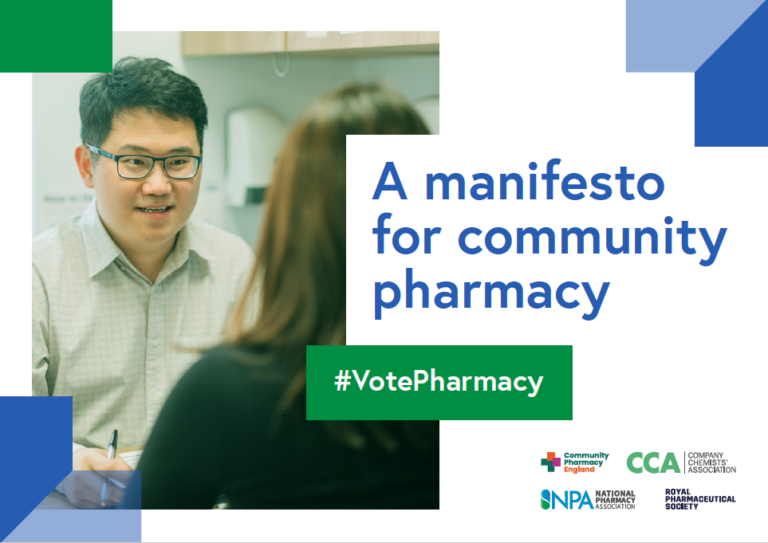
Pharmacy bodies launch community pharmacy manifesto
This news story was published when the organisation was the Royal Pharmaceutical Society. Community Pharmacy England, the Company Chemists’ Association, the National Pharmacy Association and the Royal Pharmaceutical Society have today published a joint manifesto for community pharmacy, ahead of the next general election. Pharmacy teams can use the manifesto to engage with political parties and candidates in the run-up to the election. The #VotePharmacy manifesto and other resources can be accessed from a new online general election hub, www.votepharmacy.org. The hub includes advice about engaging with candidates. Election candidates will be asked to show their support and back a six-point plan to “unleash the potential of community pharmacy”: Fill the funding gap, and commit to long-term sustainable funding, so pharmacies can deliver more of the NHS care patients need. Support and enhance the community pharmacy workforce to ensure that pharmacists and their teams can continue to meet the needs of patients now and in the future. Ensure that patients can access the medicines they need, including an end-to-end review of the medicines supply chain. Rollout an enhanced Pharmacy First service for England, mirroring the highly successful approaches taken in Scotland and Wales. Empower community pharmacists to do more, with an ambitious roadmap for independent prescribing. Make pharmacies centres for public health, prevention and reducing health inequalities. Tase Oputu, Chair of the Royal Pharmaceutical Society in England, said: “Community pharmacy plays a central role in the care of millions of patients each year, boosting vaccine uptake, tackling health inequalities and ensuring vital access to medicines. “But the system is also under pressure, and sustainable funding and support for the workforce will be crucial. “As more pharmacists become prescribers, it is vital the next government makes the most of this opportunity to transform patient care and ensure a positive future for community pharmacy at the heart of the nation’s health service.” All of these issues are highlighted in the RPS general election manifesto. Read more RCPharm news stories.