
Building the pharmacy workforce for the future NHS
Published: 23 July 2026
The Government’s forthcoming NHS Workforce Plan in England will be key in enabling the ambitions of the 10-Year Health Plan to be delivered. If the NHS is to shift care closer to home, focus more heavily on prevention and improve access for patients, it must invest in the workforce that will make that transformation possible. Pharmacy has a central role to play in this.
Delivering neighbourhood health and prevention
The 10-Year Health Plan rightly places prevention, neighbourhood healthcare and more personalised care at the heart of NHS reform. Pharmacy teams are already delivering these priorities every day and are uniquely positioned to contribute with purpose and meaning.
Pharmacists and pharmacy teams already improve access to care closer to home, support people with long-term conditions, help patients make the best use of medicines and increasingly delivering clinical care through independent prescribing. Their role is expanding, and the Workforce Plan must reflect both the opportunities and responsibilities that come with this transformation.
The Government’s engagement with professional organisations through the Partners Forum has been encouraging, and I look forward to seeing how those discussions are reflected in the final plan. Workforce planning must look beyond numbers alone and provide a long-term vision for developing the skills, leadership and capacity the NHS will need.
Developing skills for a changing healthcare landscape
New technologies and artificial intelligence will support more efficient care delivery, but the Workforce Plan must ensure pharmacy professionals have the appropriate skills and training needed to use these tools effectively while maintaining the clinical judgement and trusted relationships patients value.
Investing in education, prescribing and workforce wellbeing
As pharmacy practice evolves, dedicated investment in education and professional development becomes even more important. Independent prescribing is transforming the profession, improving access to care and helping relieve pressures across the NHS. To realise its full potential, we must ensure pharmacists have access to high-quality training and sufficient capacity for Designated Prescribing Practitioners, supported with protected time and appropriate recognition.
Supporting today’s workforce is equally important. Across every sector of pharmacy, colleagues continue to face significant pressures. Protecting time for learning, investing in wellbeing and creating opportunities for continuing professional development are fundamental to maintaining safe, compassionate and sustainable patient care.
Building an inclusive workforce and supporting research
A sustainable workforce must also be an inclusive workforce. Inclusive leadership strengthens organisations, improves innovation, and helps ensure our profession reflects the diversity of the communities we serve. The Workforce Plan should help remove barriers to entry and progression so that people from all backgrounds can thrive within pharmacy careers.
The Plan should also support research and innovation careers within pharmacy. Pharmacy teams have unique access to diverse communities and can help ensure the benefits of research are shared more equitably. Too many people still experience barriers to healthcare and research. Embedded within communities across the country, they can reach underserved populations, improve access to care, build confidence in research and support earlier intervention.
Recognising the full contribution of pharmacists
The Workforce Plan should recognise pharmacists not only as medicines experts but also as clinicians, educators, researchers and leaders. Investing in leadership development, research capability and professional development will strengthen both the profession and the wider NHS.
As the Government finalises its Workforce Plan, there is an opportunity to match its ambitions to improve patient care with a workforce strategy capable of delivering them. Pharmacy teams are ready to do more. With the right investment in training, leadership, wellbeing and professional development, they can play an even greater role in improving access, supporting prevention and delivering care closer to home.
We are committed to working with government
The Royal College of Pharmacy stands ready and willing to work with Government, the NHS and partners across the health and care system to help build a resilient, skilled and inclusive pharmacy workforce. By investing in our people, supporting research and innovation, and championing inclusive leadership, we can strengthen our profession and help deliver better health for every community.
Read more blogs.
Related blogs
Where does Pharmacy fit into Scotland’s public service reform agenda?
The new Scottish Government is prioritising public service reform, in their words, to ensure public services are inclusive, sustainable, and effective in improving people’s outcomes. As the Royal College for Pharmacy, we believe that utilising pharmacy in the most appropriate ways is key to ensuring the success of public service reform in healthcare. We exist to improve patient outcomes and advocate for thousands of pharmacists across all sectors. We’re very active in lobbying the Government for concrete policy changes which would improve patient outcomes, you can read these in our 2026 Election Manifesto for Scotland. As a key stakeholder already advocating strongly for public service reform, we recently responded to the Scottish Parliament’s Public Service Reform Committee’s consultation on this topic. However, we are concerned that the Public Service Reform Committee consultation does not create sufficient space for stakeholders to contribute ideas about the fundamental redesign of services. That’s why we’ve published an open letter to the Scottish Government and everyone with an interest in Public Service Reform in Scotland. In our letter, we call for public service reform to focus on redesigning services, not simply reducing budgets or workforce numbers. Reform should make better use of the pharmacy workforce, accelerate digital transformation through integrated health and care records, expand preventative care, and break down organisational barriers to deliver more joined-up, person-centred services. We know that pharmacists are an underutilised clinical resource that can improve access to care, deliver independent prescribing, deliver appropriate care to reduce pressure on hospitals and other NHS services, and help deliver better outcomes for patients across Scotland. Fiona McIntyre FRCPharm, Policy and Practice Lead for the Royal College of Pharmacy in Scotland has set out more about what genuine public service reform would look like for pharmacy in her blog ‘Pharmacists must be fully integrated into the NHS’. In this piece, she argues that pharmacists must be fully integrated into the NHS if Scotland is to meet future healthcare challenges and maximise the benefits of recent pharmacy education and legislative reforms. With all pharmacists now qualifying as independent prescribers, pharmacy teams have significant potential to support a focus on prevention, manage long-term conditions and provide care close to home. Achieving this will require better integration of community pharmacy into NHS services, universal access to shared digital health records, greater investment in pharmacy teams, and the redesign of care pathways so that pharmacists can work at the top of their clinical expertise. We look forward to continuing to work with the Scottish Government, MSPs and other stakeholders to achieve fundamental reform of pharmacy services, supporting the Scottish Government's ambition to improve outcomes for people across Scotland. Laura Wilson FRCPharm Director for Scotland
Hearing from you and how you’re shaping our proposals for change
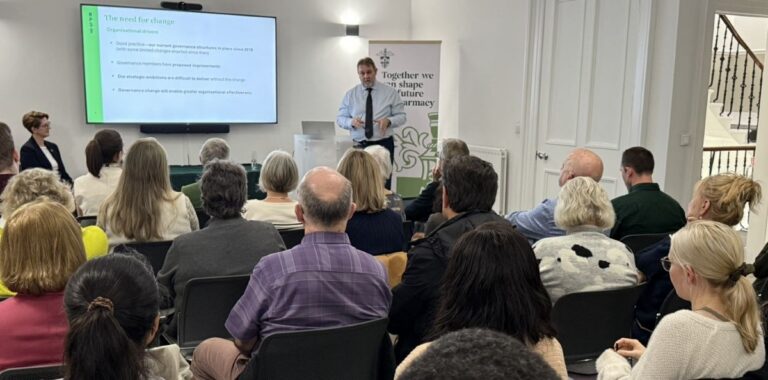
This blog was published when the organisation was the Royal Pharmaceutical Society. The Royal Pharmaceutical Society (RPS) has been out and about across GB over the past six weeks, hosting a series of 15 in-person ‘roadshow’ events for pharmacists and pharmaceutical scientists (whether members or not). We held our final week of roadshow events in Cambridge, Bristol and Nottingham, marking the end of a few weeks of travel and great discussions. These events, and some supporting webinars, have outlined our proposals for change and our ambitions to become a royal college and have been a great opportunity to hear the initial views of those working in pharmacy, on the proposals and more broadly the future of the pharmacy ecosystem. Having participated in all but one of the events, I’ve enjoyed the evolution of our presentation as we heard the feedback from participants, saw what resonated, and understood where we needed to add clarity to the proposals. It also means that some who attended the earlier sessions will have seen slightly different versions of our presentations, and so we have more to do, later this year and early next year to continue to explain what our proposals mean. Though we started each event with a fairly detailed presentation from RPS, we heard that there are those who are looking forward to seeing the line-by-line changes we are proposing for our Royal Charter: this will be set out next year once we’ve taken on board all of the feedback and finalised the proposals. Whilst the presentation was necessary, so those attending could understand our proposals and the context in which we were making them, by far the most valuable part was the Q&A, where we were joined by many of RPS’s Board and Assembly members. It was great to have our Assembly and Board members blending their personal professional viewpoint and support for the change proposals, really bringing things to life in a meaningful way. And of course, the opportunity to listen to what mattered to pharmacists and pharmaceutical scientists, both generally and in relation to our proposals to become a royal college, was the purpose of the exercise. The questions people asked, and the discussions that took place during the events (and often for a good while afterwards) have provided real insight that we are committed to actioning. We’re in the process of summarising the roadshow experience, theming the questions we received and taking on board the feedback to ensure our responses and explanations are clear and address the issues raised. This will form the basis of a report that we will share with those who attended, with RPS members and with the wider pharmacy community. I don’t want to preempt the report, but I would like to share a few early reflections from my personal experience of the last few weeks. Firstly, I want to say a big thank you to everyone who chose to give up a weekend morning or an evening to come to talk with us. Almost 1,000 people registered to attend across all of the events, and most events were attended by the majority of those who registered (plus a few who hadn’t and who were also welcomed!). It was great to see people from a wide range of professional settings; from community, hospital, primary, industry and academia (including some old friends from my hospital pharmacy days) and an array of people representing different specialisms and career stages. I was particularly struck by a number of early career, foundation trainees and pharmacy students who attended — the thoughtfulness in their questions and their passion for their chosen profession was notable — they inspired me to continue to advocate for these changes and provided the motivation to get out there and deliver another roadshow event when a cup of tea and a good book were beckoning. If they are any measure of our future workforce the profession will be in safe hands and we owe them our best efforts to deliver the royal college change that I believe will help elevate the profession and their professional futures. A major theme from the conversations was credentialing, which I believe is an important part of our vision for the future of the profession and something we’ve invested a lot of time into developing over the last 4 to 5 years. I am heartened by the level of interest in credentialing, as at its core it is about assuring patient safety, and the questions show that we still have a lot of work to do, explaining it and its value across all patient-focused roles. I am keen to further explore how we can best support those undertaking their credentialing journey. It was hugely valuable to discuss the challenges with pharmacists working in a variety of settings and to hear from employers about their experiences and perceptions and what they need from credentialing. If I’m honest, I didn’t know exactly what to expect from a workforce under so much pressure at the moment and so was delighted by the general level of warmth for our proposals and the recognition of what it could mean for pharmacy. This quickly led on to questions about what came after the royal college proposal and how this aligned with our commitment to improving as an organisation and delivering value for our members. We hear the call for improvements to our in-person and online engagement strongly and our plans for a digital transformation will be fundamental to delivering on this and an improvement for our members, which are the focus of two other programmes the RPS has been working on and which we will bring to life more next year. Whilst our focus right now is on the significant change in the way that we are structured and governed, which is primarily focused on enhancing our role as the professional leadership body for pharmacy, for me this is inseparable from our member services. I see professional leadership and membership as two sides of the same coin, and by strengthening one area we also add to the vitality of the other. This illustrates that there’s a lot on the horizon for the RPS (hopefully the future Royal College of Pharmacy). We have many issues to tackle. Not all of them will be straightforward and many of them will need us to collaborate more effectively and more openly with others in pharmacy and healthcare. If our proposals are accepted there will be a lot of complex internal work required to bring them to life and it’s important that we do not lose sight of the needs of the profession as we make these changes. But the fact that so many people turned out to discuss them reinforces in me the sense that a lot of pharmacists are rooting for these changes and willing us on to be successful to the benefit of the profession, patients and the public. It’s therefore critical all round that we continue to listen and communicate about our activities. This brings me back to the report on the roadshows that I mentioned at the start. The report will present the conversations at the roadshows in the round, for the benefit of everyone who attended – and I hope for many more who were not able to come. That report will appear next month and I urge everyone to have a read. The questions raised by attendees will, I am sure be relevant for many others, and the report is our chance to make sure our answers are clear and available to everyone. Thereafter we will be continuing to make our proposals for change clear and accessible, encouraging our members to vote and then continuing to be a more communicative organisation as we pursue our journey towards becoming more effective as a voice for pharmacy, and in so doing, serve patients, our members and the wider community better. Read RPS President Claire Anderson's reflections on our roadshows. Read more about our proposals for change.