Royal College of Pharmacy in Wales
We support, promote and lead the pharmacy profession across all sectors of pharmacy in Wales.
The Royal College of Pharmacy is a GB-wide organisation, but there are significant differences in policy and pharmacy practice in Wales, Scotland and England. That’s why Wales has its own National Pharmacy Advisory Council and RCPharm Wales team: to ensure we represent, support and speak up on behalf of all our members and the wider profession in Wales.
Contact your RCPharm Regional Ambassador.
-

Professor Amira Guirguis appointed to Advisory Council on Misuse of Drugs
This news story was published when the organisation was the Royal Pharmaceutical Society. Professor Amira Guirguis, Chair of the Royal Pharmaceutical Society’s (RPS) Science and Research Committee and RPS Fellow, has been appointed to the prestigious Advisory Council on the Misuse of Drugs (ACMD). The Advisory Council is an independent expert body that advises government on the control of dangerous or otherwise harmful drugs, including their classification and scheduling under the Misuse of Drugs Act 1971 and its regulations. Paul Bennett, CEO of RPS, said: “We are delighted and very proud of Professor Guirguis’s appointment to the ACMD, which provides advice to government, carries out in-depth enquiries and influences drugs policy in the UK. “This appointment acknowledges her expertise, dedication and commitment to evidence-based science at the highest level. I’d like to offer my congratulations and wish her every success in this important role.” Find out more about the RPS Science and Research Committee More about the ACMD Read more RCPharm news stories
-
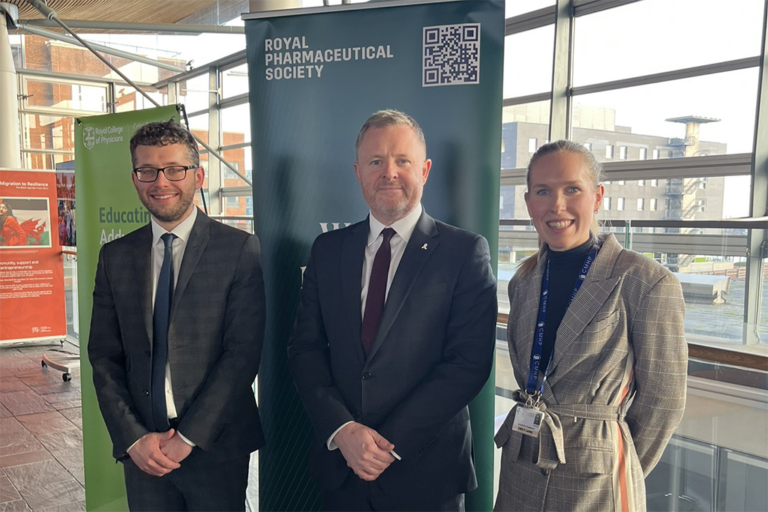
Pharmacists highlighted for key role in mental health support at the Senedd
This news story was published when the organisation was the Royal Pharmaceutical Society. The Royal Pharmaceutical Society in Wales recently showcased the important role pharmacists play in mental health care and support during a multi-professional briefing at the Welsh Parliament, Senedd. The event was co-hosted by members of the Royal College Mental Health Expert Advisory Group Wales, a collaborative that unites royal colleges and professional organisations to discuss mental health services and provide expert advice to the Welsh Government, NHS Wales and other stakeholders. Joining the RPS Wales team at the Senedd was Emily Laing, Principal Pharmacist for Mental Health at Cwm Taf Morgannwg University Health Board. Key messages were shared with politicians, emphasising the significant impact pharmacists have on mental health care. Some of our key messages included: Expertise in medicines: Pharmacists’ specialist knowledge ensures optimal medication regimens and avoids harmful polypharmacy for patients with mental health conditions, whether in hospitals or the community Workforce planning: Consistent workforce planning across Wales is essential to ensure every mental health multidisciplinary team includes a specialist pharmacist Prevention and early support: Pharmacists across all sectors play a vital role in prevention efforts, helping to identify and support individuals showing early signs of mental health decline. Commenting on the event, Elen Jones, director of RPS Wales, stated: “RPS Wales is delighted to represent the profession on the Royal College Mental Health Expert Advisory Group and collaborate with colleagues across professions to drive positive changes for mental healthcare. “I’m particularly grateful to Emily for her invaluable expertise at the event. She did a great job in bringing to life how pharmacists’ skills have a tangible impact on patients’ quality of life. “At RPS Wales, we look forward to continuing our active involvement with the Royal College Mental Health Expert Advisory Group, ensuring the crucial role of pharmacists is recognised and continues to develop within mental health service provision.” Emily Laing, principal pharmacist for mental health at Cwm Taf Morgannwg University Health Board, said: “It was great to be able to share my experience and explain in detail to the elected members the value our skills as pharmacists bring to our patients and to mental health multidisciplinary teams. Thanks to RPS for the opportunity.” Read more RCPharm news stories.
-

Our response to Guild of Healthcare Pharmacists open letter
This letter was published when the organisation was the Royal Pharmaceutical Society. Following the open letter sent to us by the Guild of Healthcare Pharmacists (GHP), we have responded to them and have set out our response below: Dear Rob, Thank you for your recent letter concerning our Constitution and Governance Review. The Royal Pharmaceutical Society (RPS) is currently engaged in a conversation with our members and the wider profession about our proposals for change and our ambition to become a Royal College. These proposals are being set out for pharmacists and pharmaceutical scientists (whether members or not) via a series of ‘roadshow’ engagement events across GB during October and November. A recurring focus of the conversations we are having at these events is our ambitions to integrate credentialing into the profession; some of the questions about credentialing are echoed in the Guild Council’s letter. We are happy to clarify the benefits we envisage will flow from the further embedding of credentialing and to address some of the other points raised by the Guild Council. The key purpose of RPS credentialing is to protect the public and the integrity of the pharmacy profession through assuring patient-focused pharmacists (i.e., roles that have a direct impact on individual patients and/or patient populations) working at advancing levels of post-registration practice. Defining and assuring post-registration professional standards is a fundamental activity for a royal college and thus fully aligned with our proposals for change. Credentialing provides considerable benefits for pharmacists and the system. For a pharmacist, credentialing can support a standard professional career structure which offers potential for advancement. Credentialing also engenders professional confidence and pride, increases professional cohesion and provides a mechanism by which the skills and capabilities of an individual are recognised. We have also heard from candidates about the benefits they have gained from successfully undertaking credentialing; including increased confidence, improved practice and greater integration within the wider multidisciplinary team. For the employer and wider system, credentialing provides an objective and validated assurance mechanism for employee capability within and across organisations which can inform fair and valid career progression and recruitment decisions, assure consistency across the system and improve workforce portability. It also provides a mechanism by which other health professionals and patients can recognise the level of practice of the pharmacy workforce. We have heard of pharmacists having to ‘re-prove’ their level of practice when they have moved employer, sector, or location, with some having to restart a training pathway from scratch to meet specific regional or national training requirements. This is not efficient or effective for the service, the employer or the pharmacist and is addressed by embedding credentialing in the profession. RPS, in collaboration with the pharmacy profession, has been developing our credentialing model over the last 4 to 5 years and we recognise there is much work ahead of us, in continued partnership with many others in the pharmacy ecosystem, to ensure the full value of credentialing can be realised to the benefit of pharmacists, patients and the public. The changes and opportunities that lie ahead for the pharmacy profession act as a call for action for this change. Medicines, and therefore pharmacy practice, are advancing and becoming more complex; this is mirrored by patients’ healthcare needs. In tandem, the role of the pharmacist in delivering healthcare services within the wider multidisciplinary team is evolving rapidly across community, primary, and secondary care settings, including the prescribing of medicines from point of registration from 2026. We recognise that collaboration is vital in order to enable the integration of credentialing, and we are committed to continued engagement with employers across GB during 2025 and beyond to highlight the value of credentialing for them and their employed pharmacists. We will continue working closely with the Chief Pharmaceutical Officers, Pharmacy Deans and other NHS leaders, and will collaborate with professional representative bodies and other stakeholders, to demonstrate the value credentialing brings to the profession, patients and the wider healthcare system. Introducing a formal progression model into the post-registration space will involve additional effort and cost but we believe that these will be proportionate to the benefit (to patients, pharmacists and the profession) they will bring. NHS education commissioners have already supported pharmacists to engage with credentialing by, for example, providing access to the RPS post-registration foundation e-Portfolio, supporting post-registration foundation candidates through credentialing via national training programmes and funding candidates through core advanced credentialing. We will continue to advocate for employer and system support for the further rollout of credentialing. Credentialing has already been integrated into NHS policy as a requirement to progress to consultant pharmacist roles, in all sectors, including the NHS managed sector, as articulated in the NHS Consultant Pharmacist Guidance. Integrating all levels of credentialing meaningfully into the profession will require collective action and support and achieving this will not be achieved by the RPS or any future royal college in isolation. To be fully woven into the profession, credentialing needs to be integrated into job descriptions, job plans and career progression (including remuneration). We continue to drive for this through our advocacy work. And of course, pharmacists need to be supported. We agree that ensuring pharmacists have the time, space and support to develop professional practice portfolios is essential to integrating credentialing meaningfully in the profession. We have advocated for this through our Protected Learning Time policy and we recognise the need for more effective job planning. RPS curricula describe the recommended level of commitment from employers required to support a pharmacist undergoing a credentialing pathway. We’d like to emphasise that RPS credentialing is not a micro credential in a specific area of clinical practice but the assurance of a level of practice. When credentialing at core advanced level, we are assuring clinical and non-clinical capabilities (for example leadership) which align to the multiprofessional definitions of advanced practice in other professions. Where there is a patient and system need for specific clinical definition and assurance, we will continue to collaboratively develop specialist curricula, as we have done recently in critical care with the UK Clinical Pharmacy Association (UKCPA) and mental health in collaboration with the College of Mental Health Pharmacy (CMHP). The requirements of the specialist curricula can be demonstrated at the same time as the core advanced credentialing process or separately, depending on the pharmacist’s career preferences. Moving away from the question of credentialing and considering the wider ambitions of our proposal for change, we must consider governance. Governance mechanisms exist to ensure appropriate decisions are made in line with the organisation’s ambitions. Our rigorous governance review aims to embed transparency in the way we work and ensure that the future Royal College remains led by the profession. Our intent to register as a charity further ensures that there are appropriate external frameworks and scrutiny in place so that we meet our intended objective of advancing the science and practice of pharmacy, with patient and public benefit at the forefront of our work. We look forward to constructive dialogue with the Guild Council over the coming months as we refine our proposals for change and prepare to set the final proposition before our membership for a vote in early 2025. Meanwhile we invite Guild members together with all pharmacists and pharmaceutical scientists to attend one of our roadshow events and/or to find out more about the proposals for change. Yours sincerely, Paul Bennett FRPharmS, Chief Executive, Royal Pharmaceutical Society
Our work in Wales
Pharmacy: Delivering a healthier Wales
The 2030 vision for Wales sets ambitions for how patients will benefit from the expertise of pharmacy teams.
Pharmacist independent prescribing
three core recommendations to support the increased use of pharmacist independent prescribers.
Use of the Welsh language
We recognise the importance of access to Welsh speaking pharmacists for people living in Wales.
How we work in Wales
National Pharmacy Advisory Council
Meet the elected council for Wales and find out how it works.
The Royal College of Pharmacy Wales team
Supporting members and leading pharmacy in Wales.
Our policy and advocacy work
Find out more about the College’s policy and advocacy work.