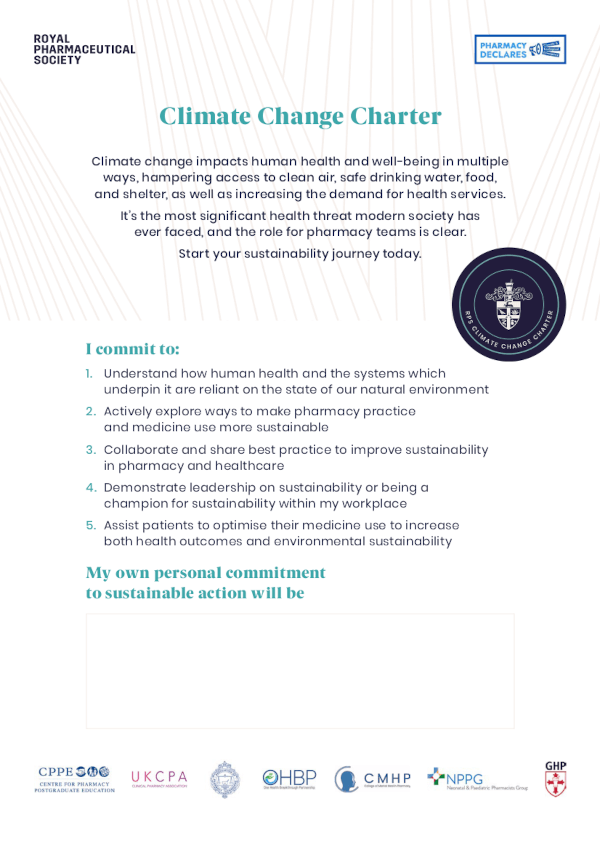
Climate Change Charter
Climate change is the most significant health threat modern society has ever faced: it impacts human health and wellbeing in a myriad of ways, and reduces access to clean air, safe drinking water, food and shelter, increasing demand for health services.
As health professionals, the role for pharmacy teams is clear.
Start your sustainability journey and show your personal commitment by following our Climate Change Charter.
Download PDF
Download the article in PDF format so that you can access anywhere
Related articles
Pharmacy’s role in climate action and sustainable healthcare
This was published when the organisation was the Royal Pharmaceutical Society. The Royal College of Pharmacy is committed to tackling the climate and ecological emergency. In September 2021, we formally recognised the scale and importance of the situation by publishing a climate declaration.1 Climate change is the most significant health threat modern society has ever faced: it affects clean air, safe drinking water, food and shelter. Combine this with the increasing demand for health services and the fact that medicines are the most common intervention in healthcare, and the role for pharmacy is clear. Medicines account for about 25% of carbon emissions within the NHS. This policy deliberately focuses on reducing the environmental harm from medicines, rather than the wider climate and ecological emergency. As experts in medicines, pharmacists have a professional responsibility to take a leading role in reducing the environmental impact of medicines use. However, pharmacy cannot do this alone. So, we are calling on the pharmaceutical industry, governments across Great Britain, and other stakeholders to work with us to make the changes that are needed to tackle the climate emergency. In October 2021, the Professional Bodies Climate Action Charter launched. RCPharm became a signatory following unanimous support from National Country Boards. Developed by the Professional Associations Research Network, of which the society is a long-standing member, the charter is designed to guide effective and high-quality climate action by professional bodies. This acknowledges that far from being simply an environmental issue, climate change is the most significant health threat that modern society has ever faced.2 It affects the social and environmental determinants of health – clean air, safe drinking water, sufficient food and secure shelter, ultimately leading to declines in human health especially across the most vulnerable and deprived in society further compounding health inequalities.3 Modelling shows us that the past 50 years of public health gains will be wiped out if we do not do something now. Climate Change Charter Sustainability policies Sustainability declaration Case studies Our commitments Context for change The United Nations chief described the latest Inter-Governmental report on Climate Change4 (IPCC) as a code red for humanity, saying that unless we act decisively now, we will exceed the 1.5 degrees of warming across the world.5 He said the message is clear that we must raise our level of ambition to mitigate certain climate disaster, there is no time for delay and no room for excuses. Without action, climate change will define the health profile of current and future generations and will challenge already overwhelmed health systems. Demand for healthcare is already increasing, with a growing and ageing demographic, increasing global burden of disease, and increasingly complex diagnostic and treatment methods. As the number of people with multiple health conditions grows, meeting their needs will be one of the biggest challenges facing the NHS. Pharmacists are experts in medicines and their safe and effective use.6 This is particularly important as medicines are the most common intervention in healthcare.7 They have three major impacts on the environment: the chemical effects of the Active Pharmaceutical Ingredients (APIs) themselves, the large carbon footprint involved in manufacture and distribution, and pharmaceutical waste. If we consider the life cycle of a medicine, from design and development, marketing authorisation to production, post- authorisation, health technology assessment, prescription and consumption, and finally waste disposal, pharmacy can have an impact at every stage. We know that medicines account for about 25% of carbon emissions within the NHS8, so pharmacists have a professional responsibility to ensure more sustainable use of medicines and to decrease the carbon footprint and environmental risk of all pharmaceutical care. The role of the pharmacist and the pharmacy team in preventing illness, optimising medicines and reducing pharmaceutical waste already reduces the impact of medicines on the climate. What we haven’t done before is overtly link the two. Pharmacists are trusted health professionals. As a profession we need to inform and educate patients and the public about the link between the climate crisis and health, which we hope will motivate others to act, resulting in healthier living and reduced environmental impact. There will be areas where pharmacists and pharmacy teams can act now to have a quick impact. Sometimes, this will be through small changes in the way we work. In other cases, it will be through larger, full system changes in the way services are designed and delivered. RCPharm are committed to supporting and advocating on behalf of the profession to make pharmacy’s voice heard and stimulate action in areas that require multi-agency or systemic change. We are calling for the pharmaceutical industry, governments across Great Britain, and other stakeholders to work with us to make the changes that are required to tackle the climate emergency. Significant research and stakeholder engagement has been undertaken to identify key priorities for how pharmacy teams can respond to the climate and ecological emergency. Improving prescribing and medicines use Tackling medicines waste Preventing ill health Infrastructure and ways of working About this policy This policy was developed with input from RCPharm members and multiple pharmacy stakeholders across Great Britain. The content was guided and reviewed by an Expert Advisor: Sharon Pfleger, Consultant in Pharmaceutical Public Health, NHS Highland; Professor (Visiting), Robert Gordon University, Aberdeen; Associate, The Environmental Research Institute, University of the Highlands and Islands; and Co-Founder, One Health Breakthrough Partnership. This is a live document and will be amended as evidence changes. References https://www.rcpharm.org/campaigns/declaration-of-climate-and-ecological-emergency/ https://www.england.nhs.uk/greenernhs/wp-content/uploads/sites/51/2020/10/delivering-a-net-zero-national-health-service.pdf https://www.who.int/news-room/fact-sheets/detail/climate-change-and-health https://www.ipcc.ch/report/ar6/wg1/ https://www.ipcc.ch/assessment-report/ar6/ https://pip.scot/2018/07/07/pharmacists-are-the-experts-in-medicines-says-alex-mackinnon/ https://digital.nhs.uk/data-and-information/publications/statistical/health-survey-england-additional-analyses/ethnicity-and-health-2011-2019-experimental-statistics/prescribed-medicines https://www.england.nhs.uk/greenernhs/a-net-zero-nhs/areas-of-focus Climate Change Charter Sustainability policies Sustainability declaration Case studies Our commitments
Case studies: sustainability
Case study one: Recycling blister packs Case study two: Inhaler recycling Case study three: Green theatre groups Case study four: Reducing use of nitrous oxide Case study five: Anaesthetic gases: Banning desflurane Case study six: Sustainable prescription ordering Case study seven: Sustainability in the workplace Case study eight: Reducing water pollution from medicines This was published when the organisation was the Royal Pharmaceutical Society. Case studies Case study one: Recycling blister packets The majority of tablets and capsules must be stored in blister packets, specifically designed to avoid crushing or damage, and to protect medicines from external elements such as water or humidity. While blister packets are important to preserve the safety and effectiveness of the medicine, their composition means that their recycling is a complex process that requires specialist treatment. Blister packets therefore, are inappropriate for household recycling and are typically destined for landfills. In 2020, Terracycle, an organisation that specialises in the reuse of non-recyclable post-consumer waste, launched a new scheme aimed at overcoming the challenges of blister packet recycling. As part of the Medicine Packet Recycling Programme, the public can drop off empty medicine blister packets at a participating pharmacy, who will then arrange for appropriate recycling with Terracycle. The empty blister packs will then be cleaned and separated into different polymer types. The material is then extruded into plastic pellets to make newly recycled products. View our policy on Tackling Medicines Waste. Case study two: Inhaler recycling Landfill disposal of inhalers is particularly harmful to the environment. This is not only due to the plastic that is not recycled, but also a consequence of the greenhouse gases released into the atmosphere from the residual gas left in canisters. If every inhaler-user in the UK returned all their inhalers for one year, this could save 512,330 tonnes of CO 2eq — the same as a VW Golf car being driven around the world 88,606 times. In order to grow the opportunities for inhaler recycling, pharmaceutical company Chiesi has launched the UK’s first postal inhaler recycling scheme in Leicestershire. The ongoing pilot allows patients to recycle any brand or type of inhaler by posting them using a pre-paid envelope. Once returned, any propellant gas remaining in the canister is extracted and reused in fridges or air conditioning units. Meanwhile, the aluminium canisters are recycled and reused, while the plastic is recycled. If there are any non-recyclable materials, they are converted into energy. The scheme complements the waste collection service already available within community pharmacies and is particularly useful for patients who may be housebound or do not regularly visit a pharmacy in person. View our policy on Tackling Medicines Waste. Case study three: Green theatre groups Certain anaesthetic gases used in surgery can have a particularly high carbon footprint, so much so that they amount to 2% of the NHS’s total emissions. With an aim of reducing emissions from anaesthetic gases, staff at NHS Lothian have established ‘green theatre’ working groups across each acute site. Comprising of members from across the multidisciplinary team, including lead pharmacists for theatres, the groups work towards reducing gas usage, minimising waste, reusing and recycling. From the group’s inception in 2019, the volatile footprint has reduced considerably through ongoing investigation and actions on anaesthetic gas mitigation. In total, low-flow anaesthesia and the amount of desflurane used has reduced from 20% of total volatile units (bottles) to less than 5%. As well as leading to more sustainable practice, the groups’ initiatives have also led to cost reductions. View our policy on Improving prescribing and medicines use. Case study four: Reducing use of nitrous oxide Known to be significantly more potent than carbon dioxide, nitrous oxide is the biggest human-related threat to the ozone layer. While medical use of nitrous oxide is thought to contribute to less than 5% of total global nitrous oxide emissions, given its high potency, reducing its usage can make a real difference. At NHS Lothian, nitrous oxide consumption was identified to be responsible for at least 80% of their total anaesthetic gas footprint. To tackle this, the pharmacy team undertook a detailed review, which found that the majority of the anaesthetic gas footprint was from nitrous oxide manifolds. On further investigation, it was determined that theatre use of nitrous oxide was in fact, low, but that supply chain wastage was likely to be the main cause. A multidisciplinary team was then established to develop metrics and collect and review data, which included manifold audits, in order to better understand usage and which manifold supplied which areas. The team identified that there was low usage of the gas, poor stock rotations and expired stock, as well as system leakage and wastage. It was decided to reduce nitrous oxide provision and to process map the current system to identify where improvements could be made. This has already resulted in one manifold being immediately decommissioned with a further two under scrutiny for decommission. View our policy on Improving prescribing and medicines use. Case study five: Anaesthetic gases: Banning desflurane Until 2019, anaesthetic gases contributed 5% of the carbon footprint of Raigmore Hospital in Inverness. An average day for one anaesthetist releases the CO2 equivalent of 4,600km driving. However, following a determined and proactive action from staff across the multidisciplinary team over an 18-month period, an average day now only accounts for about 20km. This significant reduction was achieved by pursuing three key actions: Reducing the use of nitrous oxide Promoting low-flow anaesthesia where gases are re-circulated And most importantly, reducing and then effectively banning (making non-stock) desflurane. Crucially, replacing desflurane with sevoflurane has no impact on patient care and saves about £70,000 per annum recurring for the hospital. Raigmore was the first and remains one of the few hospitals in the UK to have completely removed this polluting drug. However, a group first established at Raigmore, the Scottish Environmental Anaesthesia Group (SEAG), is now coordinating efforts to spread the message. View our policy on Improving prescribing and medicines use. Case study six: Sustainable prescription ordering With around 25% of NHS carbon emissions coming from medicines, every single unnecessary and wasted prescribed medicine makes progress on reducing health service emissions increasingly difficult. A frequent source of wasted medicines are repeat prescriptions which are automatically ordered but often are not needed. With 77% of medicines used within Dartford, Gravesham and Swanley (DSG) CSG generated by repeat prescriptions, their medicines optimisation team have prioritised reducing repeat prescribing waste over recent years. They initially implemented a telephone prescription ordering system based across a number of GP practices. It enabled patients to discuss their medicines before a repeat order was requested. It proved to be incredibly successful with prescribing costs falling by £650,000 in the first year. Building on the initial success, and in order to expand the model across the CSG area, they subsequently introduced an app-based prescription ordering system. The app facilitates repeat prescribing across the local network of community pharmacies and ensures patients are ordering the correct amounts, avoiding medicines being stockpiled and reducing waste. Find out more: https://healthera.co.uk/tackling-medicines-wastage-through-a-scalable-initiative/ View our policy on Improving prescribing and medicines use. Case study seven: Sustainability in the workplace The pharmacy department at the Royal Bournemouth and Christchurch NHS Trust have been passionate about sustainability for over a decade. So much so, they have been awarded the Green Impact Award from 2013-2020, each year building upon their previous success, going from Bronze recognition to achieving the Excellence award. Their success has been due to a few individuals initially championing change and enthusing others to get involved. Some of the changes the department has made include: Displaying signs reminding people to switch off computer monitors and lights Displaying signs by taps of contact details of appropriate personnel to come and manage a leaking tap Using a water heater rather than a kettle Recycling paper and cardboard Recycling plastic (including all wrapping/bubblewrap from deliveries) as well as procuring recycled paper for the department Introducing mixed recycle bins in every office and work/staff area, as well as specific recycle bins for plastic, pens, batteries, temperature monitors and crisp packets, to name a few. The whole team has fully bought into these simple but far-reaching actions. Not only has the activity helped make the department more environmentally sustainable, but has also brought the staff together for a joint purpose and developed a strong team spirit. View our policy on Infrastructure and ways of working. Case study eight: Reducing water pollution from medicines Medicines can have other adverse environmental impacts beyond carbon emissions. One example is pharmaceutical residues entering water bodies and the sewage system. This can occur through human excretion, skin products being washed off or by medicines being flushed down the toilet. Being aware of the harm of water contamination, the team at Caithness General Hospital in Wick tested the hospital’s wastewater for eight commonly used medicines. Seven of which were discovered. To tackle the problem and reduce the pharmaceutical footprint of the hospital water, they adopted a three-pronged approach: To “green” the medicines formulary by adding ‘environmental impact’ as an additional and equal consideration to efficacy, safety and cost-effectiveness Worked with prescribers and patients to take a “realistic medicine” approach to decision making through patient coproduction and consideration of alternatives to medicine prescription such as social prescribing or lifestyle changes Communication with the public, focusing on key actions to reduce antimicrobial resistance, to improve understanding of when antibiotics are necessary and the importance of finishing a course. In recognition of this trail-blazing work, the hospital was the first in the world to achieve Alliance for Water Stewardship certification. View our policy on Tackling Medicines Waste.