Why you should stand: insights from an elected RPS board member
Published: 28 January 2026
This blog was published when the organisation was the Royal Pharmaceutical Society.
“If you’re half thinking about it and not sure whether you should do it, you should do it.”
Audrey Thompson, now retired, was a primary care pharmacist, leading the primary care team in Greater Glasgow and Clyde. Currently a member of the Scottish Pharmacy Board, she has one year of her second term remaining, so she will be a member of the National Scottish Pharmacy Advisory Council when it launches. She is also a member of Assembly but will step down when it is replaced by the Senate.
Why are you proud to be an elected member for RPS and the future royal college?
I’ve always tried to be a cheerleader for the profession, and I’ve seen involvement with the RPS as the professional leadership body as a way to shape the message that goes to the public, politicians and the media. As an elected member you help shape policy because you are providing input to consultations that feed into legislation.
Primary care work has increased massively over the last five years, so it has been good to be able to bring my knowledge and experience of it to the board. Just now is a really exciting time for pharmacy with changes to prescribing rights, and with community pharmacy being much more embedded in core NHS provision.
A couple of issues we’ve been discussing recently have been changes to rules around dispensed medicines, and how to help patients self select pharmacy-class medicines safely and make sure that there is good governance around that. As a National Pharmacy Advisory Council member, you are shaping the guidance that will help keep people safe in practice.
Is there anything you know now that you wished you’d known before standing for election?
I wish I’d known how supportive the RPS country teams and experienced board members would be in helping me find my feet. I think that’s something that people will naturally worry about. Everyone’s got that slight concern that they might be out of their depth or might look foolish. But that absolutely is not going to be the case — and fellow council members want to help you to maximise your contribution.
I also realise now how the country boards have really benefited from having as wide a range of voices round the table as they can. We really do need people in the National Pharmacy Advisory Councils and Senate from all sectors of practice, and people at all stages of their career, so we’ve got a really good cross section of the profession who are able to shape things.
If you’re half thinking about it and not sure whether you should do it, you should do it.
What does it mean in practice to also be a member of Assembly as well as the Scottish Pharmacy Board?
Before I stood for election, I didn’t really understand how the organisation was structured or how decision-making worked. Assembly is the decision-making body at present. It’s really important that each nation has a voice there, and I was keen to be one of the Scottish voices. Governance sounds boring but there has been interesting work around that table about how the royal college is structured and what the processes are for elections. Those of us who have been on Assembly have helped shape what the new royal college will look like and put it on a good footing going forward.
The Senate will replace Assembly within the royal college and there are still lots of important and interesting discussions to be had about how to move into this new world.
How do elected members influence and develop pharmacy policy in their country? Why is this important?
Devolution is a confusing issue in healthcare. In Scotland, healthcare is devolved to the Scottish Parliament, but the legislation around medicines and the regulation of healthcare professionals remains with Westminster. One of the issues we’ve looked at recently are the proposals going through parliament on assisted dying. There is a Bill going through Westminster and a separate Bill going through Holyrood. It’s really important that we consider the Scottish Bill in the Scottish context, but also keep an eye on what’s going on in Westminster to make sure that pharmacists have the same protections, regardless of where they are working in the UK. There have been discussions on issues like conscientious objection, and what the role of the pharmacist might be in the assisted dying process.
What are the top five skills or qualities you need to be an elected member?
If you’re going to be an elected member you need to want the best for the profession. You need to be willing to speak up and fully participate in discussions. You need an ability to listen to others, and a desire to seek the best possible solutions. Pharmacists are very detail-focused people; sometimes as an elected member you need to do the detail, but sometimes you need to look at the bigger picture of how you are working with a wider healthcare team and what is needed for patients.
What was your biggest challenge or worry about standing for election and how did you overcome it?
I was concerned that because I wasn’t in a patient-facing role I might not be able to contribute in a meaningful way. While there are some policy areas where you do need specific knowledge, for most issues your general knowledge and experience of working in pharmacy gives you an understanding that means you enhance discussions. Sometimes when you’re not the expert it can be really helpful to do the ‘daft lassie’ thing and ask the obvious questions! I overcame my worries just by participating, listening to what other people are saying, and being constructive in any challenges I made. Realising how welcoming and open the rest of the board members are helps you to build your confidence.
Further reading
- Find out more about the elections to the National Pharmacy Advisory Councils.
- Read more blogs
Related blogs
Why you should stand: reflections from an elected RPS board member
“There is a lot of support between board members – current members really want to help new members to settle in as quickly as possible.”
Hearing from you and how you’re shaping our proposals for change
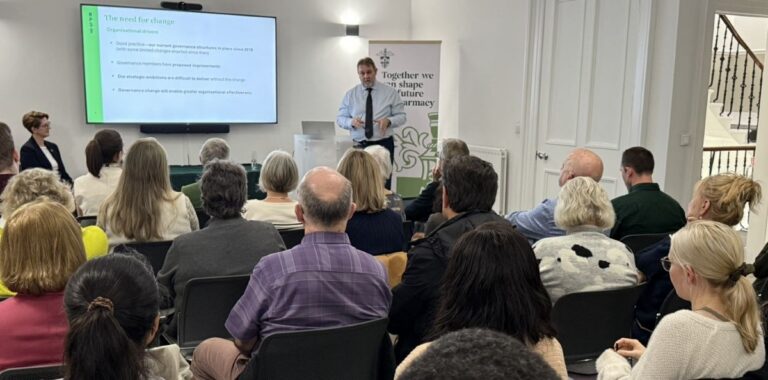
This blog was published when the organisation was the Royal Pharmaceutical Society. The Royal Pharmaceutical Society (RPS) has been out and about across GB over the past six weeks, hosting a series of 15 in-person ‘roadshow’ events for pharmacists and pharmaceutical scientists (whether members or not). We held our final week of roadshow events in Cambridge, Bristol and Nottingham, marking the end of a few weeks of travel and great discussions. These events, and some supporting webinars, have outlined our proposals for change and our ambitions to become a royal college and have been a great opportunity to hear the initial views of those working in pharmacy, on the proposals and more broadly the future of the pharmacy ecosystem. Having participated in all but one of the events, I’ve enjoyed the evolution of our presentation as we heard the feedback from participants, saw what resonated, and understood where we needed to add clarity to the proposals. It also means that some who attended the earlier sessions will have seen slightly different versions of our presentations, and so we have more to do, later this year and early next year to continue to explain what our proposals mean. Though we started each event with a fairly detailed presentation from RPS, we heard that there are those who are looking forward to seeing the line-by-line changes we are proposing for our Royal Charter: this will be set out next year once we’ve taken on board all of the feedback and finalised the proposals. Whilst the presentation was necessary, so those attending could understand our proposals and the context in which we were making them, by far the most valuable part was the Q&A, where we were joined by many of RPS’s Board and Assembly members. It was great to have our Assembly and Board members blending their personal professional viewpoint and support for the change proposals, really bringing things to life in a meaningful way. And of course, the opportunity to listen to what mattered to pharmacists and pharmaceutical scientists, both generally and in relation to our proposals to become a royal college, was the purpose of the exercise. The questions people asked, and the discussions that took place during the events (and often for a good while afterwards) have provided real insight that we are committed to actioning. We’re in the process of summarising the roadshow experience, theming the questions we received and taking on board the feedback to ensure our responses and explanations are clear and address the issues raised. This will form the basis of a report that we will share with those who attended, with RPS members and with the wider pharmacy community. I don’t want to preempt the report, but I would like to share a few early reflections from my personal experience of the last few weeks. Firstly, I want to say a big thank you to everyone who chose to give up a weekend morning or an evening to come to talk with us. Almost 1,000 people registered to attend across all of the events, and most events were attended by the majority of those who registered (plus a few who hadn’t and who were also welcomed!). It was great to see people from a wide range of professional settings; from community, hospital, primary, industry and academia (including some old friends from my hospital pharmacy days) and an array of people representing different specialisms and career stages. I was particularly struck by a number of early career, foundation trainees and pharmacy students who attended — the thoughtfulness in their questions and their passion for their chosen profession was notable — they inspired me to continue to advocate for these changes and provided the motivation to get out there and deliver another roadshow event when a cup of tea and a good book were beckoning. If they are any measure of our future workforce the profession will be in safe hands and we owe them our best efforts to deliver the royal college change that I believe will help elevate the profession and their professional futures. A major theme from the conversations was credentialing, which I believe is an important part of our vision for the future of the profession and something we’ve invested a lot of time into developing over the last 4 to 5 years. I am heartened by the level of interest in credentialing, as at its core it is about assuring patient safety, and the questions show that we still have a lot of work to do, explaining it and its value across all patient-focused roles. I am keen to further explore how we can best support those undertaking their credentialing journey. It was hugely valuable to discuss the challenges with pharmacists working in a variety of settings and to hear from employers about their experiences and perceptions and what they need from credentialing. If I’m honest, I didn’t know exactly what to expect from a workforce under so much pressure at the moment and so was delighted by the general level of warmth for our proposals and the recognition of what it could mean for pharmacy. This quickly led on to questions about what came after the royal college proposal and how this aligned with our commitment to improving as an organisation and delivering value for our members. We hear the call for improvements to our in-person and online engagement strongly and our plans for a digital transformation will be fundamental to delivering on this and an improvement for our members, which are the focus of two other programmes the RPS has been working on and which we will bring to life more next year. Whilst our focus right now is on the significant change in the way that we are structured and governed, which is primarily focused on enhancing our role as the professional leadership body for pharmacy, for me this is inseparable from our member services. I see professional leadership and membership as two sides of the same coin, and by strengthening one area we also add to the vitality of the other. This illustrates that there’s a lot on the horizon for the RPS (hopefully the future Royal College of Pharmacy). We have many issues to tackle. Not all of them will be straightforward and many of them will need us to collaborate more effectively and more openly with others in pharmacy and healthcare. If our proposals are accepted there will be a lot of complex internal work required to bring them to life and it’s important that we do not lose sight of the needs of the profession as we make these changes. But the fact that so many people turned out to discuss them reinforces in me the sense that a lot of pharmacists are rooting for these changes and willing us on to be successful to the benefit of the profession, patients and the public. It’s therefore critical all round that we continue to listen and communicate about our activities. This brings me back to the report on the roadshows that I mentioned at the start. The report will present the conversations at the roadshows in the round, for the benefit of everyone who attended – and I hope for many more who were not able to come. That report will appear next month and I urge everyone to have a read. The questions raised by attendees will, I am sure be relevant for many others, and the report is our chance to make sure our answers are clear and available to everyone. Thereafter we will be continuing to make our proposals for change clear and accessible, encouraging our members to vote and then continuing to be a more communicative organisation as we pursue our journey towards becoming more effective as a voice for pharmacy, and in so doing, serve patients, our members and the wider community better. Read RPS President Claire Anderson's reflections on our roadshows. Read more about our proposals for change.